
When it comes to online security and privacy, preserving the two is always an ongoing battle.
In the digital world where user data is a commodity, information is being traded behind people's back, and huge money is made for those traders. User information is always high in demand. Brave, which has long touted itself as a privacy advocate, is trying continuously to stop its users from being tracked or traced.
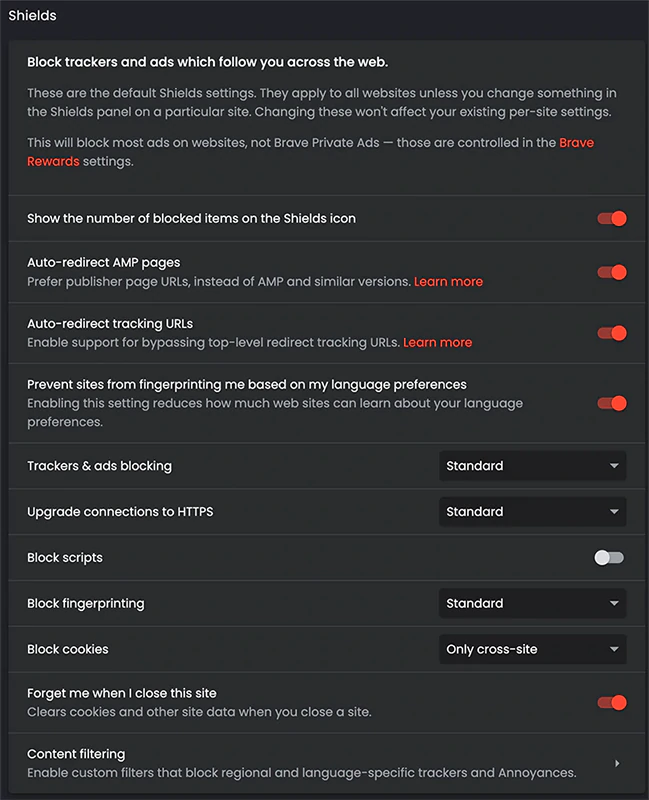
This time, the browser maker is including a feature it calls the 'Forgetful Browsing,' which allows users to always clear cookies and other storage when the site is closed.
In an article on its website, Brave said that:
In response, third-parties are increasingly relying on first-party storage to continue tracking users. Forgetful Browsing is the first in a series of upcoming tools Brave has planned to continue protecting Brave users and address first-party reidentification."
"Forgetful Browsing is similar to, but more powerful and protective than, popular browsing extensions and private browsing modes."
Forgetful Browsing here is just another tool in its fight to protect users' online anonymity.
When enabled, the feature will "clear first-party storage for the site a few seconds after there are no more open tabs for the site," Brave explained in the update announcement on its website.
"Forgetful Browsing clears both explicitly stored values (e.g. cookies, localStorage, or indexedDB, and indirectly stored values (e.g. HTTP cache or DNS cache)."
So here, the feature essentially prevents websites users have visited from identifying them when they revisit them.
By clearing cookies from users' last visit, as well as automatically removing data in local storage and the cache, Brave browser makes it theoretically impossible for websites to consider users next visit a revisit.
In other words, each and every time users revisit a website they visited, the website will consider that visit a new visit.
Users will always be a new visitor, and never a returning visitor.
But because cookies and cache about users' visit to a website is deleted, this means that users will be logged out to the website they visited, if they have an account associated with it.
Brave said that acknowledges that other browsers do have tools for dealing with first-party tracking, but claims that their version of the tools are "clumsy, inconvenient, and scoped either too broadly or too narrowly, all of which invite unwanted–and irreversible–reidentification."

Forgetful Browsing is specifically designed to tackle the problem of first-party tracking.
Whereas third-party trackers are the main focus of various privacy tools and anonymous browsers, first-party trackers are often considered the "friendlier" trackers, since their purpose is mostly to power analytics and to improve the website.
This is the reason why first-party tracking is usually ignored, because it's assumed that users have explicit awareness of what data of theirs is tracked by the websites that they actively visit.
While first-party cookies have their advantages, such as keeping users logged in, but there are also downsides.
For example, first-party trackers can help with user profiling being built for the purpose of more aggressive targeting of ads.
So here, Forgetful Browsing is Brave's solution to preserve users' privacy, when dealing with first-party trackers.
Forgetful Browsing can be toggled on or off in the settings menu of the browser, and that it can also be applied to all websites users visit, or from only a select number of their choosing.
Brave said that it's releasing Forgetful Browsing to its desktop browser starting version 1.53, and its Android browser starting version 1.54.
Read: 'First-Party' Trackers, And How Tech Companies Can Still Track People In A Different Perspective




















































































































































































































































































