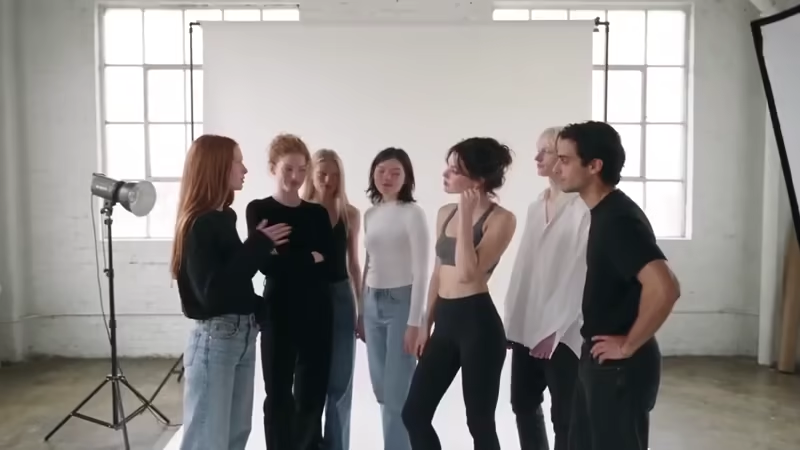
Producing consistent visual content that features people interacting with products has long required coordinating talent, locations, and usage rights for each new campaign or format.
Scheduling and appearance agreements add cost and time, and any change in the person on camera usually means starting over.
Generative image and video tools have lowered some of those barriers, yet keeping the same face recognizable across a series of stills, clips, and formats has remained difficult without repeated manual intervention.
Glif functions as a chat-based creative agent.
A user supplies a brief along with any product photos or brand references, and the system selects among more than one hundred models for images, video, audio, and text, then chains the necessary steps.
One part of the platform is its Characters system.
This supplies a library of original AI-generated people (roughly 150 to 165 at present).
Each carries a profile with casting age range, height, look, and languages, plus a reference sheet showing front, three-quarter, profile, and over-the-shoulder views.
Users can select one or more from the library for a project, or create a new character by uploading as little as a single reference image. Once added, the system passes those references to the generative models in use so the face stays consistent across outputs.
This arrangement supports several concrete production patterns.
A product photograph and a short description can yield a character unboxing the item in a domestic setting, delivered as a short vertical video together with matching stills.
The same character can appear in lifestyle scenes, talking-to-camera segments, or across a full set of ad formats (static posts, carousels, reels) from one brief.
Different characters from the library can be tested against identical product material and copy to observe how presentation changes.
Styles can be applied so the overall aesthetic remains uniform, and the agent can incorporate music or voice elements into the same session.
Characters are prepared for video models such as Seedance 2.5, with the intention that identity holds while the person moves or speaks; other models (Wan, Kling, Flux variants, and others) can also be used depending on the request.
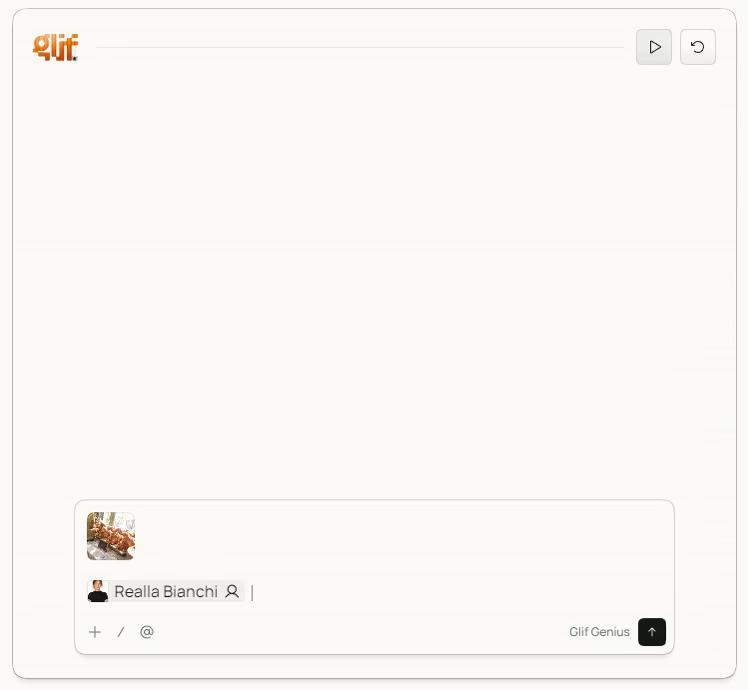
Preparing one of these characters for ongoing use involves uploading a reference image or a small set of views.
That image is then supplied whenever new assets are generated, so the same person can hold, wear, or present a product in fresh poses, settings, and formats.
In ordinary machine-learning practice, training a model means adjusting a neural network's parameters across many examples until it internalizes a particular look or behavior, a process that typically needs substantial data and compute. But here, "training" a "mode" literally means preparing the character to forward references of information they need to convey on behalf of the user.
In this case, the preparation is limited to storing and forwarding references to the general-purpose models already running on the platform.
The character that results can be directed through product shots the way a human model is directed, without the creation of a separate specialized network.
All of the work occurs inside one conversation.
The user describes the desired assets, adds product references and a character, and the agent handles model selection, generation steps, and assembly. Documentation notes that the characters are fictional and that they should not be presented as real customers or used to create implied testimonials.
Ordinary platform rules and advertising disclosure requirements continue to apply.
The practical effect is that a single reference can stand in for repeated casting across a campaign's stills and clips. Whether the character comes from the existing library or is created from an upload, the same identity can move from one format to another without rebooking or reshooting.
What changes from one request to the next is the brief, the product references, and the chosen models, not the person on camera.
Over time this shifts the bottleneck from finding and securing talent toward describing the desired scenes and reviewing the outputs.
The agent still selects and sequences the underlying tools, and the user still supplies the product material and the direction.
The result is a workflow in which persistent on-screen people are assembled from references rather than from new shoots, and in which the term model refers to the person presenting the product as much as to the software that generates the image.






















































































































































































































































































