
WordPress is a popular CMS, and it has taken a significant step forward in embracing AI.
And this time, it's by introducing a new AI agent skill called 'wp-playground.' Announced by WordPress contributor Brandon Payton, this tool is designed specifically to accelerate development workflows for plugins, themes, and other customizations.
By integrating with the Playground CLI, which is a lightweight, sandboxed environment that runs full WordPress instances locally without needing a traditional server setup, the skill allows AI agents to automatically spin up WordPress, mount generated code into the right directories, and test changes in real time.
The core advantage lies in creating a rapid, repeatable feedback loop.
Previously, one of the biggest bottlenecks for AI-assisted coding in WordPress was the slow process of testing: setting up an environment, logging into the admin panel, and verifying behavior could take a minute or more each cycle. With wp-playground, that startup time drops to just a few seconds thanks to clever helper scripts that handle initialization, automatic WP-Admin login, and graceful shutdowns.
AI agents can now use familiar tools like curl or Playwright to interact with the running site, check outcomes, apply fixes if issues arise, and re-test, all within the same consistent sandbox.
This makes experimentation safer and faster, as developers avoid risking live sites while iterating quickly.
A new AI agent skill has been introduced that streamlines testing and iteration in WordPress and works with Playground. This innovative tool reduces setup time from minutes to seconds, enhancing collaboration and creativity.
Test it out today: https://t.co/LP7NWA8Jz5 pic.twitter.com/Xq6ujsp9vy— WordPress (@WordPress) January 30, 2026
This development highlights the powerful intersection between content management systems (CMS) like WordPress and AI technologies.
CMS platforms have long served as structured, extensible foundations for building and managing digital experiences, but they traditionally rely on manual coding and testing. AI introduces automation and intelligence at multiple levels: generating code from natural language prompts, suggesting optimizations, and now actively testing and refining outputs in context.
The fusion brings substantial benefits, including dramatically reduced development time, allowing solo developers or small teams to prototype complex features that once required extensive effort.
It lowers barriers for non-expert users who can describe desired functionality in plain English, enhances code quality through immediate verification loops that catch errors early, and fosters greater innovation by enabling rapid experimentation without setup overhead.
Ultimately, this blend makes WordPress more accessible, efficient, and future-proof in an era where AI is transforming how software is created.
Looking ahead, the release also launches a dedicated GitHub repository for WordPress agent skills, inviting community contributions and expansions.
Ideas already in discussion include persistent Playground instances linked to project directories, commands for existing environments, and even automated Blueprint generation for reproducible setups.
Yet, as with any major technological shift, wp-playground and similar AI advancements come with notable drawbacks.
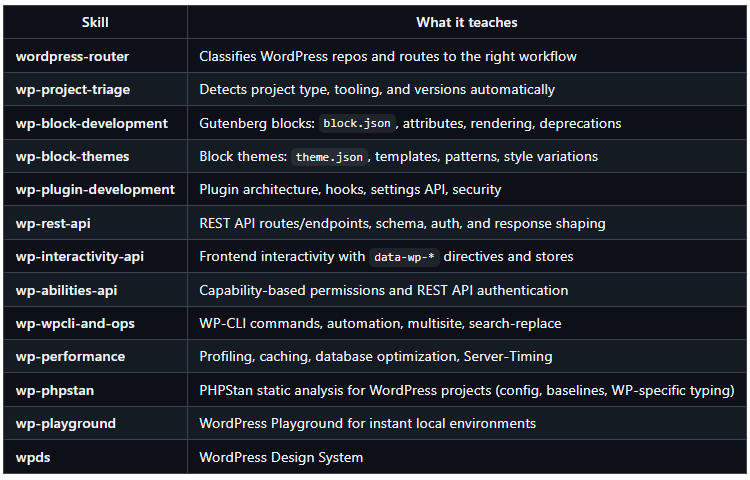
The tool depends heavily on the quality of the underlying AI models, which can still produce outdated patterns, overlook security best practices, or generate code that requires significant human oversight to meet professional standards. Setup still requires technical knowledge of tools like Node.js, npm, and terminal commands, limiting its immediate accessibility for beginners.
More broadly, the rise of agentic AI in WordPress development raises concerns about over-reliance on automation, potentially leading to shallower understanding of core concepts among newer developers or inconsistent code quality if human review is skipped.
While AI excels at routine tasks, it still struggles with nuanced architecture, custom business logic, complex integrations, and creative problem-solving that demand deep platform expertise.
Many in the community argue that AI will augment rather than replace skilled WordPress developers, much like how WordPress itself democratized web building without eliminating the need for experts who architect advanced solutions, optimize performance, ensure security, and provide strategic guidance.

















































































































































































































































































