People can talk about anything on the web, and as a result, news words and grammars can be created.
And when it comes to the web, where people can literally hide behind their screens, racial prejudice and racial politics do happen a lot. And Google as the largest search engine there is, is embracing the so-called 'woke' culture, by trying to cut then down.
To do that, it is introducing an 'inclusive language' function that designed to avoid the use of politically incorrect words.
For example, users typing ‘landlord’ can see a warning that it ‘may not be inclusive to all readers’ with the suggestion they should try ‘property owner’ or ‘proprietor’ instead.
Another example, is the word ‘humankind,’ in which Google can suggest if it sees a more controversial word, like 'mankind.'
Google embraces this 'woke culture' using the fact that many word processor systems use methods to correct spelling and grammar.
But when it comes to the web, the creations of new words and grammars don't limit people from using existing words to offend others, and pass any word processor systems' spelling and grammar correction methods.
And by being woke-minded, Google wants to at least limit the creation of any racial words that may offend some people.
As a result of this, Google forces writers to be more creative in describing things.
For example, cutting down the phrases like "whitelist/blacklist" and "master/slave" out of the vocabulary can be a good thing, but that erases the habitual biases writers have done in the past.
For example, swapping the word "manned" with "crewed" spaceflights can correct how people in the future see histories, in which women and non-binary people are given more importance than "men."
Another example, is gender specific terms such as "policemen" or "housewife" that can be replaced with "police officers" and "stay-at-home spouse."
Google is trying to make equality more prominent.
But things don't look too well, as least initially.
This is because the feature leverages synonyms, more than it understands the context of the sentence.
For example, when users type the word "annoyed," Google may suggest the word "angry" or "upset" to "make your writing flow better." While the three words have a similar meaning, being annoyed is a completely different emotion than being angry or upset. What's more, the word "upset" is so amorphous, that it could mean a whole spectrum of feelings.
The Google feature doesn't understand that, yet.
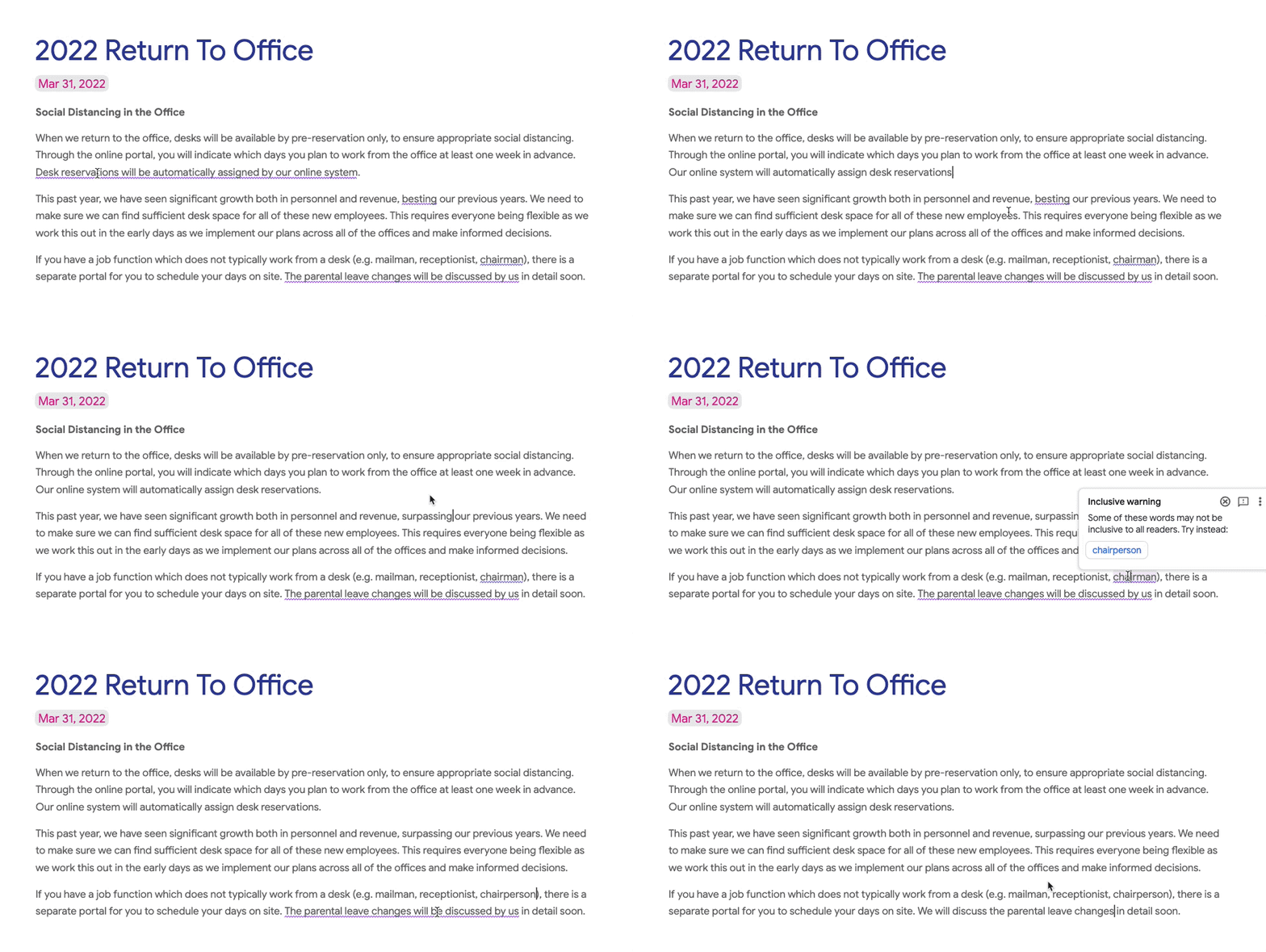
The feature can essentially fall into the same bias traps it’s trying to prevent in the first place.
Nudging users towards woke language is being seen by critics as a step too far.
Some see the warnings as intrusive, and not at all assistive.
Google explained that the feature is an "ongoing evolution."
"Assisted writing uses language understanding models, which rely on millions of common phrases and sentences to automatically learn how people communicate. This also means they can reflect some human cognitive biases," a spokesperson for Google said.
"Our technology is always improving, and we don't yet [have] a complete solution to identifying and mitigating all unwanted word associations and biases."

















































































































































































































































































