People online take the steady tick of a clock for granted, treating time as a passive backdrop to everything they do online.
To most people, their personal devices are synched across their other devices and with that, they can ensure that their calendar alerts fire on time, they can receive emails and notifications, login to websites and apps, and so on.
But behind the scenes, across the sprawling infrastructure of global tech giants, time is not just a reference point.
Instead, it is more like a fundamental pillar of modern security, database consistency, and identity verification.
When millions of servers around the world must coordinate microsecond-accurate transactions, a shared understanding of what time it actually is becomes the silent glue holding the entire internet together.
Meta has a way to make sure that time is not tampered with.
Since the 1980s, the backbone of digital time synchronization relied on the Network Time Protocol (NTP). This is a system born in an era when the internet was smaller, quieter, and built on implicit trust.
"The client sends 48 bytes, something sends 48 bytes back, and the client believes it. There is no signature and no identity," said Meta in a blog post.
Under standard implementations, computers simply reach out across the network and ask remote servers for the current timestamp in plain, unencrypted text.
This absence of authentication means that any party sitting between a server and its source can intercept those packets and lie about the time.
In the hands of a malicious actor, tricking a server into winding its clock forward or backward breaks the foundational assumptions of online trust, rendering cryptographic certificates invalid, exposing authentication tokens to replay attacks, and throwing distributed databases into chaos.
To eliminate this vulnerability across its massive infrastructure, Meta engineered and deployed Network Time Security (NTS), bringing modern cryptographic authentication to time synchronization at global scale.
Intead of the decades-old way of asking time, NTS wraps time requests in TLS-encrypted handshakes and using stateless cryptographic cookies.
The implementation ensures that every timestamp received by a machine is verified against a trusted identity and protected from tampering mid-transit.
If an adversary attempts to alter a packet or inject a fake time signal, the system instantly identifies the discrepancy and discards the payload. Designing the deployment to operate statelessly allowed the infrastructure to handle billions of high-speed requests without creating performance bottlenecks.
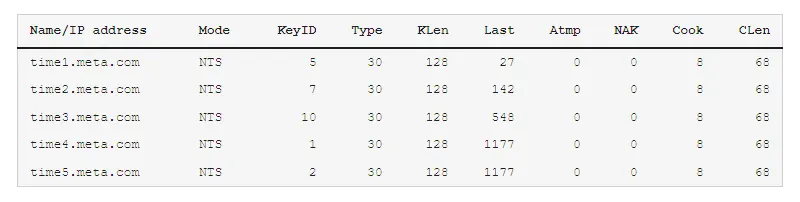
In other words, NTS uses a pool rather than a server. Since a single server line only gives one responder, this creates a single point of failure. Using a pool NTS receives information from several sources at once so it can outvote a bad one.
Securing the clock might sound like an obsessive technical detail, but it reflects a broader shift toward zero-trust architecture across cloud computing.
In an environment where every API call, security certificate, and financial record relies on strict temporal boundaries, trusting an unauthenticated network packet is no longer an option.
Transitioning from legacy time protocols to cryptographically signed alternatives ensures that even the most fundamental layer of system operations remains resilient against modern threats, proving that in enterprise security, even the clock requires a digital guard.