 Facebook, the social giant company, is fighting a U.S. court order in which it was forced to hand over data belonging to almost 400 people involved in a benefit fraud trial. While the case dates back to 2013, a judge only made the details public in the 25th June. The social media has said that the request was "by far the largest" it had ever received from the government.
"This unprecedented request is by far the largest we've ever received - by a magnitude of more than ten - and we have argued that it was unconstitutional from the start," wrote Chris Sonderby, a Legal Adviser to Facebook.
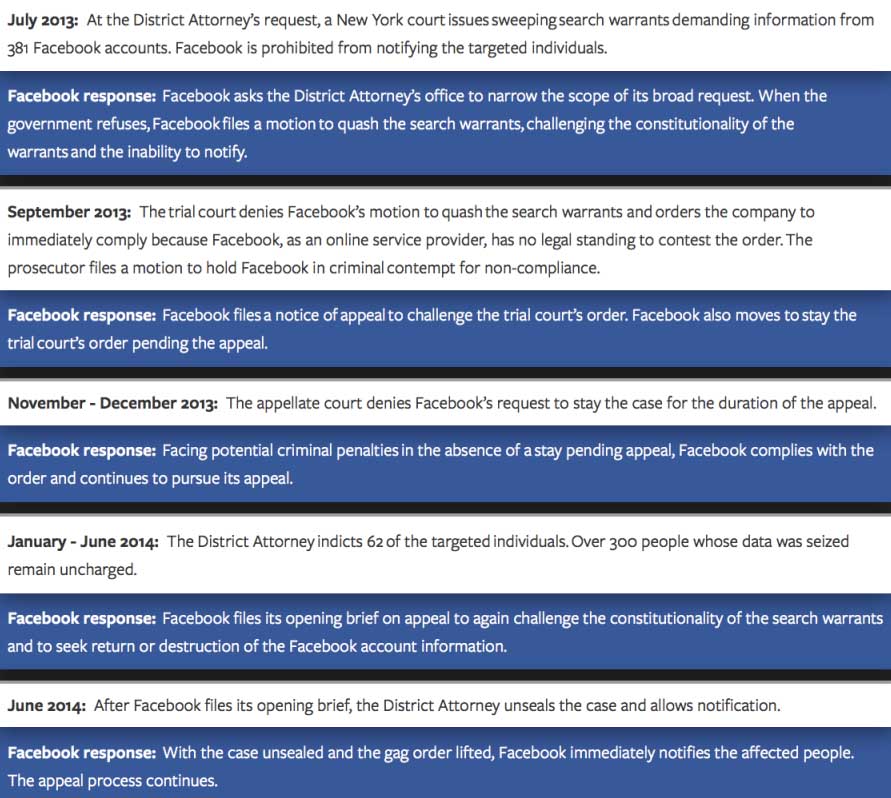
The original case investigated fraudulent claimants of U.S. federal disability benefits, whose Facebook accounts apparently showed that they were in fact healthy. A judge said that Facebook must comply with search these warrants by handing over 381 accounts that contained "evidence of criminality."
After an appeal was denied, Facebook complied with the request but protested that it violated the Fourth Amendment of the U.S. constitution, which protects against "unreasonable searches and seizures".
However, Facebook's major concerns related to not only the size number of accounts from which data had been demanded, but also the lack of restrictions when it came to the U.S. government retaining the data. The lack of date restrictions on the warrant, would allow the U.S. government to keep the data indefinitely, and the range of data requested, which it said would contain private material which bore no relation to the trial.
The data requested include nearly all data - including photos and private message. Although Facebook "fought forcefully" against complying with the requests, the company was eventually forced to do so, Sonderby said.
A lower court told Facebook that, as an online service provider, the company did not have the "legal standing to contest the warrants." An appeals court denied its application to stay the earlier ruling and the prosecutor filed a motion to find the company in criminal contempt.
Sonderby said that Facebook's legal team then filed an appellate brief as a last move to invalidate the warrants and force the government to return the data it had seized. And after the appeal was filed, the government unsealed the warrants and related court filings, which at least enabled Facebook to notify the members affected by the warrants.
"But we feel strongly that there is more work to do, and we will continue our legal fight to retrieve data that has been seized and retained by the government," said Sonderby. "We recognize that law enforcement needs to investigate potential crimes, but we believe all government data requests must be narrowly tailored, proportionate to the case, and subject to strict judicial oversight. Moreover, we believe search warrants for digital information should be specific and narrow in scope, just like warrants for physical evidence. These restrictions are critical to preventing overreaching legal requests and protecting people’s information."
Sonderby also said that: "Of the 381 people whose accounts were the subject of these warrants, 62 were later charged in a disability fraud case. This means that no charges will be brought against more than 300 people whose data was sought by the government without prior notice to the people affected.”
Defending the actions of the courts, a spokesperson for the Manhattan District Attorney said:
"The defendants in this case repeatedly lied to the government about their mental, physical, and social capabilities. Their Facebook accounts told a different story."
The judges then wrote in their findings:
"Facebook could best be described as a digital landlord, a virtual custodian or storage facility for millions of tenant users and their information. Hence, the search warrants authorize the search and seizure of digital information contained within the Facebook server."
Facebook is not alone in its derision for government requests for data. Facebook, with Google, Microsoft and Yahoo! have also been fighting back on government data requests. Facebook as the digital landlord, and many other tech companies have banded together in a bid to demand better transparency and protection to their users.




















































































































































































































































































