 Tuesdays is the day for Facebook employees to feel how it's like to be 'slow'. Called 2G Tuesday, the internal program is to give those that work for Facebook, the sense of connection in developing countries - places where Facebook's users mostly originate.
When Facebook employees log in on a Tuesday, they'll be asked on their News Feed whether they want to use the slower connection, which lasts for about an hour. This will offer them the opportunity to give feedback to Facebook's team of emerging-markets engineers on what works and what doesn't.
The program is optional. But for those that want to experience the 'speed', "for that next hour, their experience on Facebook will be very much like the experience that millions of people around the world have on Facebook on a 2G connection," said Engineering Director Tom Alison.
"They're going to see the places that we need to improve our product, but they're also going to see the places where we have made a lot of progress."
In the country where Facebook comes from, and many other developed nations, faster 3G and 4G connection are already common. These types of connections give the ability to browse the internet and all of its media with ease and speed.
This is a contrast to developing nations where speedy internet is still a luxury, or even at all still absent.
Facebook said that people living in developing countries are coming online at "a staggering rate" using much slower 2G connections, which can take up to two minutes to download a single web page. As a matter of fact, millions of people all over the world are coming online for the first time with that 2G speed.
"We need to understand how people use Facebook on different internet connections in all parts of the world so we can build the best experience for them," said the social media giant.
This is the reason why Alison and his team of emerging markets engineers are spending much of their time in redesigning Facebook to optimize it on slow connections. As part of their job, the team regularly use phones that simulate 2G and take trips to developing countries in order to get a better understanding on how people there use Facebook.
But since not all Facebook's employees get the chance to travel on international trips, Facebook's 2G Tuesday is meant to mimic the situation back at home.
To Be Available To Everyone Means To Become Accessible To Everyone
Facebook's attempt to redesign its product for users with slow internet connection, is because they are making making up most of its active user base. This attempt was, for instance, previously made by Google that launched a low-speed version of its search service, as well as an offline watching feature for its YouTube video site.
Facebook's 2G Tuesday came about a month after the company renamed its controversial Internet.org website and app to Free Basics. Facebook's initiative is meant to provide free basic internet services to people that never had internet before. The company initiate this attempt by partnering with local telecommunication companies in their respective targeted countries.
Facebook's Mark Zuckerberg has said that his, and Facebook's ultimate goal, is to get the two-thirds of the world that is currently offline to be able to connect to the internet.
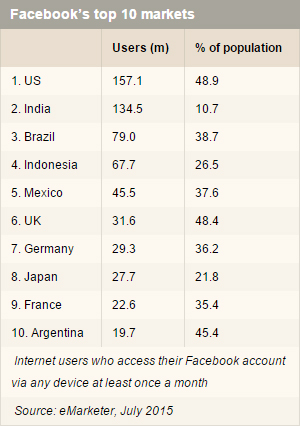
In global, Facebook's penetration despite slowing down, is still increasing. With U.S. coming at the number one spot, India, Brazil and Indonesia are the company's largest number of audience in a July 2015 report. Thanks to the increasing mobile penetration in many countries, Facebook is reaching 1 billion mobile users.
While India is leading Asia-Pacific in term of Facebook users growth. According to eMarkerter, Indonesia is having the highest mobile usage rate worldwide, making it the third-largest mobile phone Facebook audience worldwide, after the U.S. and India.

















































































































































































































































































