Large language models (LLMs) are useful because they can quickly process and generate human-like text based on vast amounts of knowledge, making them versatile tools.
Since OpenAI introduced ChatGPT and sparked an arms race between tech companies, large and small, Google entered the arena with Gemini, a powerful LLM that taps into all of Google's knowledge and prowess.
As LLM technology advances, these models can process increasingly larger numbers of tokens at once.
This means they can handle longer conversations, analyze more complex documents, and maintain richer context. This results in more coherent, relevant, and detailed responses.
This time, AI chatbots have seen their memories grow longer, and this allows users to \refer to older conversations or save certain information for future reference. Things like name, or what city you live in, memory is powerful and extremely useful.
While it does come with its own unique set problem, one of which is how personalization can change the behavior and output as the LLM tries to do what it thinks users want rather than what users ask it to do. Regardless, a memory is a powerful feature, and most of the time, all users want is more about better fluidity in conversations, better experience, and a lot less copy-and-paste.
Back in February, Google introduced a new 'memory' feature to Gemini, which gives the LLM-powered chatbot the ability to recall past conversations.
While this made Gemini more capable, the memory was limited, as it could store information but not actively use it to shape future interactions.
Now, Google is taking things a step further with the launch of what it calls 'Personal Context.'
In a blog post, Google said that:
"The Gemini app can now reference your past chats to learn your preferences, delivering more personalized responses the more you use it."
We’re introducing a new setting that allows Gemini to learn from your past conversations over time.
When this setting is on, Gemini remembers key details and preferences you've shared, leading to more natural and relevant conversations, as if you're collaborating with a partner… pic.twitter.com/4sgCpYQYOD— Google Gemini App (@GeminiApp) August 13, 2025
This upgrade turns Gemini’s memory into a more personalized chat experience, enabling it to learn from a user’s preferences over time and tailor its responses accordingly.
In other words, Gemini can now remember details users share, like things they like, and use them later when generating ideas.
In an example, Google explains that if a user tells Gemini their favorite comic book, and later ask it to help plan a personalized birthday party, it may suggest that comic book as the theme. From there, it could recommend matching food, decorations, and even themed party games.
In the prior iteration, users had to ask Gemini to specifically reference older chats in order for it to access that information. At for whatever reasons, it could fail to do so in certain cases.
With the upgrade, Gemini can learn without being told, or being asked for it directly.
The new feature keeps Gemini ahead of Anthropic, which released its own chat memory function a couple of days ago for its Claude chatbot. Claude’s new memory works the way Gemini’s used to, where you have to specifically ask Claude to reference old chats and apply that knowledge to new conversations.
The memory feature is available on rivals, like ChatGPT and Claude. But Personal Context somehow propels Gemini ahead of those two.
This can happen because Personal Context continuously learn from interactions. The longer and the more frequent, and the more things users share with the bot, the more it will learn from those information. And based on that, Gemini should be able to better tailor its responses.
Google said that the upgrade is rolling out to all users when using the Gemini 2.5 Pro model in select countries, emphasizing that it's planning to expand the feature to users of Gemini 2.5. Flash model, as well as to more countries.
This setting is turned on on by default. But Google ensures that users remain in control, and can turn this setting on or off at any time.
To do this, they can head to Settings in the Gemini app and select “Personal context,” then ”Your past chats with Gemini.” As before, users can manage and delete their conversations in Gemini Apps Activity.
We also know that sometimes you want to have a one-off or sensitive chat with Gemini without it influencing future conversations. For those moments, we’re introducing Temporary Chat.
These features are rolling out over the next few weeks. Learn more here: https://t.co/D7D8BAe8JO pic.twitter.com/oQ2q6obS62— Google Gemini App (@GeminiApp) August 13, 2025
Next, is the 'Temporary Chat' feature.
Just like Chrome's Incognito mode, anything that is done within Temporary Chat will vanish as soon as the session is closed.
What this means, Gemini will not store any chats on Temporary Chats in the recent chats section of the app or within Gemini Apps Activity. Furthermore, Google also said that chats in Temporary Chat will not be used to personalize users' Gemini experience or train Google’s AI models.
Google only said that they're only kept for up to 72 hours, in case users return.
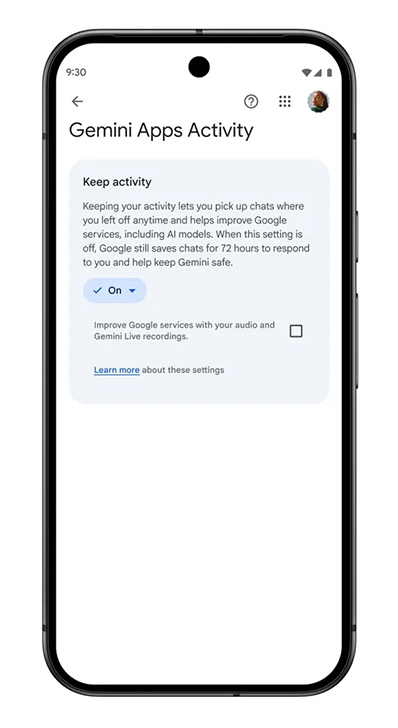
Lastly, Google said that it's improving privacy in Gemini.
To enable this, Google is renaming the “Gemini Apps Activity” setting to “Keep Activity.”
When turned on, a sample of future uploads will be used to help improve Google services for everyone. Users who prefer not to share their data can simply switch the setting off or use Temporary Chat instead.
Notably, if a user’s current Gemini Apps Activity setting is already off, Google will keep it turned off when the upgrade to Keep Activity rolls out.

















































































































































































































































































