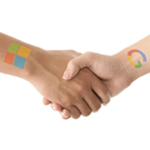
 Google and Microsoft have agreed to settle an ongoing patent war concerning communications and video technology, as well as their long-running lawsuits that went over smartphones to video games. About 20 lawsuits were lodged in the U.S. and Germany. And the truce means an end to the battle between the two giants.
The tech giants have been litigating over technology innovations for five years. From Google's former Motorola Mobility unit had been demanding royalties on the Xbox video-gaming system, to Microsoft seeking to block Motorola mobile phones from using certain features.
The battles were particularly over software, has been intensified in recent years as the two sought to capitalize on their patent portfolios. But with the truce to end the patent war, both companies are trying to provide a solution that can benefit all parties involved.
"Google and Microsoft have agreed to collaborate on certain patent matters and anticipate working together in other areas in the future to benefit our customers" said the technology giants in a joint statement.
The two companies didn't disclose financial terms and details of the deal were not shared, but in the joint statement the firms did say that they would collaborate.
As a start, the two companies have pledged in a statement to work together in other ways related to intellectual property. That includes the development of a royalty-free, video-compression technology to speed downloads, in an initiative that also involves Amazon and Netflix.
So rather than litigation, both companies are shifting towards licensing as a solution to their problem.
"Microsoft and Google are pleased to announce an agreement on patent issues," said the two companies in their joint statement. "As part of the agreement, the companies will dismiss all pending patent infringement litigation between them, including cases related to Motorola Mobility."
The companies agree they want to make it harder for patent-licensing firms that don't make products and are derided as "trolls." The European Union is setting up an EU-wide patent court to ensure that similar lawsuits won't become as prevalent in Europe as they were in the U.S..
Getting Tangled In Disputes
The agreement between Google and Microsoft marks a new amity between the two enemies. This is also because Microsoft's CEO Satya Nadella carries a different "tone" in his leadership if compared to previous CEOs. One example was on August 10th, when Sundar Pichai was named CEO of Google, Nadella tweeted congratulations to him, calling the promotion "well deserved."
The companies have been in tension since Microsoft claimed in 2010 that Google's Android mobile operating system had incorporated Microsoft's technology but didn't pay any royalties. Microsoft also sued Google over a patent that allowed for long text messages to be broken into pieces, sent, and reassembled on the receiver's phone.
Among the numerous lawsuits that were filed, was Microsoft against Motorola which was then a standalone company.
It was a case that Google later inherited as part of its $12.5 billion purchase of Motorola Mobility. By acquiring it, Google took Motorola's large number of patents relating to mobile phone and network. Google sold Motorola to Lenovo for $2.91 billion by retaining the bulk of the patents it took on the original deal.
Microsoft claimed that Motorola was demanding the equivalent of $4 billion a year in royalties on the Xbox and accused it of backing away from pledges to fairly license patents on fundamental video compression and wireless technologies. An appeals court in July upheld a finding that Motorola breached that agreement.
The case against Motorola involved in part the use of ActiveSync, a popular feature that allows users to coordinate their calendars on their phones and desktop computers. Microsoft obtained an order blocking the feature on Motorola phones imported to the U.S. though it later said that U.S. customs officials never enforced it.
Furthermore, Google that is pushing new mobile products to the market, is competing with Microsoft, mainly its tablet computer.
While the deal ends this round of lawsuits, there is no guarantee that Google and Microsoft would not clash again in the future. The limited truce follows a similar deal between Samsung and Apple who choose to drop their patents in 2014.




















































































































































































































































































