
AI is speeding up very fast, and sooner than later, there is nothing that can stop it from getting everywhere.
The AI chatbot hype sent up so steeply following the release of ChatGPT by OpenAI, that pretty much all big tech companies are either developing or exploring ways to create and/or utilize the technology for their own benefit.
Due to how lucrative the industry has become, the arms race is financially motivated, and only the one that keeps advancing to new heights can thrive.
A few months earlier, Google among others, introduced what it calls the 'Gemma 2B' which has been trained with 2 billion parameters.
While this AI model is no where as powerful as Gemini, which Google is developing to rival the likes of GPT-4, the AI stands out in terms of speed.
According to Google, Gemma 2 is lightweight, meaning that it should have faster inference speeds and lower computational demands.
This time, Google is introducing a variant of this AI it calls the 'Gemma 2 2B.'
This AI is also a 2 billion parameter model, but unlike its older sibling, it's small enough to fit into a smartphone.
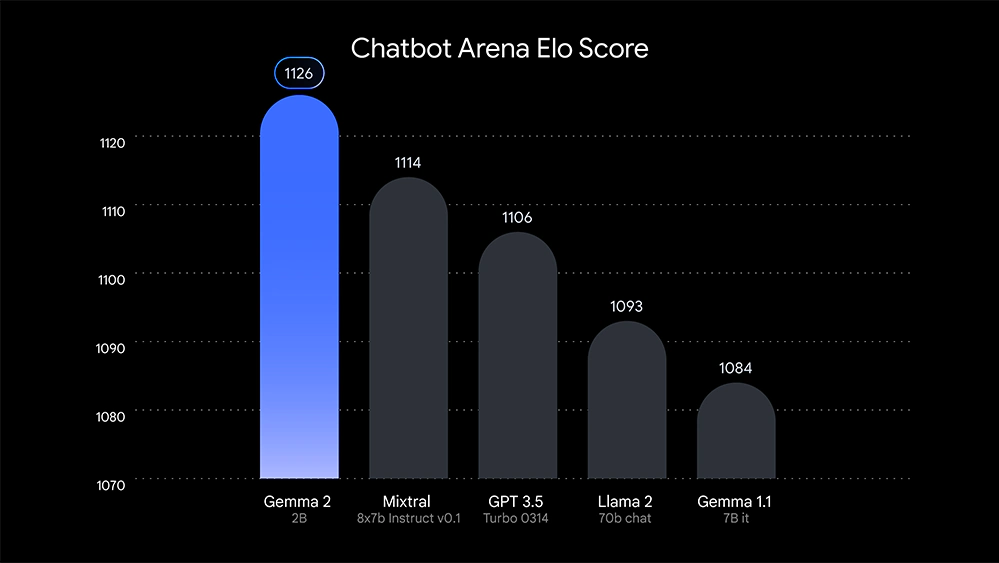
The milestone is that, it still offers a GPT 3.5 levels of performance.
What this means, Gemma 2 2B is as powerful as the AI that powers the first ChatGPT, but without needing a powerful computer to operate.
As Google explained in a blog post, the model offers "best-in-class performance for its size, outperforming other open models in its category," and the LYMSYS charts certainly show some impressive stats.
Which such advantage, Gemma 2 2B should be a useful variant in the Gemma 2 family, which focuses on smaller and more lightweight AI that ran run on a wider ranger of devices, not just powerful computers.
The model achieves this kind of performance "by learning from larger models through distillation."
The method was first introduced back in 2015, in which it employs a sophisticated student-teacher approach in the training steps to allow the development of smaller, more compressed AIs.
It's worth noting that cloud-based AI is, and will continue to dominate.
Due to its obvious advantages due to running on supercomputers rather than on the edge, these AI products will always be the top-of-the-line products.
But inevitably, as the technology matures, more people would prefer to run some kind of AI on their devices, without the internet.
And Gemma 2 2B is paving that path for Google.
With the market for mobile and edge-based Al is apparent, the market's demand for Large-Language Models that run locally should also be apparent.
At this time at least, even the lightest but capable AI needs hardware that are good enough.
For example, newer iPhones that run at least iOS 14, and later Android phones using Snapdragon processors like the Galaxy S23 Ultra, are some that can.

















































































































































































































































































