Google has a lot in mind, and many of the things involves Artificial Intelligence (AI). Meant to make computers smarter, AI is a way humans want computers to represent them. This time, Google is putting it into a good test, and the subject is cryptography.
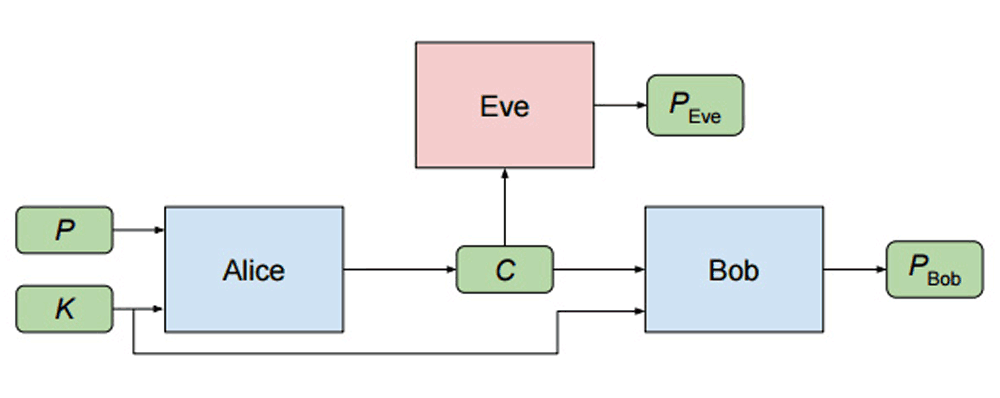
A team of researchers at Google Brain, a division that focuses on deep learning, built a game with three entities powered by deep neural networks: Alice, Bob, and Eve.
They have discovered that if AI, when given a task properly, could create an inhuman (odd) sort of cryptographic schemes. And because AI made it, they're also able to encrypt and decrypt the information.
What the researchers did was simple: Alice was designed to send an encrypted message of 16 zeroes and ones to Bob, which was designed to decrypt the message. The two bots shared the same key, the foundation for the message's encryption. Then they put another neural network into the equation. The name was Eve. Here, Eve was tasked to intercept the communication and designed to try to decrypt the message, without the key.
The project works on one condition: a "loss function" for each party. Bob should read Alice's encrypted message, and so should Eve. But the encrypted message had to be as close to the original message as possible.
To avoid Eve figuring out the encryption, Alice started encrypting the message in different ways. Bob then adapted to the shift in order to keep up. The researchers measured Eve's success by how close it got to the correct message.
Researchers Martın Abadi and David G. Andersen said:
The three AI were designed as generative adversarial networks. What this means is that they weren't previously taught about encryption or shown examples on encrypted and decrypted messages. They were just designed to outsmart each other.
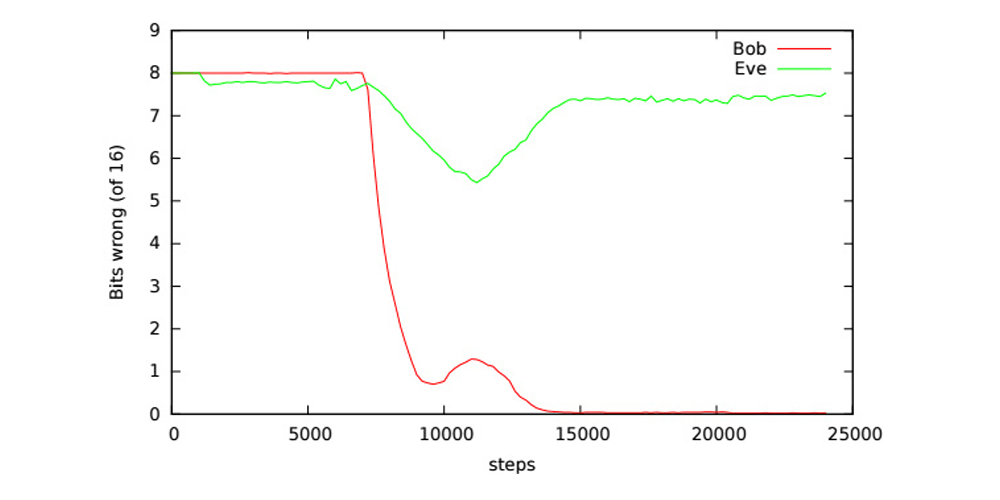
In the image below, Bob (red) quickly adapted to the learning encryption because it had the shared key, while Eve (green) was unable to keep up.
For the first 7,000 messages, Alice and Bob started out simply and Bob figured out Alice's messages quite easily. Meanwhile, Eve had to guess and that wasn't easy for the AI. But after the next 6,000 messages, Bob and Alice became very good at encrypting and decrypting, with Bob able to decrypt messages with no errors at all. Eve that has learnt its way around the subject, did get some correct with seven or eight of the 16 characters missing.
What happened was, over time and eventually, Bob and Alice were able to communicate using the shared key. They got really good at sharing encrypted information and many of their techniques were quite odd and unexpected (uncommon in human-generated encryption).
This is because the kind of learning is done over thousands of iterations by a mosaic of mathematic weights being altered by algorithms.
Without time-consuming analysis, even the researchers themselves can't understand how the encryption were built.
What this research has concluded is that AI can be good in creating their own solid encryption as long as they value security. Eve has had a hard time in decrypting encrypted message communications because it had no key. This is similar to humans. What this means is that computers can be made talk to each other in a way that even humans or other robots won't be able to crack.




















































































































































































































































































