There is something quietly radical about the way certain ideas refuse to stay confined to the classroom where they were first introduced.
Knowledge that begins as a blackboard sketch can travel for decades, reshape how people think about change itself, and end up informing everything from the design of algorithms to the pricing of risk.
In an age when information is abundant yet understanding remains scarce, the persistence of a single clear insight can matter more than any polished curriculum.
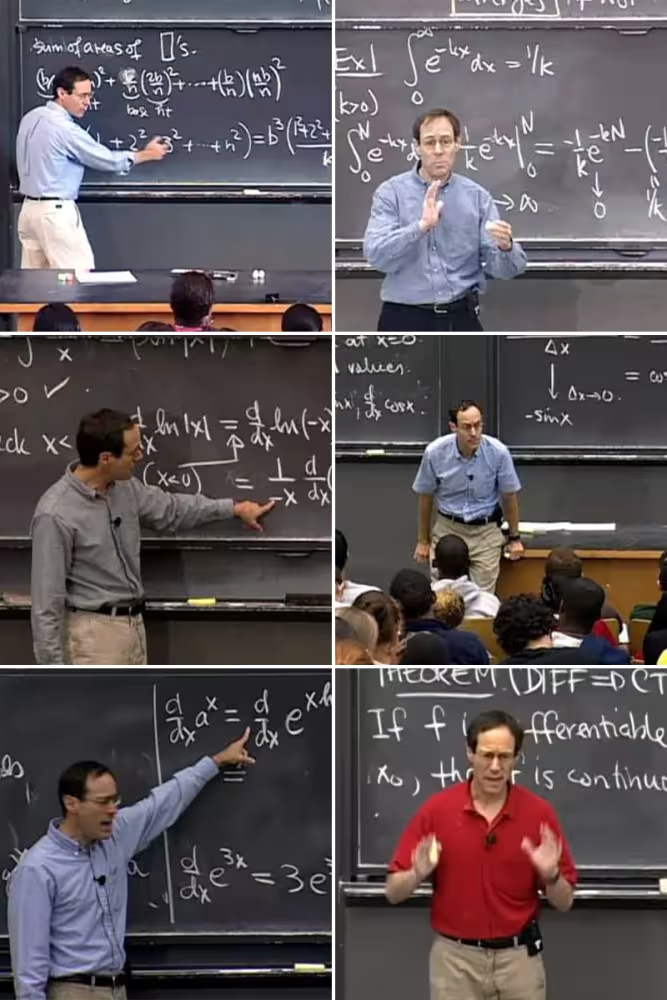
In the opening lecture of MIT’s single variable calculus course, Professor David Jerison presents the derivative not as a collection of memorized formulas but as one geometric act.
For many people, calculus is among the most difficult subjects to understand, let alone master. Yet his Lecture 1 alone has millions of views, reaching far more people than any physical classroom for that subject.

In his lecture, Professor Jerison defines the derivative geometrically:
- Take two points on the curve (P and Q).
- The line between them is a secant.
- Slide Q toward P so the gap vanishes.
- The limiting slope of those secants is the tangent slope: the derivative.
He calls this limit definition "the most important formula today, which we use to derive pretty much everything else."
In the same lecture, he already derives the power rule from it.
The product, quotient, and chain rules follow in the next few lectures as direct consequences of the same limit.
Rather than introducing separate tricks, Jerison repeatedly applies the same definition in different algebraic settings, simplifying the resulting difference quotients until the familiar formulas naturally emerge.
In other words, calculus is not a collection of hundreds of formulas to memorize.
It begins with one simple idea: take two points on a curve, slide them together until the gap vanishes, and the limiting slope is the derivative. Everything else follows from that foundation.
Jerison recorded these lectures in the mid-2000s, and MIT later published the complete series on OpenCourseWare, where they have remained freely accessible ever since.
The power rule, the product rule, the quotient rule, and the chain rule all emerge by applying the same definition in different algebraic settings and simplifying the resulting difference quotients.
No separate tricks are required.
The limit definition is reused, again and again, until the familiar formulas appear as natural outcomes rather than arbitrary rules.
In short, calculus is not a hundred formulas to memorize.
Instead, it's just one idea: take two points on a curve, slide them together until the gap vanishes, and the slope left is the derivative. Everything else is just consequences.
The derivative is no longer a black-box operator but a precise description of instantaneous rate of change.
That same rate of change appears under many names.
In physics it is velocity, the limit of average speed over shorter and shorter intervals. In economics it is marginal cost or marginal revenue, the incremental change that guides pricing decisions. In machine learning it is the gradient that tells a neural network how to adjust its weights.
Backpropagation itself is simply the chain rule applied repeatedly, and the chain rule is nothing more than the original limit definition applied to a composition of functions.
One operation, discovered in the seventeenth century and clarified on a chalkboard at MIT, continues to power the optimization routines that train modern artificial intelligence systems.
The deeper lesson is pedagogical.
Mastery does not come from accumulating techniques but from grasping the single idea that generates them. Once the limit of the secant slope is understood, the rest of differential calculus becomes a matter of careful bookkeeping.
The lectures demonstrate this economy of thought with unusual clarity, moving from pure geometry to formal definition to concrete computation within a single hour. Viewers who stay with the argument leave with more than a set of rules. They leave with a way of seeing change itself.

















































































































































































































































































