Computers don't process videos the way humans would. While most systems that claim to "watch" a video, they actually sample it.
To do this, a typical pipeline pulls frames at a fixed rate, often one per second, then feeds that sparse stack of stills into a model along with whatever audio or transcript is available.
While this approach is simple to run and easy to price, it also creates a familiar tradeoff.
When the frame rate rises, token counts will climb quickly. Keep the rate low, brief events that happen for less than a second will not be processed.
On a clip that is minutes long, the waste is tolerable. But on a 90-minute lecture, or a multi-hour recording, missing frames will definitely become a constraint.
Google wants to solve this.
On 1 September 2026, Google described a different pattern for its latest Gemini models and called it agentic video understanding.
Instead of ingesting the file at a preset frames per second rate, the model is allowed to decide what to inspect, at what speed, and through which channel: visual frames, audio, or transcript.
It does that inside a loop, calling an internal tool to load only the stretch of the file that the current question seems to require.
The company presents this as a close cousin of agentic vision, the earlier setup in which Gemini could write and run code to crop or zoom an image rather than guess from a single pass.
The feature is live on Gemini 3.7 Flash, Gemini 3.6 Flash, and Gemini 3.5 Flash-Lite.
Developers can turn it on by setting a processing field to agentic when they pass a video upload or a YouTube URL through the Gemini API in Google AI Studio or the Gemini Enterprise Agent Platform.
Static processing remains the default.
The two modes can even be mixed in one request, so one clip can be scanned agentically while another is sampled at a fixed rate.
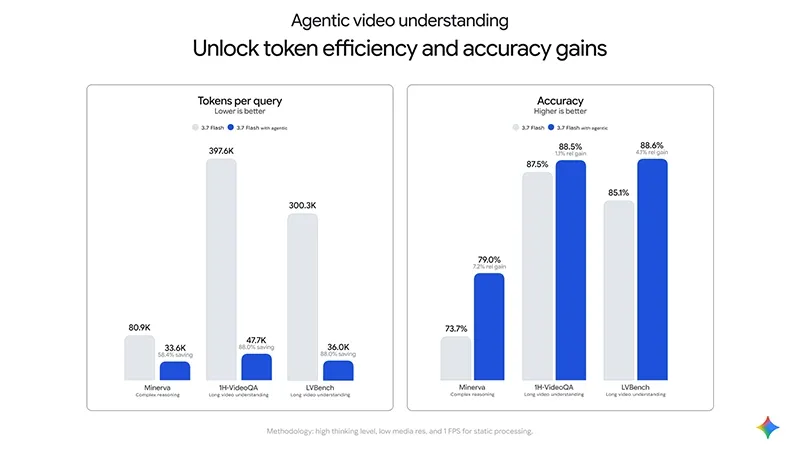
Google’s published numbers are “up to” figures drawn from standard video analysis benchmarks: as much as 88% fewer tokens, as much as 66% lower cost, and as much as 7% higher accuracy.
The company says Gemini 3.7 Flash with the agentic path sits on the accuracy to cost frontier among the models it tested.
Those gains are described as largest on long form material, the range that runs from ten minute how to videos through hour long talks and multi hour recordings, where a fixed one frame per second pass either becomes expensive or throws away the moments that matter.
A short comparison clip posted with the announcement shows more modest savings on two I/O 2026 keynote questions.
Asked which terminal utility drew a locomotive on screen, both static and agentic Gemini 3.7 Flash identified sl (Steam Locomotive). The static run used 45,280 tokens. The agentic run used 27,669, a 39% drop. A second query, asking for the third logo in the second row of a partners slide and who presented it, produced Microsoft and Vidhya Srinivasan in both columns, at 127,628 tokens versus 94,962, a 26% drop. The headline "up to 88 percent" is therefore a ceiling from the benchmark suite, not a guarantee on every file.
The use cases Google lists follow from the ability to change speed and modality mid analysis.
Sub second moment retrieval is meant for state changes and cut points that a one frame per second sample would miss, which matters if the goal is automated editing rather than a loose summary.
Needle in a haystack search is the long file version of the same idea: answer a specific question without paying to encode every second. Anomaly detection is framed as resampling a suspicious window at a higher frame rate. Counting objects or repeated actions is the case where a single pass often double counts or skips a cycle.
There are limits.
Documentation notes that the extra navigation steps can raise time to first token on clips shorter than about five minutes, because the model spends time planning and calling tools before it starts writing an answer. Only the three Flash family models listed above support the mode. In stateless API use, follow up turns need the processing_call and processing_result steps kept in context. Drop them and the video grounding is lost even if the request does not error. Token use is dynamic, so cost is no longer a simple function of duration times a fixed frame rate.
Google says the same capability will move into the Gemini app on Flash and Flash Lite models, and that in the coming months it will sit behind YouTube's Ask YouTube answers on the watch page, where replies are supposed to stay tied to what is actually on screen.
For now the practical surface is the API.
Anyone already sending long videos through Gemini can treat this as a processing flag rather than a new product: same models, a different way of deciding which seconds get turned into tokens.




















































































































































































































































































