In the competitive landscape of large language models (LLMs) and agentic tools, organizations continue to release products aimed at assisting software engineers.
xAI has contributed Grok as one of the models in this space, emphasizing real time information access and direct interaction capabilities. Building on this foundation, the company introduced Grok Build, a terminal based coding agent that operates as a command line interface for complex development tasks.
Grok Build entered early beta in May 2026 and became available to SuperGrok and X Premium Plus subscribers.
The tool enables users to issue natural language instructions for activities including plan generation, file modifications, command execution, and dependency management. It incorporates a plan mode that presents proposed changes for review and approval before implementation. Multiple subagents can be delegated portions of larger tasks to run concurrently.
The agent automatically incorporates project conventions from files such as AGENTS.md along with any configured skills or extensions present in the working directory.
Earlier releases around the same period added support for skills, which function as persistent, reusable sets of instructions and workflows that Grok applies across sessions without repeated prompting. These elements prepared the ground for further modular extensions.
Now, xAI is launching what it calls the Grok Build Plugin Marketplace in beta.
The Grok Build Plugin Marketplace is now in beta.
Build with MongoDB, Vercel, Sentry, Cloudflare, and Chrome DevTools plugins from your terminal.
Read more https://t.co/ShPeozXSxA pic.twitter.com/pOFttEuwdF— xAI (@xai) June 11, 2026
The marketplace operates as a built in feature of Grok Build and provides a centralized way to discover and install packages that bundle additional functionality.
Plugins act as self contained packages that extend the agent's capabilities.
Each plugin can combine skills for procedural guidance, slash commands, agent definitions, lifecycle hooks, MCP server configurations, and LSP server setups. Installation of one plugin activates the full set of included components.
The initial beta catalog includes plugins developed with partners.
The MongoDB plugin supports data exploration, collection management, and query optimization. Vercel integration handles deployment management, build status checks, and domain configuration. Sentry provides tools for stack trace analysis and production error debugging. Chrome DevTools enables live browser control, performance trace recording, and network inspection. Cloudflare contributes capabilities for Workers and Durable Objects. An entry called Superpowers includes examples of common agent driven workflows.
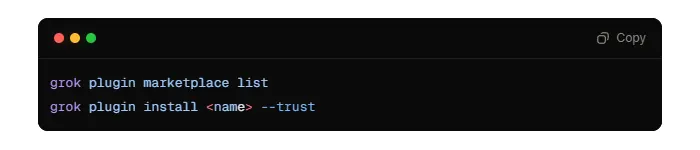
Interaction with the marketplace occurs directly in the Grok Build terminal.
Users can browse the catalog and install entries using commands or natural language prompts. Each plugin in the catalog pins to a specific commit in its source repository, and the system verifies this reference during installation.
Multiple plugins can be added in one operation.
The catalog itself is maintained as an open GitHub repository under the xai org organization.
Anyone can contribute new plugins or updates by preparing the required directory structure and submitting a pull request.
The repository distinguishes first party plugins from third party ones and supports both local vendoring and remote references pinned to exact commits. Automated scripts generate a component index for preview, and changes pass through validation and review processes.
This marketplace represents a further step in the development of Grok Build, which began with core agent features and skills support in its May 2026 beta.
It offers a structured method for expanding the range of tool integrations available within a terminal centered coding workflow.




















































































































































































































































































