Information reaches people through many channels, yet the balance among those channels has shifted noticeably over the past decade.
Text still carries formal records and careful argument, still images freeze single moments for inspection, and audio preserves the tone of a voice. Video, however, combines motion, speech, environment, and sequence into a single stream that often feels closer to direct experience.
As a result, large volumes of news, instruction, demonstration, and casual observation now travel primarily as moving pictures rather than as written accounts.
Extracting reliable detail from that stream has remained comparatively laborious.
A viewer must either watch an entire clip or skip forward and backward in search of particular actions or statements.
Automated tools have long been able to produce transcripts from the soundtrack, yet transcription alone discards the visual layer: the gestures that accompany the words, the objects that appear on a table, the order in which events unfold across the frame.
Image-recognition systems could examine individual frames, but they treated each frame as an isolated photograph, missing relationships that only emerge over time.
Against that background, the capacity to query video directly has become a practical requirement rather than a novelty.
In one recent development, Elon Musk announced that Grok now allows users to upload video files to a conversation much as they already do with photographs.
And once a video is uploaded, Grok can examine both the visual sequence and any accompanying audio, then returns answers that refer to specific moments, objects, speakers, or patterns of motion.
The range of possible questions is broad.
A user may ask for a concise summary of the entire clip, for a description of what occurs between two given timestamps, or for identification of particular people or items that appear on screen.
Questions about sequence are also feasible: whether one action precedes another, whether a certain object changes location, or whether a stated claim is supported by what is shown. In some cases the analysis extends to questions of origin, noting visual or auditory regularities that suggest the footage was synthesized rather than captured from a physical scene.
Because the process begins with an ordinary upload, no specialized software or separate processing pipeline is required.
The same conversational interface that already accepts text and still images simply expands to accept motion.
The responses remain textual, making them easy to copy, quote, or refine through follow-up questions.
A longer recording can be examined in successive passes: an initial overview, then focused inquiries into particular segments, then clarification of details that remain ambiguous.
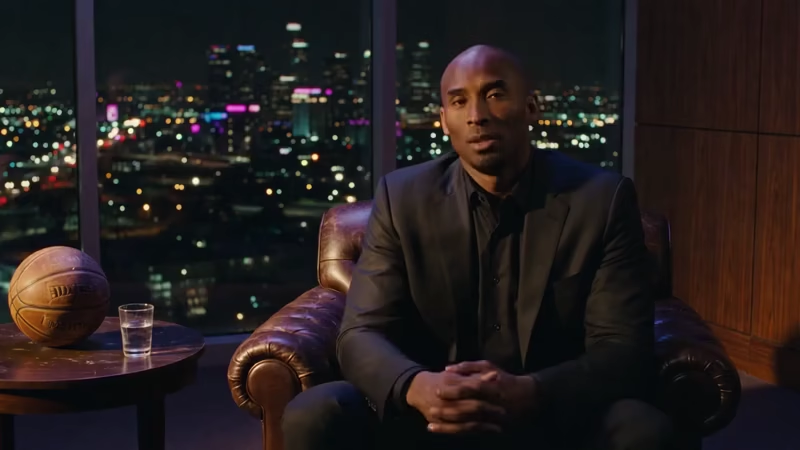
In the demonstration, Musk shared a deepfake video of the late Kobe Bryant appearing to promote Grok-4.5. Grok analyzed both the speech and the visual details before concluding that the video was indeed a deepfake.
This approach does not eliminate the need for human judgment.
As with any AI system, descriptions generated from video can still misinterpret context, overlook subtle cues, or reflect limitations in the underlying model.
Yet it reduces the amount of time spent locating relevant portions of footage and assembling a coherent account of what those portions contain. In settings where many short clips must be reviewed, or where a single longer recording contains scattered pieces of useful information, the ability to ask direct questions shortens the path from raw material to usable understanding.
The same capability sits alongside existing tools for generating images and short video sequences, for analyzing still photographs, and for handling documents.
Together they form a continuous set of operations on different media types within one conversational space.
As the volume of recorded motion continues to grow, the practical value of being able to interrogate that motion without first converting it into text or still frames becomes clearer. The underlying method remains straightforward: attach the file, pose the question, and receive an answer grounded in the visual and temporal content of the recording itself.
Google's Gemini offers similar video-understanding capabilities, particularly for videos uploaded to YouTube, where it can analyze content directly through integration with Google's own platform.

















































































































































































































































































