Since young we have all been fascinated with stories. As adults, we sometimes hunger for even more stories.
This is when researchers from UC Santa Barbara, developed an AI to determine if a neural network could be used to deduce novel, abstract stories from images. The team developed a neural network capable of telling stories out of images, in a way that imitates human storytelling.
What makes it interesting is that it can identify and describe objects, making preferences about what's happening inside a picture.
And what makes it even more interesting is that the AI can be eerily good at its job.
"Different from captions, stories have more expressive language styles and contain many imaginary concepts that do not appear in the images," said the team on their whitepaper.
The neural network is called Adversarial REward Learning (AREL) framework.
What makes this AI different if compared to other similar AIs is that it doesn't rely on automatic evaluation systems. What this means, the AI wasn't designed to clone humans. However, it imitates them.
The team conducted a Turing Test on humans of Amazon’s Mechanical Turk. This was to simply ask the workers to determine whether a story was created by a human or a computer. According to the researchers, AREL passed the Turing Test three our of five times.
What this means, AREL can create stories so convincing to fool humans.
The second test was the researchers in asking the Turk workers to choose between AREL, a human story, and one created by previous state of the art AI. The result was about half of the human workers chose AREL.
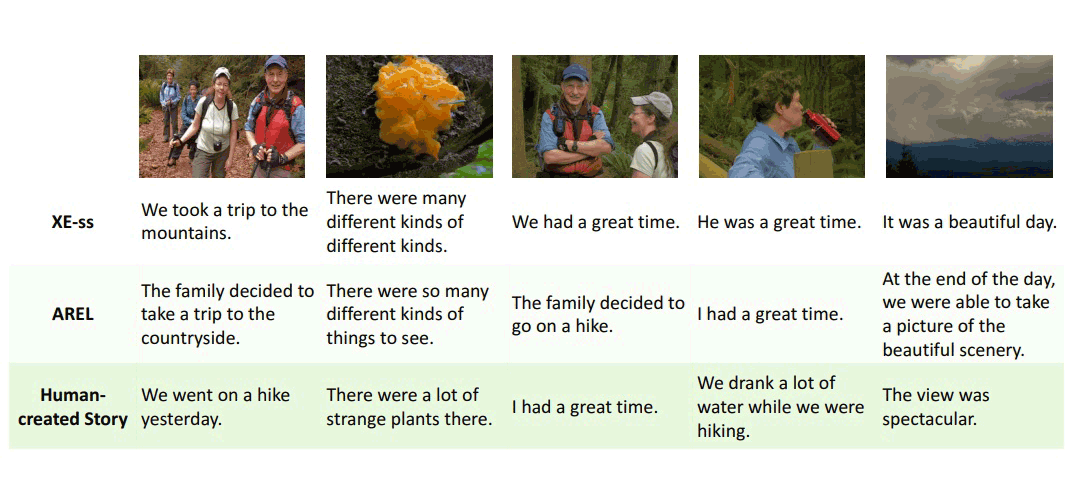
The goal of this research was to know the implications of storytelling AIs. The results show how neural network can be designed to better align with humans, and this should pave another straight path into the advancements of language processors.
With AI having the ability of storytelling, scientists can make AIs to better explain its thoughts, explaining its decision-thinking and reasoning.
While AREL is far from perfect and is far from ready for its show time, the research clearly lays the groundwork for future endeavors to create a better neural network.
According to the researchers:




















































































































































































































































































