Anyone who has spent time building software knows the rhythm well enough. They can finish a change, open a pull request, and then the real wait begins. Comments come back. A test fails. Someone has to find time to approve it.
By the time the code finally merges, they have already moved on to the next piece of work and half forgotten the details of the first one.
To many people, this can be frustrating.
Things can get worse when developers let coding agents write large parts of their code.
Anthropic noticed the same thing on its own Claude Code team, where Claude now writes most of the code. No matter how fast and efficient the AI tool has become, reviews and approvals were still moving at human speed.
And here, the team engineered something to close the distance.
The company calls it 'Claude Ship.'
Initially introduced in beta, it is literally a set of agents that can review pull requests, work on fixes, and, when a team’s rules allow it, approve the change.
The idea is simple.
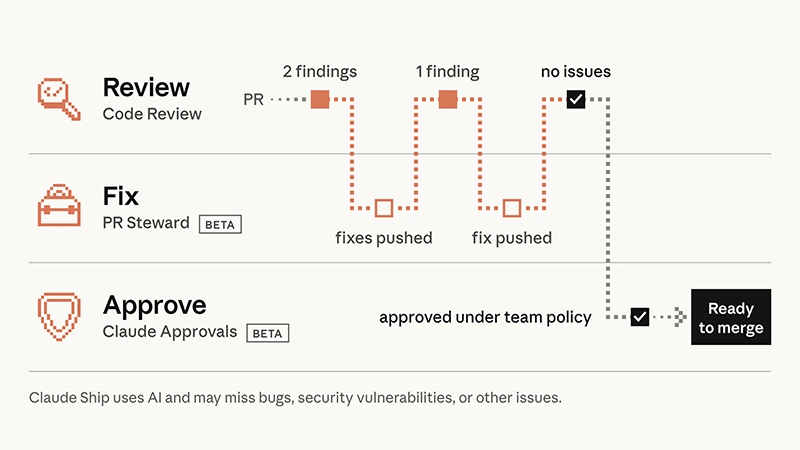
Once the pull request exists, the rest of the process should keep up with the speed of writing. Claude Ship does this with three pieces working together.
Code Review, which was already generally available, looks at the change from several angles, checks its own findings, and posts clear comments ranked by importance. PR Steward, still in beta, steps in on failing continuous integration checks, merge conflicts, and review feedback. After every push it explains what it changed and how to undo it. Developers can still steer it with a comment or tell it to stop. Claude Approvals then applies a policy the team writes as a file in the repository. It can green-light routine changes on its own or require a person for anything more sensitive.
Anthropic compares the policy to a smarter version of GitHub's CODEOWNERS file, and teams can include signals such as review findings or their own plain-language classifiers.
For individual developers the entry point is a new command in Claude Code.
After updating, they can run /ship on a ready change.
Claude opens the pull request, reviews it, and works through feedback and failing checks.
Whether anything actually merges still depends on users' permissions and the repository's branch rules.
On Team and Enterprise plans, an admin can turn the agents on for an entire repository so they run automatically on the team’s pull requests.
Users can choose the review depth (quick, standard, or deep), set when reviews run, and add monthly spend limits.
Claude Approvals starts once a policy file sits on the default branch, and most teams are advised to begin in observe-only mode so they can see what the policy would decide before it actually blocks or allows merges.
Anthropic has been running this on many of its own pull requests.
From June to September the Claude Code team more than doubled the number of merged pull requests while the share of changes that later had to be reverted fell by more than 40%.
In one recent case a product manager saw confusing documentation, asked Claude to check whether a fix was already underway, and moved on.
The pull request opened, Code Review found nothing blocking, a human signed off on the docs, Claude Approvals passed, and the change merged the same evening.
Early customers describe a similar shift.
One engineering director said Code Review has caught real issues before a human even looked at the pull request, and PR Steward helped contributors fix them. Reviewers still stay in the loop, but their time now goes to the changes that actually need human judgment.
Another leader noted that teams in their pilot spend less time working through feedback and more time building, and that the agents can be tailored to existing processes.
Usage is billed on tokens, so turning the agents on can raise costs depending on how many pull requests users cover, how deep the reviews go, and how much fix-up work PR Steward performs.
Admins can set spend caps.
Claude Approvals itself has no base charge, though any classifiers or triggered reviews are billed. Eligible Enterprise organizations can claim at least $10,000 in credits to use within 30 days, provided they claim by January 15, 2027.
The agents are not available to organizations that use zero data retention, the HIPAA configuration, or customer-managed encryption keys. Branch protection rules and required checks continue to apply exactly as before, so a team can still insist that certain changes need a person.
Claude Ship is available now in beta on Claude Team and Enterprise plans for GitHub repositories.
Code Review is generally available; the other two agents remain in beta.
Developers can try the /ship command in the CLI and desktop app today, while admins can enable the agents repository by repository and start with observe mode if they want to build confidence first.
The goal Anthropic states is straightforward: help teams ship code as fast as they can write it, while still deciding for themselves which changes need a human.