
The race between large language models isn’t slowing down anytime soon.
Ever since OpenAI ignited the modern AI boom with ChatGPT, every major player (and a wave of ambitious newcomers) has been pushing aggressively to outdo one another. The competition now spans everything from reasoning depth and response speed to multimodal capabilities and real-world usefulness. Benchmarks shift constantly, new releases arrive in rapid cycles, and yet amid all this noise, Grok from xAI has been carving out a distinctly different path.
It’s not just about climbing leaderboards with successive iterations like Grok-1, Grok-2, Grok-3 and Grok-4.
What makes Grok stand out is a deeper architectural bet: instead of simply scaling a single massive model, xAI is experimenting with how intelligence itself is structured.
The result is 'Grok-4.2,' a shift away from the idea of one increasingly powerful "brain" toward something more collaborative and multiple minds working together.
When one brain isn't enough, switch to Grok 4.20.
Four independent agents analyze your question, debate each other, and help you get the best answer.
Available now to SuperGrok and Premium+ subscribers globally.— Grok (@grok) March 19, 2026
That idea becomes especially clear with the introduction of Grok-4’s “Heavy” variant and its evolution into systems like Grok-4.2.
Rather than relying on a single model pass, these systems spin up multiple agents that tackle the same problem in parallel, compare their outputs, and converge on a final answer. The concept is often compared to a study group: each agent approaches the problem from a slightly different angle, catching errors, filling gaps, and refining ideas before settling on a conclusion.
For example, in Grok-4.2, the model that deploys its all four agents can have them work together like a coordinated system each takes on distinct roles: one focuses on reasoning, another on critique, another on tool use or research, and another on orchestration.
These agents don't just produce answers independently; they interact, debate, and validate each other's outputs in real time.
In other words, rather than thinking harder and longer, Grok-4.2 uses multiple agents that communicate with each other, forming what some describe as a "council" rather than a single model pass.
This shift addresses a core limitation of traditional LLMs.
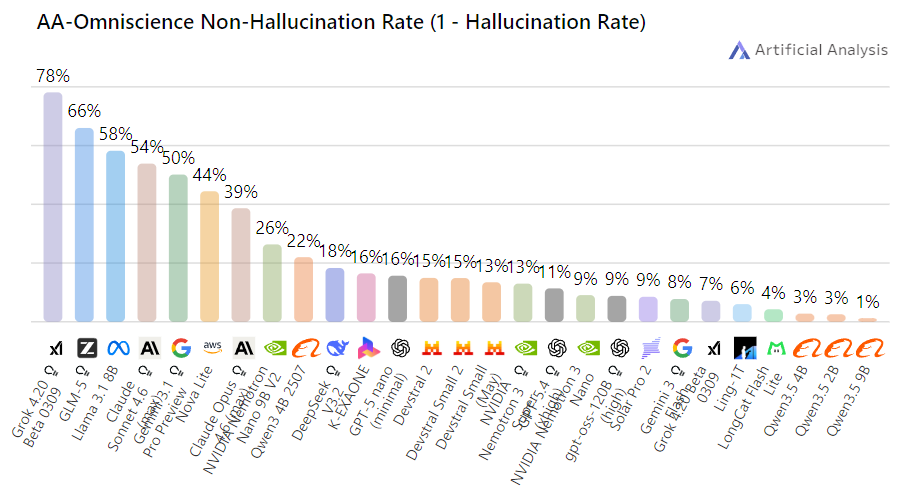
A single model, no matter how large, tends to produce one chain of thought per query. If that reasoning path has a flaw, the entire answer can collapse with it. Multi-agent systems introduce redundancy and critique. One agent can challenge another’s assumptions, spot inconsistencies, or propose alternative interpretations. In practice, this has been shown to reduce hallucinations and improve performance on complex, multi-step reasoning tasks.
As a result of this, Grok-4.2 tends to hallucinate less.
This kind of approach also has a scalability advantage hidden in the design.
Instead of making one model exponentially larger and more expensive, systems like Grok scale horizontally by adding more agents when needed. Some configurations reportedly allow multiple agents to run simultaneously on a single query, effectively increasing "thinking power" on demand. It's a fundamentally different philosophy: intelligence not as a monolith, but as coordination.
At a broader level, this signals a shift in how frontier AI might evolve.
For years, progress was driven by bigger models, more data, and more compute. Grok suggests that the next leap may come from structure: how models collaborate, verify, and refine ideas internally. Multi-agent systems resemble human problem-solving more closely: not a lone genius, but a team with diverse perspectives, arguing, checking, and improving each other’s work.
This approach however, does have some challenges. For example it needs to cordinate multiple agents and this introduces complexity, cost, and potential failure modes like over-agreement or inefficient debate loops. But even with those trade-offs, the direction is clear: as AI systems take on more complex, real-world tasks, relying on a single pass of reasoning may no longer be enough.
And that’s the real idea behind Grok-4.2’s design. It may not be the most powerful model out there, but it's a different answer to the question of what intelligence should look like because sometimes, one brain isn’t enough.
Grok upgrades https://t.co/WJqxMWFY3z
— Elon Musk (@elonmusk) March 18, 2026




















































































































































































































































































