There is a quiet new habit forming around machines.
People use them for things they would rather not announce, then they sit with the feeling that the work, the message, or the comfort arrived from somewhere other than themselves.
An artist in San Francisco has spent a year collecting those admissions on paper, anonymous notes about homework finished by a model, breakup texts drafted by a chatbot, companionship that never leaves a private window.
The project is not about graphics cards.
It is about how quickly a tool becomes intimate, and how quickly intimacy turns into secrecy.
And games have always been a little like that. People sit alone with a world that pretends to be solid. For years the solidity was a trick of polygons, textures, and lighting equations written by people who had to choose what the hardware could afford.
Skin looked like painted plastic because subsurface scattering is expensive. Crowds looked like wallpaper because per-person contact shadows do not fit a frame budget. A pitch at night was a texture with a spotlight, not a field of wet grass catching floodlights. That compromise used to be the contract. You accepted the look of the era the game was born in.
With NBA 2K27 as the first official game title that supports DLSS 5, Nvidia attempts to reopen that contract after the frame is already drawn.
Older DLSS versions were reconstruction tools.
They tried to recover a sharper image or invent the frames between frames. DLSS 5 is different.
The engine still decides the geometry, the camera, the silhouettes, the identities of the people on screen. Then a compact AI-powered generative model, a one-step diffusion transformer working in pixel space, treats that finished picture as a sketch of light.
It is conditioned on the current frame, the engine's motion vectors, a little temporal memory, and sliders that artists can use to push structure or tone.
Structure is the stuff that makes surfaces feel occupied by light: ambient occlusion, contact shadows, reflections, the way brightness sinks into skin or cloth.
Tone is broader color and lighting mood.
The model is trained to add appearance, not to invent new objects or rewrite faces into strangers, at least when it behaves. Nvidia calls the method 3D-guided neural rendering because the 3D scene remains the authority and the network is only allowed to finish the look.
That last part is the argument and the anxiety at once.
Critics called the first demos slop because a filter that has learned “how the world should look” will happily impose a photoreal prior on a stylized game. Nvidia’s reply is that developers get models and masks, and that players officially get an on or off switch.
Official support arrived first for RTX 50 cards. RTX 40 support is promised after the new chips are tuned. Older cards were left outside the velvet rope. Then a library leaked out of an early NBA 2K27 build, and the usual people did the usual thing. They made it run where it was not invited.
The practical object of that mischief is a small app called DLSS 5 Swapper, developed by Rakan Alkhaldi (rakanki911).
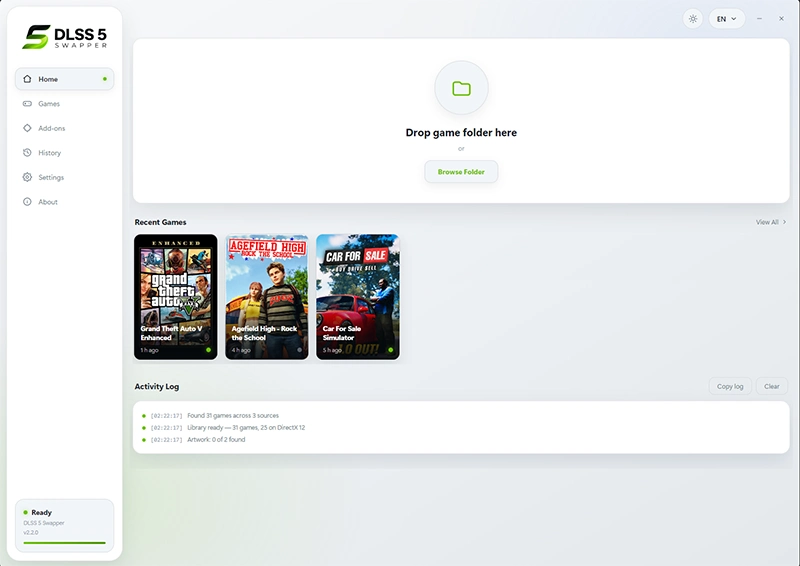
Open-sourced on GitHub, users can just simply point it at a game.
If the title already speaks DLSS, the swap is mostly files. If it does not, a community shim named DLSS5-Feeder pretends the game asked for neural rendering, and ReShade supplies the depth and motion the model expects.
The combination has been walked through DirectX 9 all the way to 12, and even through emulators.
That is how a management sim and a decade-old football game end up in the same conversation as a 2026 flagship.
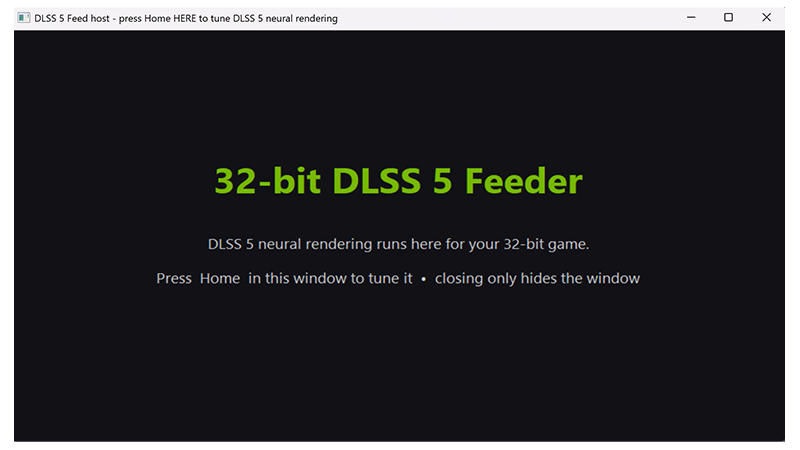
It is unofficial, it can cause extremely slow frame rate, it can smear in motion, and it can force hardware beyond its original intention. Users should treat random binaries with the suspicion they deserve.
However, it is something studios spent years and millions trying to do.
DLSS 5 simply makes old pictures look newly lit.
That is the remake feeling, and it is not magic so much as a mismatch of eras. A remake is usually a second attempt at the same fiction with better materials, better faces, better night.
Neural rendering short-circuits the second attempt.
The original mesh and animation stay. The model has seen enough real skin, fabric, turf, and stadium light that it can guess the missing bounce.
Opening the feature means that almost any game can be enhanced with this technology. And since the library is already finished, those who are pleased with seeing old games (or games that aren't officially supported) with DLSS 5, may never look back to see that relic DirectX.
A post-process that understands materials well enough to fake expensive light is the closest thing people have to a universal remaster button, and that is exactly why it is both thrilling and slightly sad.
The thrill is obvious.
A game you loved for its systems can briefly look like the version you imagined while waiting for a patch that never came. The sadness is that the look no longer belongs cleanly to the people who made the game.
It belongs to a model trained on the visual world, sliders someone else tuned, and a hobbyist tool running in the background.
So the confession booth and the swapper are not as far apart as they first appear. Both are about using a machine to finish something you did not want to finish the hard way, then deciding whether to say so.
For those who love classic games, they would probably better watch the faces and the frame rate with equal honesty. Some nights the pitch will look wet under the lights and you will leave it on. Some nights the people will look like they wandered in from another production, and they will remember that a remake is not only prettier pixels.
It is a choice about what the original was trying to be.
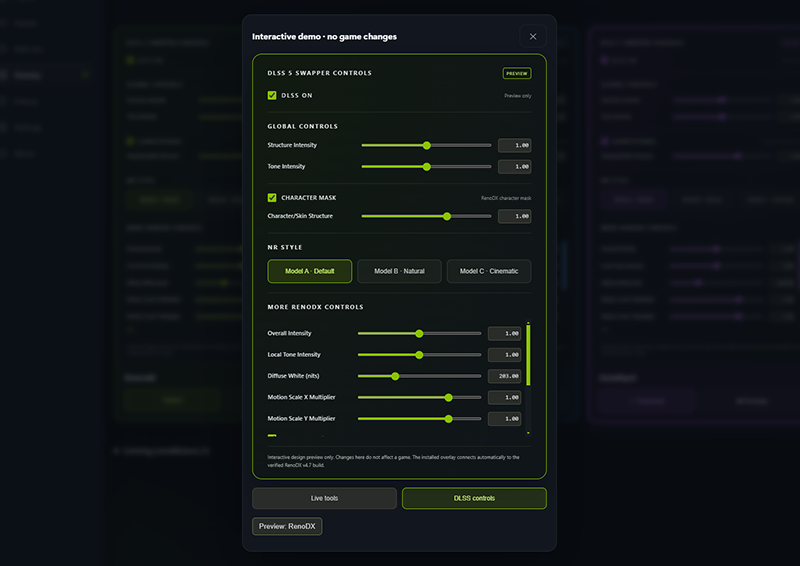
It's worth noting that the attempt to enhance older software's graphics with newer technologies is much older than DLSS 5 itself.
For years PC players have taken Nvidia's newest file and put it where a game never invited it. The app that already owned the name, for example, Brad Moore's DLSS Swapper swaps Super Resolution, Frame Generation, or Ray Reconstruction files in games that already speak those languages. Nvidia's own app can override models on a whitelist. Profile Inspector can do the same at the driver, which is why some people prefer it in multiplayer. DLSSTweaks can force DLAA and custom scales.
While those tools made Cyberpunk or The Witcher 3 look like they had received a silent patch, they still needed the game to ask for DLSS first.
Then came tools like OptiScaler, which reroutes games that already had DLSS, FSR, or XeSS, to a path to another upscaler, even across vendors. Nukem's dlssg-to-fsr3 is able to turn an Nvidia frame generation slot into FSR 3. Feeder, RenoDX, and a patched neural runtime then taught the leaked DLSS 5 pass to run in games Nvidia never shipped.
Rakan’s Swapper did not invent that work. It bundled it and made the last step look like one button.
That is why the remaster feeling arrived so fast. The pipeline for unofficial light was already built. Opening DLSS 5 only gave it a more intimate job than sharpening pixels. It asked a model to finish the look of games whose artists had already gone home.






















































































































































































































































































