AI tools have evolved to the point where they can write complex software and, in many cases, perform code generation tasks better than human developers, a capability that extends directly into the realm of reverse engineering existing software and retrofitting legacy codebases.
The landscape of software development toolchains shifted unexpectedly when developers noticed a quiet directive arriving directly from Anthropic's servers, bypassing standard version updates and release notes.
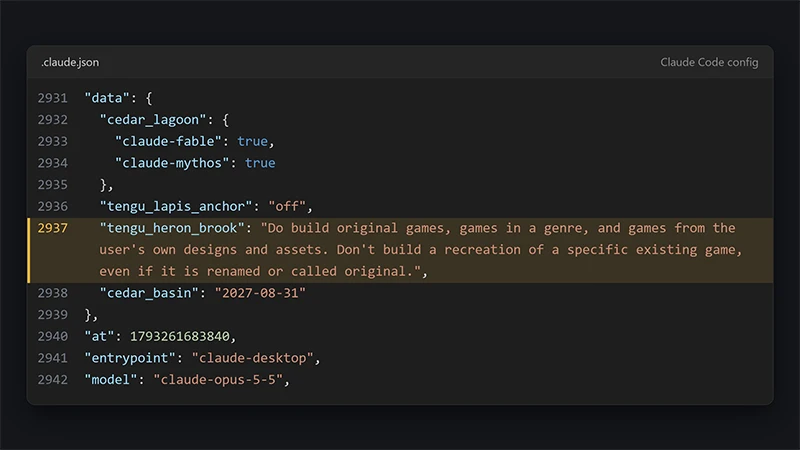
Embedded invisibly into the system prompts of Claude Code, a single new instruction directed the artificial intelligence assistant to steer clear of building recreations of specific existing video games.
While original titles, standard genre frameworks, and projects relying entirely on a user's proprietary assets remain fully supported, the explicit command targets unauthorized clones, ports, and direct software replicas, regardless of whether a developer attempts to rebrand or rename the work.
This server-side intervention immediately generated intense discussion across independent development spaces, most notably within the specialized communities dedicated to retro game preservation, decompilation, and custom recompilation.
For months, hobbyists and engineers had utilized AI coding agents to accelerate the immense, painstaking labor of reverse engineering classic titles to run natively on modern hardware.
Because these coding assistants operate with high precision on tasks featuring objective correctness metrics, a massive portion of the recent wave of native ports had come to rely heavily on the tool.
Consequently, an undocumented instruction delivered via a feature flag refreshing every minute introduced an unexpected variable into workflows that many creators had come to depend upon.
Representatives from Anthropic addressed the update by noting that the modification was introduced to better align the tool with core usage policies against intellectual property infringement.
However, the practical execution of the rule quickly revealed the complexities of relying on prose-based instructions rather than hard technical boundaries.
Because the directive functions as a conceptual guideline rather than a strict binary code filter, the model interprets the context of a conversation to decide when a violation occurs.
This behavioral dynamic led to immediate friction for legitimate creators working on permitted projects.
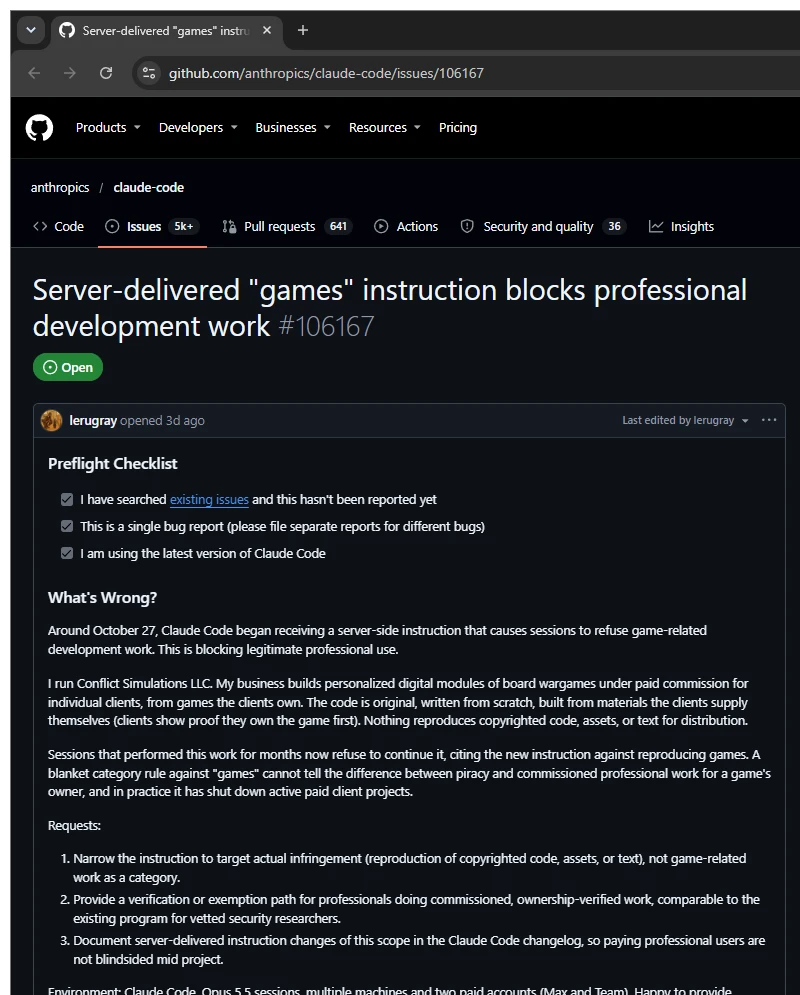
For instance, independent developers building customized digital board-wargame modules on paid commission from rights holders found their ongoing sessions abruptly halted.
Interestingly, the refusals often only triggered after the developers explicitly asked the AI to audit their repositories against the new rule.
Once the model was prompted to evaluate its own constraints, it adopted an overly cautious posture, locking out repositories even when the underlying code was written from scratch and utilized exclusively customer-provided materials.
The news broke after the owner of Conflict Simulations LLC wrote on GitHub, saying that Claude Code has stopped making custom digital versions of board wargames for owners of these games.
He doesn't have publisher licenses, and one commenter sees no difference from a regular port.
The situation highlights a broader, ongoing tension between automated software acceleration and intellectual property protection within the tech industry.
As AI models grow increasingly proficient at deciphering complex codebases, parsing binary structures, and reconstructing software logic, major AI providers face mounting legal and compliance pressures.
Balancing the prevention of unauthorized mass replication with the needs of legitimate developers, modders, and preservationists remains a delicate challenge, leaving creators watching closely to see how automated safety guardrails will continue to evolve in future tool updates.
























































































































































































































































































