 When users first buy a new Android smartphone, Google's products, Facebook, Instagram and others are some of the common apps in users' to-do list. Microsoft wants a to be there joining the crowd with free Office apps, including Skype.
In other words, the Redmond-based company wants its products in every Android phones, and that is done by partnering with manufacturers to bundle its apps.
On the meantime, there are already a bunch of Android apps which allow Office files to be opened and edited. But as Microsoft is saying, there weren't nearly as good as the original ones. Microsoft's Office apps have been free for a while, but Microsoft just wants to make it better for users, its partners, including itself.
Microsoft said that by having its apps pre-installed on Android tablets and phones, its manufacturer partners can increase the value of those devices, and realize new revenue streams in the process.
For Microsoft that has been thriving in software sales, the move isn't at all surprising. Especially in after the fact that it has been struggling to get Windows 10 and Windows-related phones to sell. The move by Microsoft is is latest attempt to win by gathering all parties involved.
In fact, some may consider this as the only realistic solution of closing the app gap and bringing Windows Phone forward.
While the company is also preloading its new generations of Windows 10 smartphones with Office. Microsoft is also focusing on its competitors' because it realizes that encouraging software support there could also be a moneymaker.
In terms of market share, Android is one of the most popular mobile operating system in the world, comparable to Apple's iOS. So besides making things good on Windows-related phones, the attempt to bundle its apps on competitors' should be a promising one.
A quick search for apps by Microsoft Corporation on Google's Play Store, will show the following picture (a screenshot of what Microsoft has to offer as of February 2016).
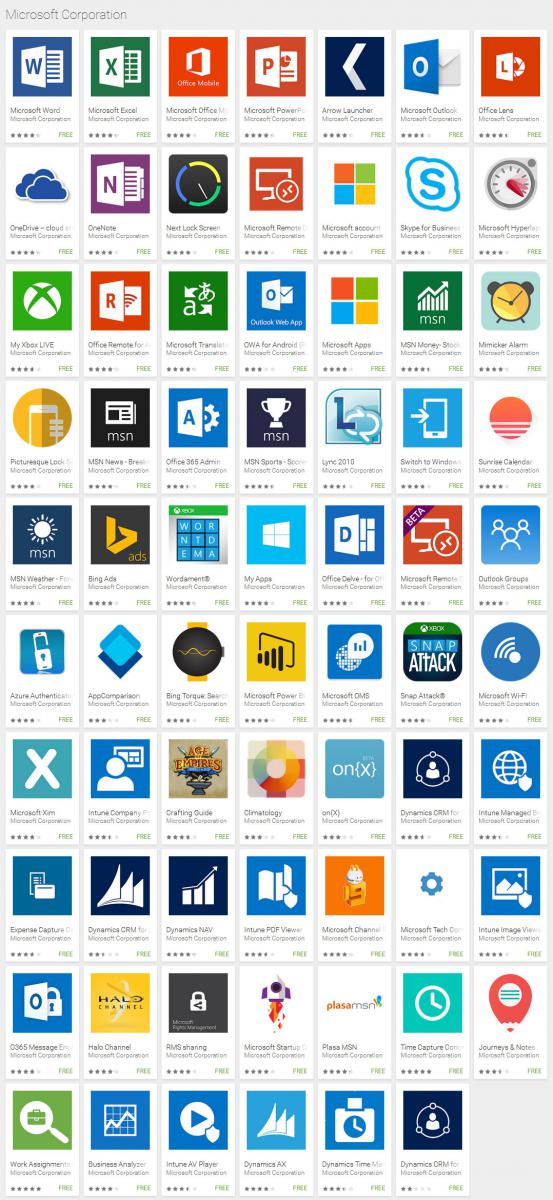
Here and There, All Microsoft
In 2016, Microsoft has partnered with over 70 manufacturers as they all agree to bundle Microsoft's apps with their phones for free. The number has doubled since 2015 when the company made similar deals with 31 individual companies.
As a part of its aggressive move to put more Windows 10 in people's devices, the strategy by Microsoft is also an ongoing effort to make its software more compatible to competing platforms. Microsoft's Cortana is one example. In 2015, Microsoft has made the digital assistant available on both Android and iOS.
Microsoft's Office apps for iOS and Android that have been around for quite a while, have been downloaded more than 100 million times.
While the apps are available for free, the more they are exposed, the more users will use them. Microsoft hopes that among those users, there will be some that eventually pay for its full Office 365 suite.
Here Microsoft's ambitions are made clear. With the many agreements with hardware makers, Microsoft is demonstrating how it can leverage the scale of its hardware ecosystem in overall.
"This is a cornerstone of our broad services strategy, to bring an array of Microsoft services to every person on every device," said Nick Parker, Corporate Vice President for OEM (original equipment manufacturer) division, in a statement.
In short: if you can't beat them, join them.
Further reading: No More Avoiding. Microsoft's Aggressive Strategy Wants Windows 10 Everywhere






















































































































































































































































































