The next evolution of large language models (LLMs) may not be about size or raw power—but about localization.
Ever since OpenAI introduced ChatGPT, the race where tech companies compete to create increasingly powerful AI continues. And as a result, they collectively reshape industries.
But as adoption widens, these AIs need to be finely tuned to better meet the demands of specific regions and languages.
Stepping into this space, Paris-based AI startup Mistral has unveiled 'Mistral Saba,' a custom-trained model designed specifically for Middle East- and South Asia-based interactions.
What this means, unlike its general-purpose counterparts, Mistral Saba has been optimized to excel in Arabic and many Indian-origin languages, and is particularly strong in South Indian-origin languages such as Tamil.
This in turn should make Mistral set a new benchmark for language fluency and cultural nuance.

In an announcement, Mistral AI said that:
"In such scenarios, custom-trained models tailored to regional languages can grasp the unique intricacies and insights for delivering precision and authenticity. To that end, we are proud to introduce Mistral Saba, the first of our specialized regional language models."
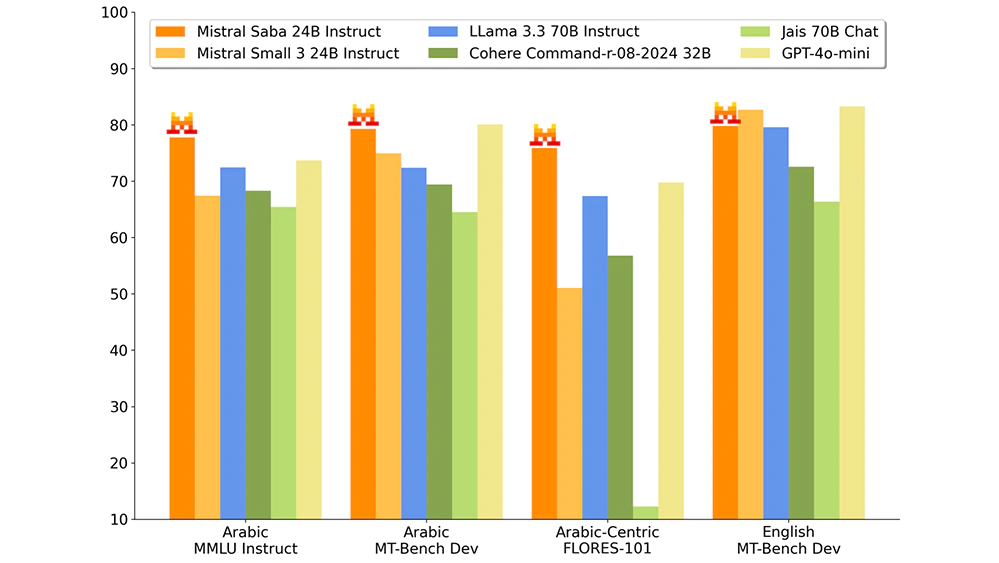
With 24 billion parameters, Mistral Saba is a relatively compact model—comparable in size to Mistral Small 3—but significantly outperforms it in Arabic-language tasks.
While fewer parameters typically mean better efficiency and lower latency, a well-trained model can still deliver exceptional intelligence without unnecessary computational overhead.
This is because Mistral Saba was trained on meticulously curated datasets from across the Middle East and South Asia, allowing the model to be able to provide "more accurate and relevant responses than models that are over 5 times its size, while being significantly faster and lower cost."
The approach also makes it able to be trained to highly specific regional adaptations.
An intriguing side effect of Mistral Saba’s development is its proficiency in Indian-origin languages, particularly Tamil and Malayalam.
This unexpected advantage stems from the historical and cultural ties between the Middle East and South Asia, further broadening the model’s utility beyond its primary target audience.

Use cases include creating virtual assistants that engage users in natural, real-time conversations in Arabic, enhancing user interactions across various platforms.
For example, Mistral Saba can be fine-tuned to become a specialized expert in various fields such as energy, financial markets, and healthcare, offering deep insights and accurate responses all within the context of Arabic language and culture.
But understanding local idioms and cultural references, the AI can also help businesses and organizations create authentic and engaging content that resonates with Middle Eastern audiences.
The launch of Mistral Saba marks a strategic shift for the French AI powerhouse, signaling a stronger commitment to the Middle East. By tailoring its technology to the region’s linguistic and cultural needs, Mistral aims to expand its footprint and attract a growing customer base.
By pushing the boundaries of regional AI development, Mistral is signaling a shift toward localized intelligence, where models are not just large, but deeply attuned to the cultures and languages they serve.

















































































































































































































































































