
Apps are already conquering the mobile space, and now it's conquering the internet traffic.
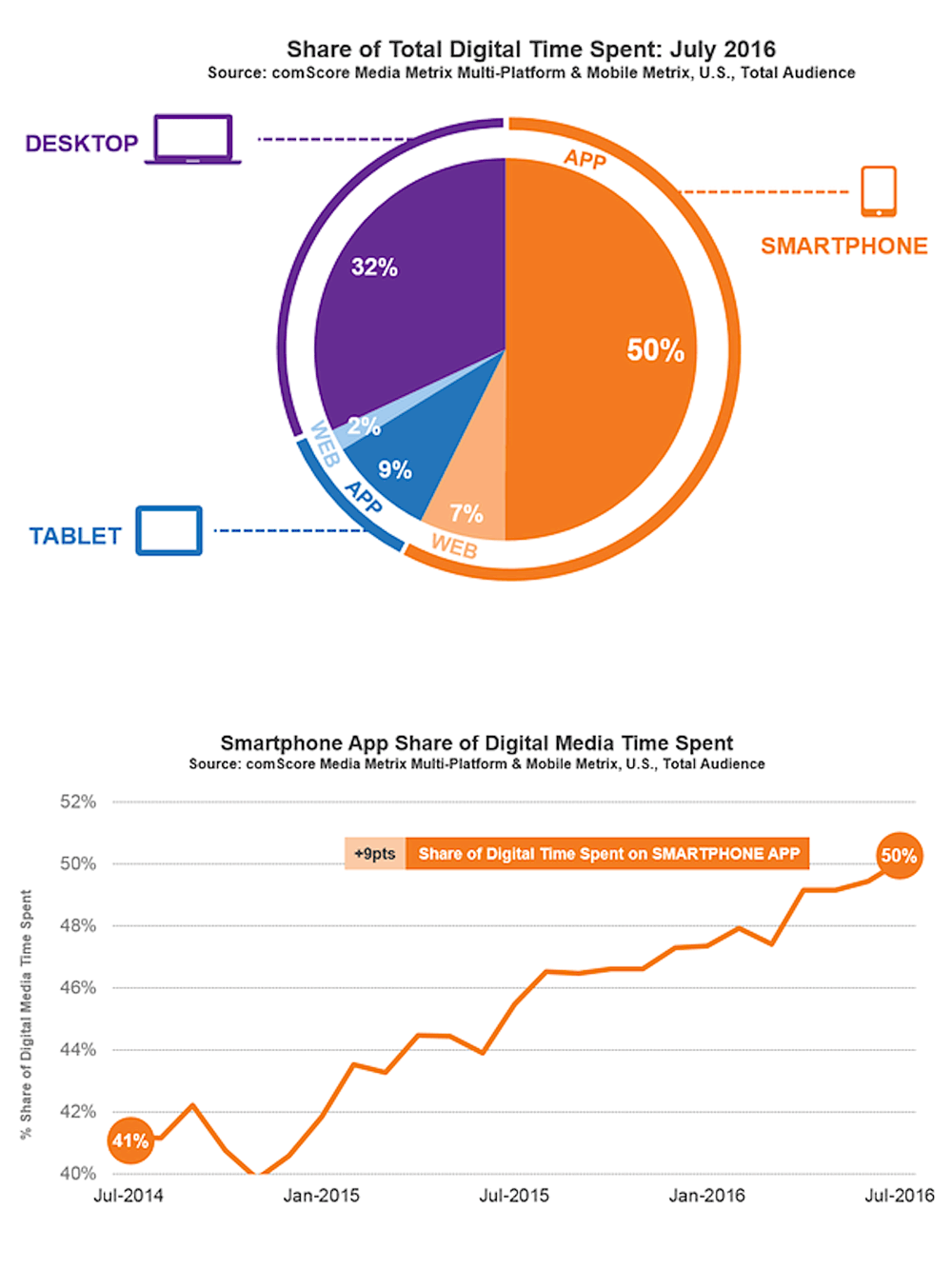
We have been dreaming about the open web where things grow from the inside, wanting to burst its outer core. But as mobile apps come to popularity, there is nothing that can stop them from growing. In July 2016, mobile apps took more than 50 percent of online attention in the U.S., or more than every other internet access combined. The number comes lower on developing countries, but still the number is increasing rapidly.
From web browsing from smartphones, tablets and desktop. According to Comscore, smartphone app usage alone takes up more people's attention than all of that, combined.
The shift isn't a surprise and indeed was predicted. Almost everyone owns at least a smartphone and/or tablet. And within each device, they download and install multiple apps for different purposes.
The reason for this surge is that people are now accessing their mobile devices more than ever before. And most of their times they spend on their devices, are spent inside apps. So whether or not they have a PC sitting around somewhere in their house, a smartphone app is probably the first thing they do when they want to listen to music, get mail or get directions.
While mobile browsers are indeed getting better and a lot faster than before, they're still unable to keep up with the growing mobile trend; they can't match dedicated apps in terms of performance, ease of use and capabilities.
In short, the relatively more powerful laptops and PC computers can't simply match the sheer convenience of mobile apps.
Over the past decade, the popularity of devices with the "smart" prefix highlights the ability of multitasking, dedicated high-resolution camera and 24 hours connection. Thanks to the more reliable internet available, people can connect and access the World Wide Web easier than ever before.
Out of the ways people can access the web, there was a time when web browsers are the main gateway for most people. Here people were limited to several options and limited capabilities. But when apps' popularity grew, about any services both offline and online, were starting to have their own app presence.
Within their own dedicated app, those services can become closer to their customers because of they aren't restricted by browsers. Apps can get deep inside a users' phone in a way more personal than websites can ever be. This has given apps a major advantage if compared to most websites.
However, apps are living inside a walled garden. What this means: apps live only by their own means, inside the platform of choice. Contents that were once freely available and indexable, are siloed and more difficult to search and link to. But those drawbacks didn't stop the trend.
Apps are leading the revolution by giving solution to given problems.

As the popularity of apps continue to rise, more and more businesses around the world from large to small, are increasingly relying on cloud computing and apps to run their operations and solve business problems.
In July 2016, 64 percent of small businesses across the U.S., Canada, Australia, and the UK now run their operations in the cloud. This is an up from 37 percent in 2015. The number comes from those than run businesses on Facebook, LinkedIn, or with WhatsApp, Facebook Messenger and others. Smaller businesses tend to run their business through popular apps, and use them for invoicing, billing and also management.
More than two in five small businesses reported that their biggest challenges were controlling costs and reducing expenses. By using apps, their top factors were: improving cash flow, customer billing and time management.
In short, for them, apps can help with productivity, cash flow and minimizing expenses.
As for large businesses and enterprises in 2016, about 68 percent of them are using mobile and web-based apps in their daily basis, compare to just 50 percent in 2015.
Related:






















































































































































































































































































