Video has a way of freezing decisions that still feel unfinished.
A location that no longer fits the story, a costume that reads wrong under new lighting, a performer who was right for the blocking but not for the final tone. For a long time those mismatches meant another shoot, another schedule, or a compromise that stayed in the cut.
That tension between what was captured and what is needed later is ordinary in production, and it is the quiet problem a new editing style is starting to treat as something you can revise after the fact.
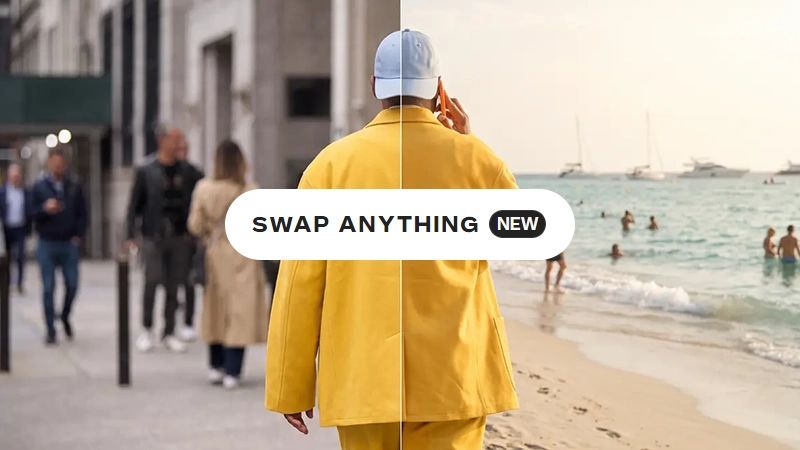
Pika Labs has been showing a tool it calls 'Swap Anything,' an app on its current platform that takes an existing clip and replaces selected pieces of it.
In the examples posted this week, the change can be a person, an outfit, a setting, or a prop.
The company says the software keeps the original timing, motion, and narrative spine, so the edited version still follows the same beats even as the surface of the scene changes.
One demonstration starts with a woman in a long purple dress standing on a basketball court.
The swap turns her into a full-size rabbit mascot and moves the action onto a city street in front of a mural, then intercuts the two versions so the same run, the same turn, and the same shot toward a hoop play out in both worlds.
Another clip works a more crowded contrast.
An office elevator and open-plan floor become a subway platform and train car.
A white horse walking the office aisles is exchanged for a woman in a red tulle gown and a heavy white coat.
Commuters, cubicles, and passing trains stay in rhythm with the original camera path.
The point of the demos is not spectacle for its own sake. It is that the underlying performance and cutting pattern survive the substitution.
The feature sits inside a larger product change that Pika announced several days earlier, when it described a rebuilt creative platform with separate apps for different jobs rather than a single generator.
Swap Anything is one of those focused tools, aimed at people who already have footage and want to alter specific elements instead of generating a whole new clip.
The earlier announcement framed the platform as a response to complaints about quality, model choice, and pricing in generative video. This week's posts treat the swap app as a concrete instance of that approach, not as the main story.
Modern video-to-video gemerators are expected to have the ability to track lighting, scale, and camera movement across frames, and small errors become obvious once motion is involved. What Swap Anything shows is a workflow that treats a finished take as raw material rather than a locked object.
For anyone who has ever wished a scene could keep its energy while changing its clothes, that is a practical shift, even if it remains one piece of a wider set of tools.






















































































































































































































































































