
Apple is late in the game, and while promising a lot, it still lacks the experience other battlehardened competitors have accumulated over years of public testing, user feedback, and infrastructure scaling.
For a long time, the Cupertino giant relied on its legendary knack for perfectionism, choosing to sit back while rivals stumbled through the awkward early phases of generative technology.
But the tech landscape has shifted dramatically, and waiting on the sidelines is no longer a viable strategy when consumers expect machines to think, plan, and execute tasks across apps automatically.
That realization has triggered a scramble to catch up, forcing the company to confront both its own internal friction and the formidable head start held by competitors who have been iterating on autonomous systems for years.
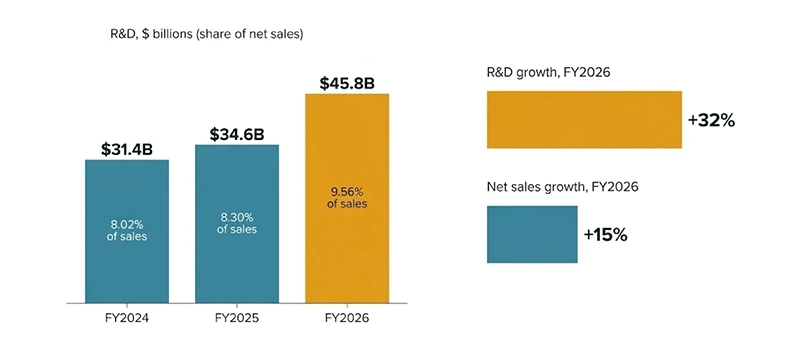
To pursue this goal, Apple's research and development has grown more than twice as fast as sales.

Internal dynamics at multinational technology companies often reveal a great deal about how deeply external market pressures are felt behind closed doors.
When leadership roles pivot, the philosophies governing software timelines and hardware integration are frequently called into question, pushing established engineering teams to reevaluate how fast they can adapt.
Recent reports indicate that executive leadership has been actively pressing software engineering departments to accelerate timelines for artificial intelligence capabilities.
While the company has traditionally prioritized deliberate, highly controlled rollouts over hasty feature deployment, the current digital assistant landscape demands a much higher degree of autonomy.
Rival firms have already introduced proactive agents capable of managing multi-step goals in the background without requiring constant user intervention, leaving traditional request-based models feeling somewhat dated.
This competitive gap has sparked serious discussions about evolving Siri from a standard voice-activated helper into a more autonomous, ChatGPT Dots style agent capable of independent task execution.
Yet bridging that gap requires navigating a fundamental mismatch in corporate planning cycles. Historically, software development operates on relatively short windows, whereas hardware teams rely on rigid multi-year roadmaps.
Aligning these disparate schedules while simultaneously tightening development phases for upcoming software iterations creates a high-pressure environment for engineering teams.
Managing server-side computational costs and token allowances has also become a point of careful internal calibration as features grow more complex and resource-intensive.
Critics and industry observers alike note that moving toward a true agentic model involves more than just a surface-level redesign; it requires a complete rethinking of privacy architecture, API access across third-party applications, and cross-device synchronization.
Even if the final roadmap remains unwritten, the forceful directive from the executive suite has firmly established AI as the definitive anchor for the future of the entire ecosystem.