

There was the time when smartphones that has the fastest processor speed or better camera to win the premium smartphone flagship market. On the contrast, currently consumers are looking for a device that can give them, not just hardware satisfactions, but also experience.
As the battle for flagship smartphones began, consumers are no longer judging their future phones by their specifications. Although 2 GB of RAM and 13 MP of camera can give satisfaction, and consumers can have the highest specification from a device in the market and enjoy all their mobile activities without problem or hassle, now the market is more into seeking the experience they have never felt before.
High performance from a mobile device can be wasteful if it's not used as what it's built for. Smartphone vendors now realize that high specs are not enough to make the consumers impressed. Experience is what they need, and experience is now that gives satisfaction into their daily lives.
The Fight for Innovation
Hardware specs, processor speed, camera and screen resolutions are slowly moving aside. Vendors now are focusing more on how they can create new innovations into their flagship products. Technology has got closer into people's lives more than ever, and now vendors that are turning their heads slightly away from hardware battles, are trying to give the satisfaction by giving technology that can be used in any means inside their consumer's life, and make their life simpler.
New technology implemented into flagship devices are now the innovations that people are looking for. This can give a substantial advantage for vendors to sell their product to get the most share out of the market.
Apple's iOS that has been restricted, and dedicated only to Apple, made no attempts for vendors to integrate. On the other hand, Google's Android has given their vendor partners the ability to "improve" its user interface by giving add-ons on top of the operating system. The ability to add improvements that can be integrated into the device give vendors the opportunity to have their products marketed as innovation. HTC BlinkFeed in HTC One, the water and dust resistant Sony Xperia Z, the "S" controls in Samsung Galaxy S 4, and dual recording in LG Optimus G Pro, are some of the new innovations that are introduced in the early 2013.
Apple iPhone 5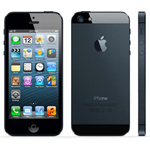
Apple introduced the iPhone 5 in September 12th, 2012. The device is the sixth generation of the iPhone and succeeds the iPhone 4S.
The slimmer, lighter model that introduces a higher-resolution 4" screen to the series with 16:9 widescreen aspect ratio, includes a custom-designed ARMv7 processor called the Apple A6, iOS 6, and support for LTE. the iPhone 5 and its A6 chip, highlights Apple's effort to set a new benchmark in the mobile business.
Commentators and reviewers has praised the product for its high resolution screen surpassing that of the iPhone 4S, which is considered to be one of the best phone screens available on the market. Most negative reviews came from the new connector, which is incompatible with devices and cables that use the superseded 30 pin connector.
The iPhone 5 sold out twenty times faster than the 4 and 4S models. Apple said that they were "blown away by the customer response". Apple's vice-president of worldwide marketing, said that over two million iPhone 5 orders had been received in the first 24 hours. The release and sale of the iPhone 5 has also slowed down the growth of Android, and could boost annualized U.S. GDP growth by $3.2 billion, or $12.8 billion at an annual rate.
Shortly after the announcement of the iPhone 5 and preceding the launch, Apple's stock price rose to a record $705.07. The iPhone sells 27.4 million units worldwide during the fourth quarter of 2012, representing 8 percent of total global smartphone shipments.
Samsung Galaxy S 4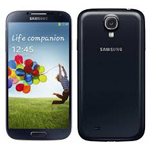
Samsung Galaxy S IV is the flagship smartphone Samsung introduced in March 14th, 2013. As one of the leading innovator in the smartphone market, the Galaxy S series has grabbed most of the Android flagship mobile device market, with the market share that matches Apple's iPhone.
Samsung's Galaxy S series has been praised for more the numerous of times because of its innovations, with each model surpassing its predecessor's shadow. The GS 4 that claims to have over 150 new features added into it, is the most wanted Android smartphone in 2013.
Sells for Galaxy S 4's predecessor, the Galaxy S III, sold 18 million units in the third quarter when the device held the #1 spot in global shipments. The S III was overtaken by Apple by a wide margin in the fourth quarter of 2012.
HTC One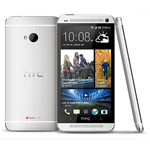
The flagship smartphone introduced by the Taiwanese company is an Android smartphone set to be released by in late March 2013. HTC One, serving as a successor to the One X+, emphasis has been placed by HTC on its hardware and software design, along with its unique camera implementation.
Although HTC has developed several notable Android devices, its smartphone products have struggled financially in recent years due to the growing success and loss of market share to other vendors such as Apple and Samsung.
HTC One was first unveiled at a special press conference on February 19th, 2013. Released through 185 carriers and retailers in 80 countries, it's be the largest global launch in the company's history. Launch carriers include AT&T, Sprint, and T-Mobile in the United States, Everything Everywhere, O2 and Vodafone UK in the United Kingdom, and Bell, Rogers and Telus in Canada.
The HTC One uses an all-aluminum frame with an antenna built into its backing; intended to give the device a premium feel in comparison to smartphones made with a plastic shell. Using HTC's Sense user experience and Android Jelly Bean 4.2.1, the device includes a 1.7 GHz quad-core Snapdragon 600 processor, 2 GB of RAM, a 4.7" 1080p Super LCD 3 display with 468 ppi, and either 32 or 64 GB of internal, non-expandable storage. The HTC One also supports LTE where available.
The HTC One's 4 MP camera includes an "UltraPixel" image sensor, which uses larger pixels internally that allow more light to be captured. The use of larger pixels improves overall image quality, especially in low-light environments. The camera also includes optical image stabilization, and is further enhanced by improvements to the camera app and the ImageSense 2.0 image processor. The HTC One's audio system includes front-facing BoomSound stereo speakers, Beats Audio, and HDR audio recording.
The new version of Sense on the One, version 5, uses a new minimalist visual style with a redesigned home screen. The default home screen is BlinkFeed, a new scrolling news aggregator similar to Flipboard and Windows Phone's live tiles, displays a scrolling grid of news headlines and social network content.
The camera app includes a new feature known as "Zoe", which allows a short video clip to be taken alongside each photo. The resulting photos and videos can also be automatically combined and synchronized with music to produce a multimedia presentation that can be shared with others through the Zoe Share service. The One also includes the new Sense TV app; which includes an electronic program guide and can act as a remote control via an IR blaster in its power button. An updated music app now includes a visualizer and support for on-screen lyrics.[ A new Sync Manager allows content to be migrated from HTC devices with Android 4.x and iOS device backups, and an updated version of the Get Started feature (as introduced by the One X+) allows users to perform initial setup for their One from a PC using a web-based service.
The company's flagship phone in 2012, the One X, received critical acclaim from reviewers, but was overshadowed by the iPhone 4S and Samsung Galaxy S III, and was commercially unsuccessful. In response, HTC chose to take bigger risks with its next flagship device in order to make it stand out better among its competition, which included a major overhaul of its Sense user interface. For 2013, HTC planned to double its marketing budget in comparison to 2012.
LG Optimus G Pro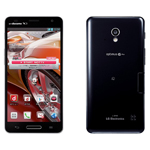
LG Optimus G Pro is LG's flagship that succeeds the original Optimus G smartphone. The South Korean’s handset, which looks very similar to Samsung’s Galaxy Note II, is equipped with a 5.5" full HD 1080p display, a 1.7 GHz quad core Snapdragon 600 processor and a 13-megapixel rear-facing camera. The Optimus G Pro also includes a microSD slot, NFC, LTE connectivity, a 3,140 mAh battery and Android 4.1.2 Jelly Bean.
The Optimus G Pro is launched in South Korea in late February and has already sold more than half a million units in just 40 days.
The G Pro has seen considerably more success than the original Optimus G smartphone, which reached sales of 1 million units in four months on the market in South Korea, Japan, Canada and the U.S..
The device that is available in black and white, integrates its curved glass surface with the touch sensor to generate a thinner display and body.
Sony Xperia Z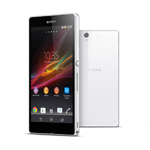
The Sony Xperia Z is designed, developed and marketed by Sony Mobile as a full HD touchscreen enabled Android flagship smartphone. The phone was announced by Sony at CES 2013 and was released in February 2013.
The Xperia Z runs the Android Jelly Bean 4.1.2 OS. The smartphone features its resistance to water and dust, and a 13 MP Exmor RS camera and a full HD (1080p) display that encompassed Sony's Industrial 'Omni-Balance' Design. The design is focused on creating balance and symmetry in all directions with its rounded edges and smooth, reflective surfaces on all sides. The device is created upon a skeleton frame made from glass fibre polyamide that is certified to IP55 and IP57 standards and is dust and water proof, allowing immersion under 1 meter of fresh water for up to 30 minutes.
Its 5" screen is able to display 1920x1080 pixels, 16,777,216. The screen is color TFT Sony Mobile BRAVIA Engine 2 Scratch-resistant, shatter proof sheet on mineral glass capacitive touchscreen. The device is equipped with 2 GB of RAM, 16 GB internal storage, capable to be expanded to 32 GB with external storage.
As with all flagship devices, NFC is a core part of the device, allowing with 'one touch' for smartphone to TV and play music on a NFC wireless speaker. Additionally Xperia Z includes HDR video recording capability, battery stamina mode which Sony claims to increase its standby time up to 4 times.
Sony Xperia Z has successfully combines looks, power and connectivity to supply one of the most impressive Android experiences. With its 5", 1080p phone with new design and technology, the Xperia Z was one of the most compelling flagship smartphone with the highest specs at its release time.
The Xperia Z won the "Best Smartphone" and "Best of Show" awards.
Nokia Lumia 920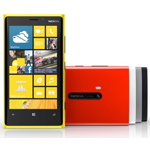
Nokia Lumia 920 is a flagship smartphone developed by Nokia that runs the Windows Phone 8 operating system. First announced on September 5th, 2012, and first released on November 2nd, 2012. the device features 1 GB of RAM, a 1.5 GHz dual-core Qualcomm Krait processor, a Qualcomm Adreno 225 GPU, a 4.5″ IPS TFT LCD display, as well as a curved Gorilla Glass protecting its capacitive touchscreen.
The Lumia 920 has Nokia's PureView technology with optical image stabilization for still images and videos on the rear camera, featuring an optically stabilized 8.7-megapixel BSI image sensor with f/2.0 Carl Zeiss Tessar lens, short pulse high power Dual LED flash and 1080p HD video capture. The front camera is capable of capturing HD video at 720p.
The device comes with 32 GB internal storage without slot for external storage. Its touchscreen also can be used with the gloves worn by the user. The Lumia 920T variant comes with a 1.7 GHz dual core Qualcomm Snapdragon Krait.
The device can be recharged either physically or inductively using the Qi technology. Rather than requiring the use of a traditional physical connection to the device. This feature allows Lumia 920 to be placed upon a charging pad, but unlike a physical connector, using this method hinders the use of the device while charging. The charging pad requires a separate power supply.
As some reviewers criticized the thickness and weight of the phone, It is reported that the Nokia Lumia 920 successor, codenamed the Nokia "Catwalk", will be lighter and thinner and made of aluminum instead of polycarbonate.
BlackBerry Z10/Q10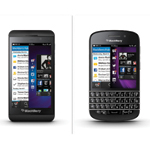
After the long awaited delays, Research in Motion Ltd that changed its name to BlackBerry to represent its identity, unveils two BlackBerry devices at the events in New York, Toronto, London, Paris, Dubai and Johannesburg. The devices that BlackBerry introduced are a full touchscreen device (Z10) and a full-keyboard version (Q10).
The Z10 features a 4,2in (1280x769 pixels) touchscreen, a dual-core 1.5Ghz processor, 2 MB of RAM, 16 GB internal storage with external slot for 32 GB storage. The handset is equipped wit a back-facing 8MP camera and a 2MP camera at the front. The Q10 on the other hand, is equipped with a QWERTY keyboard with 3.1in (720x720 pixels) touchscreen display. Both devices are NFC capable. BlackBerry 10 currently has 70,000 apps, the most applications are available during launch, the company said. Applications can be written in HTML5, and take advantage of technologies like WebGL. The company is targeting 100,000 apps by March 2013.
The interest level surrounding BlackBerry has picked up considerably, especially during the moment until the release of the OS version 10. Investors seem willing to bet on the company - its shares have more than doubled in the past six months. There are many observers that still don't believe the BlackBerry 10 will save the company, at the day of its launch, the company's stock dropped 12 percent ($13.78). Despite the rumors and pessimism, the company is aiming to deliver what BlackBerry was expected to do years ago, and compete in the market, especially among executives and corporate enterprises that once saw the Canadian company as one to rely on.
"Re-designed. Re-engineered. Re-invented." With now just about 4.6 percent of the global market for smartphones in 2012, BlackBerry exchanged dominance for survival mode. The company introduced the BlackBerry 10 as its hope to restore its glory.