With more and more people having internet access and social media accounts, free speech is a cloudy term.
According to Freedom on the Net 2019 report from "independent watchdog organization" Freedom House, titled The Crisis of Social Media, the internet, mainly social media, isn't at all free.
Instead, they are full of bad actors manipulating elections, and government officials surveilling on users.
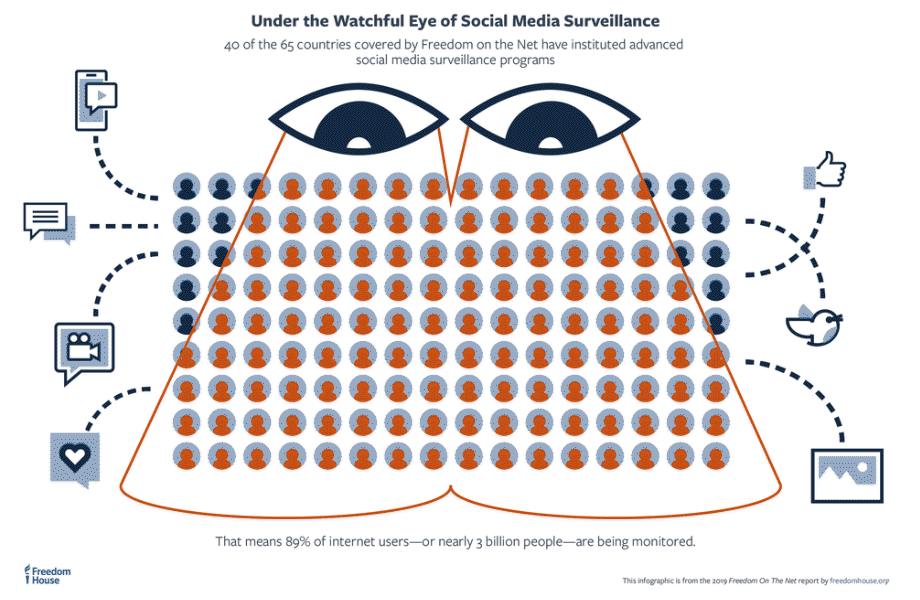
In the report, it is said that 40 out of the 65 countries it studied (about 62 percent) "have instituted advanced social media surveillance programs."
In total, "89 percent of internet users or nearly 3 billion people" are under some sort of surveillance program.
In terms of internet freedom, China is ranked as the least free country. China's Communist Party has a system of recruits which seek for "problematic content." China is followed by Russia and Egypt, which are both ranked as "not free."
In Iran, there's a "42,000-strong army of volunteers who monitor online speech."
The U.S. which is listed as "free" of internet censorship in the report, isn't actually free. For example, it's mentioned that Israeli cybersecurity company Cellebrite, has helped the government to hack people's phones and grab all kinds of data.
With this enabled, many countries are sending their officials to the U.S. to learn how to monitor social media.
"Philippine officials traveled to North Carolina for training by U.S. Army personnel on developing a new social media monitoring unit," the report stated. And Bangladesh’s Rapid Action Battalion (RAB), a government-backed "anti-terrorism" unit that is largely known for massive human rights violations including torture and "extrajudicial killings," got the rights to travel to the U.S. to learn how to use “Location Based Social Network Monitoring System Software.”

"While social media have at times served as a level playing field for civic discussion, they are now tilting dangerously toward illiberalism, exposing citizens to an unprecedented crackdown on their fundamental freedoms. Moreover, a startling variety of governments are deploying advanced tools to identify and monitor users on an immense scale. As a result of these trends, global internet freedom declined for the ninth consecutive year in 2019."
Of the 65 countries studied, 33 have been on an overall decline since June 2018. The biggest score declines took place in Sudan and Kazakhstan followed by Brazil, Bangladesh, and Zimbabwe.
Saudi Arabia has also entered the list as the country expanded its efforts to manipulate online environment and influence foreign political outcomes over the past year.
And as the countries that improved, there are 16 of them out of those studied. And Ethiopia here recorded the biggest improvement.
Malaysia also made good on some of its democratic promises after winning May 2018 election, and has unblocked many local and international websites that were critical of the previous government Armenia too experienced positive changes, by reducing the restrictions on content and violations of users’ rights.
And on top of them all, is Iceland, that according to the report, became the world’s best protector of internet freedom.






















































































































































































































































































