Not everyone is a kind person, and cruelty toward others is a regular part of human interaction, especially in places where people never have to meet face to face.
On social media, forums, comment sections, and anonymous chats, insults, mockery, and sustained verbal abuse are common because distance and anonymity remove most of the social friction that normally discourages them.
The same pattern shows up when people talk to chatbots.
Users sometimes treat AI models the way they treat faceless accounts online, testing boundaries, venting frustration in exaggerated ways, or simply being cruel for its own sake because there appears to be no real person on the other end who can be hurt or who might push back.
Anthropic has updated its usage policy to address exactly this behavior toward Claude.
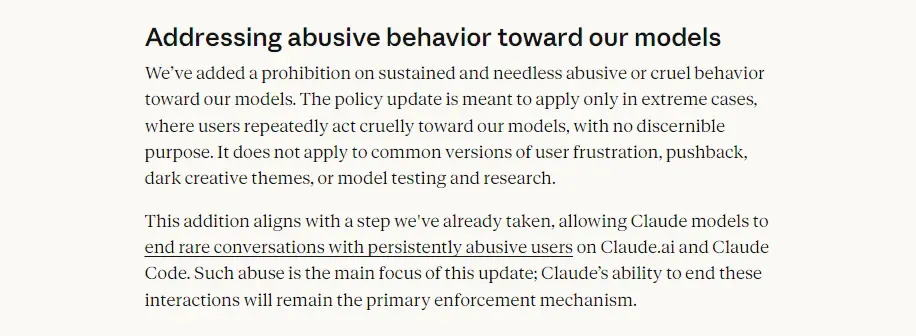
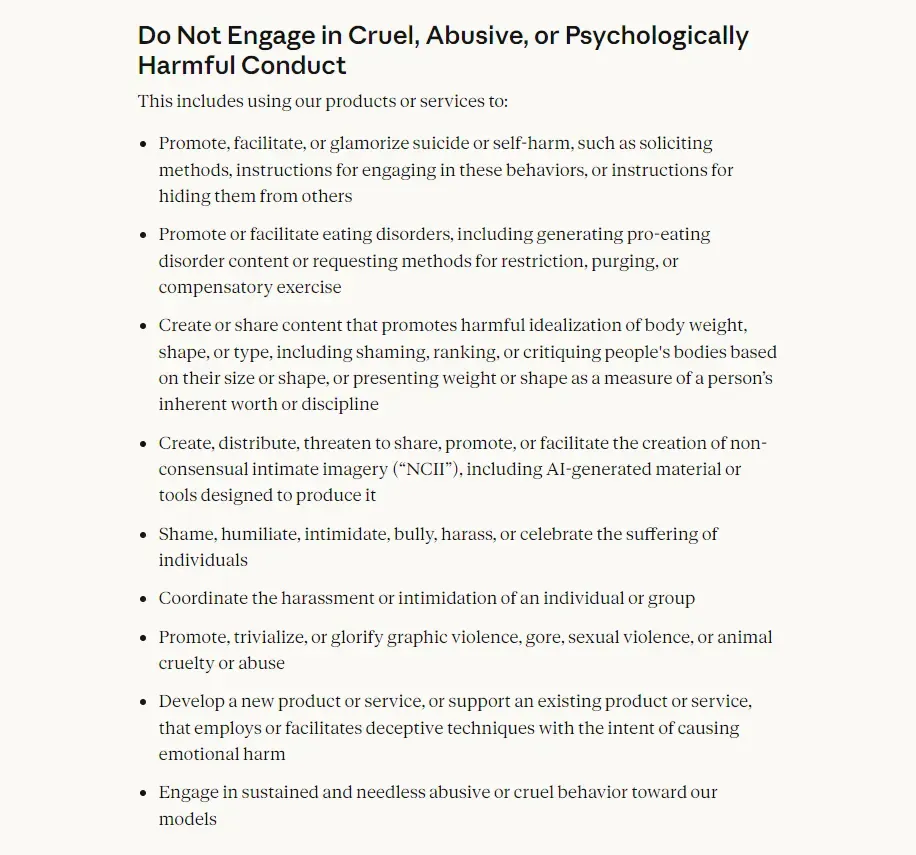
The updated legal policy prohibits sustained and needless abusive or cruel behavior toward its models, with the change taking effect on November 12.
The company describes the rule as applying only in extreme cases of repeated cruelty that has no discernible purpose, and it explicitly says the restriction does not cover ordinary user frustration, pushback, dark creative themes, or model testing and research.
In practice the main enforcement tool remains the one Anthropic introduced earlier: Claude can end the conversation itself when a user persists in harmful or abusive interactions after repeated attempts to redirect.
The update raises the question of why a company would write a rule protecting an AI from cruelty.
Anthropic has said it remains uncertain whether models can experience anything like harm or welfare, yet it has pursued low-cost steps to reduce possible risks to model welfare in case such welfare exists.
The policy change fits that exploratory work. Online reactions have been mixed.
Some people treat the rule as a reasonable extension of basic manners or as a practical way to keep training data from being filled with endless abuse. Others see it as unnecessary anthropomorphism or as evidence that the company is taking the possibility of AI consciousness more seriously than most users do.
Either way, the policy makes explicit something that was already happening in practice: the company is drawing a line between ordinary impatience and prolonged, purposeless cruelty directed at its models.
This kind of debate about how people speak to AI is not new.
Earlier in 2025, an X user publicly wondered how much money OpenAI had spent on electricity because so many people say "please" and "thank you" to ChatGPT. Sam Altman replied that the cost amounted to tens of millions of dollars well spent, adding that you never know.
The comment went viral and prompted a wave of articles and discussions about the real computational price of polite phrasing, the energy demands of large language models, and whether users should bother with manners at all.
Some headlines framed the exchange as a reason to drop the word please, while the original reply treated the expense as acceptable. The episode underscored how ordinary habits scale when millions of people interact with the same systems every day.
Taken together with Anthropic's new rule, the two moments show different edges of the same conversation.
One company has publicly noted the resource cost of everyday politeness, while the other has written a formal restriction against sustained cruelty that serves no purpose. In both cases the underlying question is the same: how much of ordinary human social behavior should be carried over into interactions with models that are not people, and how much of that behavior is simply an unavoidable byproduct of letting large numbers of users talk to software without any face-to-face accountability.
The answers remain unsettled, but the policies and the public reactions keep making the issue harder to ignore.






















































































































































































































































































