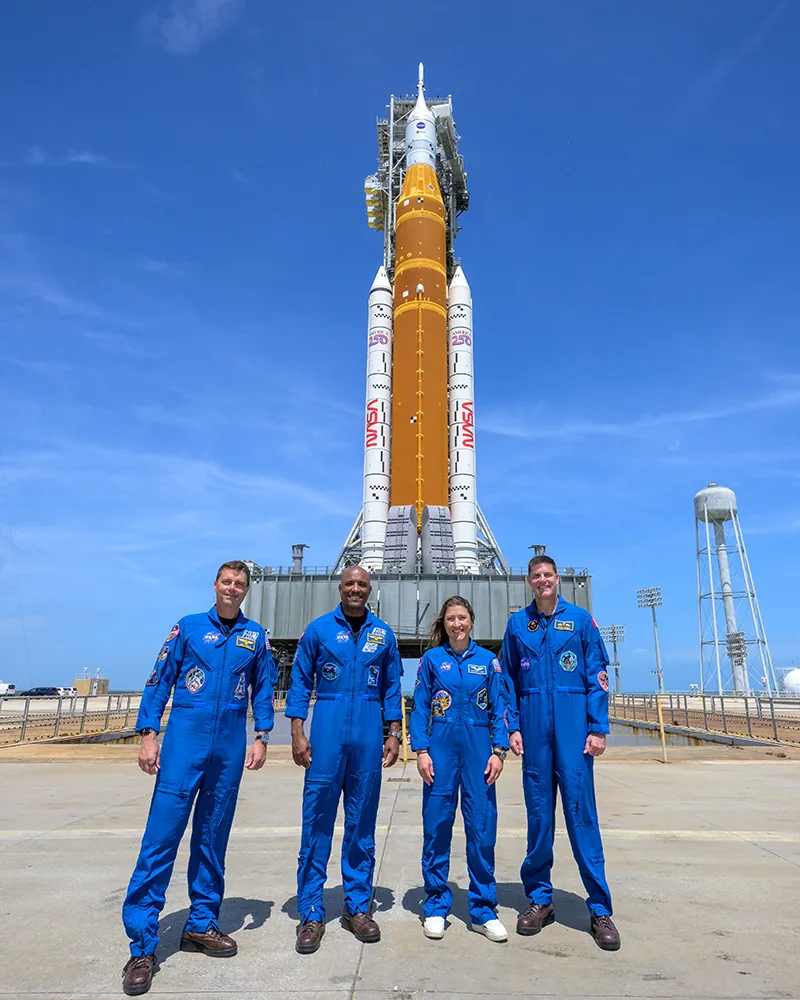
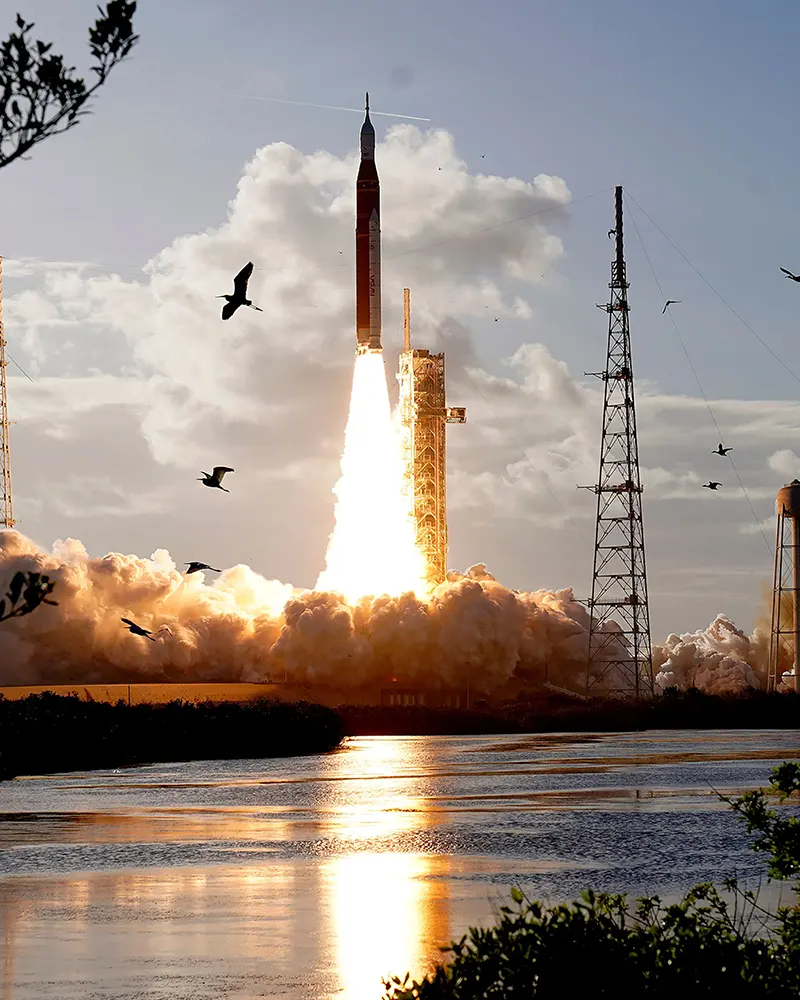
On April 1, the powerful Space Launch System roared to life at Kennedy Space Center, sending four astronauts on a journey humanity had not attempted with a crew in more than fifty years. The mission marked a major step forward in returning humans to deep space under NASA's Artemis program.
Leading the crew was Commander Reid Wiseman, joined by Pilot Victor Glover, Mission Specialist Christina Koch, and Canadian astronaut Jeremy Hansen. Together, they embarked on the roughly ten-day Artemis II mission, a daring test flight designed to carry them beyond Earth orbit, loop around the far side of the Moon, and return safely home.
At its core, the mission is a proving ground: demonstrating that humans can once again venture safely into deep space.
By testing life support systems, navigation, communication, and other critical technologies, Artemis II lays the foundation for future lunar landings and, ultimately, human missions to Mars.
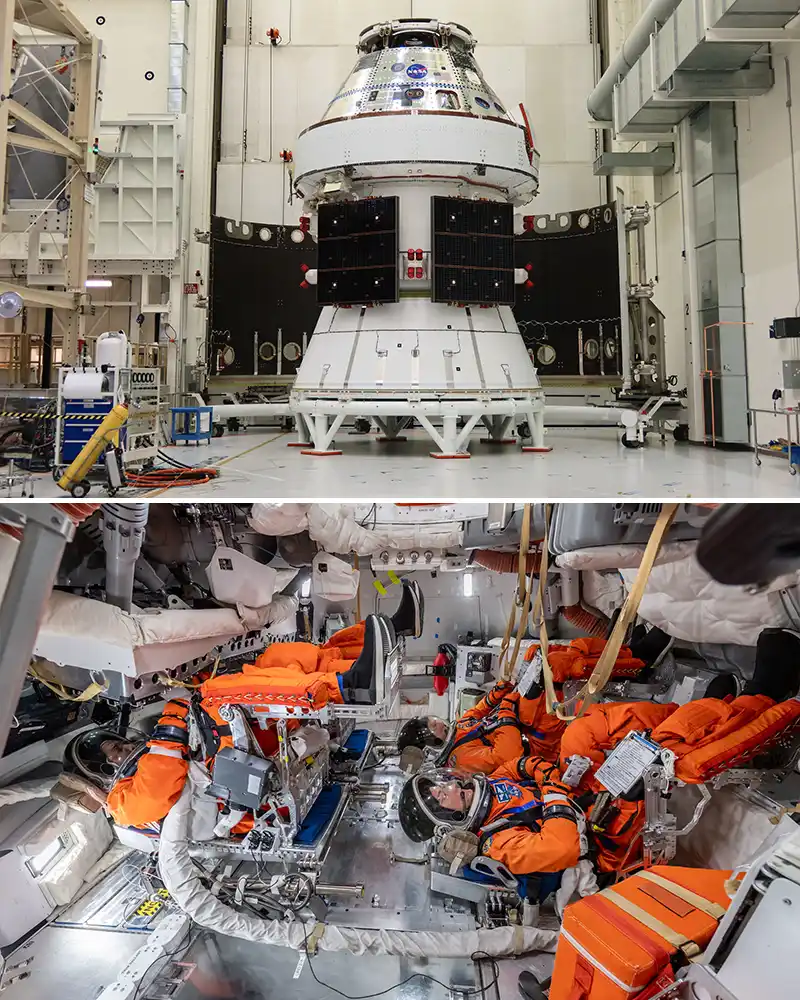
The crew traveled aboard the Orion spacecraft, with its crew module named Integrity. At about 16.5 feet in diameter, Orion provides significantly more room than the cramped Apollo-era capsules, allowing astronauts greater mobility and comfort throughout the journey.
They sit in four custom-contoured acceleration seats arranged around a central command console equipped with sleek glass cockpit displays. These seats are adjustable to accommodate a wide range of body sizes and can be folded or stowed after launch to free up more room for moving around in microgravity.
Six large observation windows encircle the cabin, giving the crew panoramic views of Earth, the Moon, and the vastness of space. Window shades can be deployed to block intense sunlight when needed. The interior also includes multiple radiation monitors for crew safety. In addition to permanently installed sensors like the NASA HERA units, the astronauts carry and position four advanced DLR M-42 EXT dosimeters at different spots around the cabin shortly after launch.
These compact, battery-powered devices measure radiation exposure with high resolution, helping scientists understand how galactic cosmic rays and solar particles affect humans in deep space.
Connected to the crew module is the European Service Module, which powers the spacecraft and sustains the crew. It houses the main engine and thrusters, generates electricity through expansive solar arrays, and supplies essential resources like water and oxygen. It also regulates temperature, ensuring the cabin remains stable despite the harsh conditions of deep space.
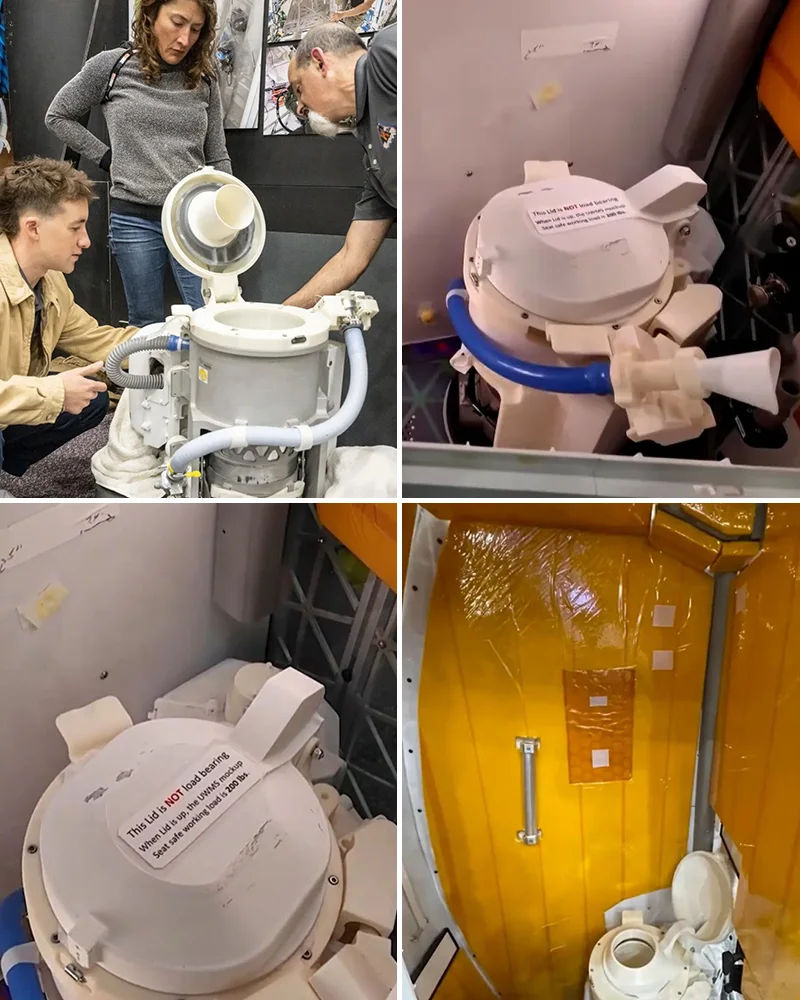
Tucked away in one corner is a small hygiene bay complete with its own privacy door, a significant upgrade for comfort on a multi-day mission. This enclosed area houses the Universal Waste Management System toilet, along with space for personal hygiene items. The bay provides a bit of separation from the main cabin, allowing the crew to handle daily needs with more dignity than in previous spacecraft designs.
The overall layout feels tight but functional: after the initial launch phase, the astronauts reconfigure the cabin by stowing seats and equipment, turning the central area into a more open workspace for eating, exercising with resistance devices, conducting science tasks, and even attaching sleeping bags to the walls for rest.
Beneath the capsule, a robust heat shield is engineered to withstand the intense heat of re-entry, protecting the crew as they plunge back into Earth’s atmosphere at speeds approaching 25,000 miles per hour.
Every inch is optimized, blending advanced technology with the very human realities of living and working together far from Earth.
But shortly after entering space, the first headache came: email.
About seven hours into the flight, Commander Wiseman radioed mission control with a classic complaint: "I have two Microsoft Outlooks, and neither one of those are working."
Then, almost simultaneously, the crew reported an even more pressing issue: a blinking fault light on their shiny new toilet.
Back on Earth, everyone who tuned it realized that even in space, Earth problems presist, and they find this amusing.
First off, Microsoft Outlook. Just like on Earth, it's the usual Outlook.
However, the astronauts relied on ruggedized Personal Computing Devices, which is essentially toughened Microsoft Surface tablets or laptops running standard Windows software. Separate from the spacecraft, the devices were only used for non-critical tasks like reading procedures, checking schedules, and handling personal or mission-support email.
In the high-latency environment of space, where connections route through delayed satellite relays, Outlook can behave unpredictably. Duplicate instances sometimes launch due to corrupted profiles, stubborn add-ins, or Windows trying to restore a previous session.
On top of that, intermittent connectivity and the challenges of syncing in deep space can leave the app stuck in a half-loaded state, with two non-functional windows fighting over the same data.
Mission control remotely accessed Wiseman's device, cleared the duplicate processes, reloaded the profile, and got everything running again, the same "have you tried turning it off and on again" fix that IT teams perform countless times a day on Earth.
Second, is the more pressing issue: a blinking fault light on their shiny new toilet.
The Orion spacecraft is equipped with the Universal Waste Management System (UWMS), a compact, roughly five-cubic-foot unit specifically engineered for microgravity. Unlike the crude plastic bags of the Apollo era, this advanced toilet features a contoured seat with handrails and foot tethers for stability, plus a door that offers a small measure of privacy.
For urine, astronauts use a funnel attached to a flexible hose (designed to accommodate both male and female anatomy). Since in space, things can get messy, especially when it comes to fluids, the toilet uses a fan that generates suction airflow to pull the liquid away from the body into a separator, where air and urine are divided.
On this short mission, the pretreated urine is simply vented overboard into space each day. Solid waste, along with any vomit or other materials, is drawn by the same airflow into odor-controlled, air-permeable collection bags and sealed in canisters with filters to manage smells and gases until the crew returns to Earth.
Early in the mission, the urine collection fan jammed and a controller (an electronic component managing the system) malfunctioned, triggering the fault light. This meant the airflow for urine wasn't working properly, though solid waste collection remained functional.
Christina Koch, ever the capable mission specialist, helped troubleshoot alongside Houston, checking valves, power connections, filters, and the fan assembly itself.
For a few hours, the crew relied on backup contingency urinal bags while ground teams walked them through diagnostic steps. Engineers eventually resolved the controller issue, cleared the jam, and confirmed the toilet was back to "go for use." The system needed to spin up to full speed before each use and run briefly afterward to ensure proper airflow, but normal operations were restored without major disruption.
These two glitches: one involving stubborn email software and the other a high-tech plumbing failure, happened within the first day of a mission that is pushing the boundaries of human spaceflight. Yet they somehow made the entire endeavor feel profoundly human.
Here were four highly trained astronauts, already more than 150,000 miles from Earth and hurtling toward the Moon at thousands of miles per hour, dealing with the exact same everyday annoyances that plague office workers and travelers back home. The toilet drama and the Outlook meltdown quickly spawned memes, jokes, and a wave of sympathetic laughter across the internet.
Even when you're on your way to lunar orbit, sometimes the basics still need fixing.
Despite the early hiccups, the crew maintained impressive calm and professionalism.
They successfully completed the critical translunar injection burn that sent Orion coasting out of Earth's gravitational grip and toward the Moon. As the days progressed, our celestial neighbor grew dramatically larger in their windows. The astronauts described the view with quiet awe, snapped breathtaking photos of the shrinking Earth, tested manual piloting, exercised, practiced medical procedures, and prepared for the upcoming lunar flyby.
That closest approach, expected around April 6, will bring them within just a few thousand miles of the lunar surface, offering human eyes a direct look at the far side of the Moon, a terrain no one has observed up close in person since the Apollo era.
In another story, as images from the Artemis II mission began circulating, showing Earth as a luminous, curved sphere suspended in the blackness of space, they were met with widespread awe and fascination.
The photographs, captured by the crew aboard Orion spacecraft during their journey beyond Earth orbit, offered a perspective few humans have ever witnessed firsthand. For most people, these visuals reinforced a well-established understanding of our planet: a round, rotating world seen countless times before through satellites, missions, and decades of space exploration led by organizations like NASA.
Yet in certain corners of the internet, the reaction followed a very different pattern.
Flat Earth proponents quickly dismissed the images, claiming they were fabricated, manipulated, or generated using computer graphics. Some argued that wide-angle or fish-eye lenses were being used to create the illusion of curvature, while others insisted the entire mission itself was staged. For these groups, new evidence does not function as confirmation but rather as reinforcement of a belief that space agencies are engaged in deliberate deception.
We’ve come so far in the last 54 years, but one thing hasn’t changed: Our home looks gorgeous from space! The left view is from the Apollo 17 crew in 1972 and the right was captured yesterday by the Artemis II crew.
— NASA (@NASA) April 3, 2026
This response highlights a deeper issue than simply disagreement over scientific facts. The skepticism is rooted in a fundamental distrust of institutions like NASA, meaning that any data, imagery, or testimony originating from them is often rejected outright. Even firsthand accounts from astronauts, individuals who have physically observed Earth from space, are frequently dismissed as part of the same perceived narrative.
As a result, no amount of photographic clarity or technological advancement meaningfully alters these views.
In the end, Artemis II is a mission designed to push the boundaries of human exploration: testing systems (and humans) for future journeys to the Moon and beyond. Even as humanity extends its reach into deep space, some perspectives on Earth remain firmly unmoved, illustrating that problems presist, even when technology advances.














































































































































































































































































