With publishers contributing to the evergrowing contents of the web, they are competing against one another for visibility.
And here, Google and Facebook, the two giants of the web, are getting much of the attention, as they are the entities that literally power the distribution of contents across the web, based on their huge reach and massive user base.
In the modern days of the web, the two giants are conquering most of the market, and here, people should play the two's rules if sources want to piggyback their popularity.
Using this power, Google and Facebook as two of the most ubiquitous digital platforms are making money from these publishers.
This essentially makes the internet a biased place, the controlled ecosystem that worries policy makers.

With the internet that allows companies to track users, advertisers pay a lot of money to reach a broad audience, by targeting those with the most interest in what they are advertising.
This is a plus, considering that advertisers pay to reach people who are precisely in needs of their products.
As the giant of the web, Google knows what people are interested in. Using its various products, from Google Search, Android, Google Maps, YouTube and many more, Google which boasts billions of users have detailed information about most if not all internet users.
This makes it capable of delivering advertisements with precise accuracy.
Social media platforms like Facebook, have a different model. But still, the power is excessive to a degree that it damages many publishers' (print in particular) business model.
To the extent, Facebook, Instagram, Twitter and so on, can capture people's attention, and monetize the interaction by enticing users to share the contents.
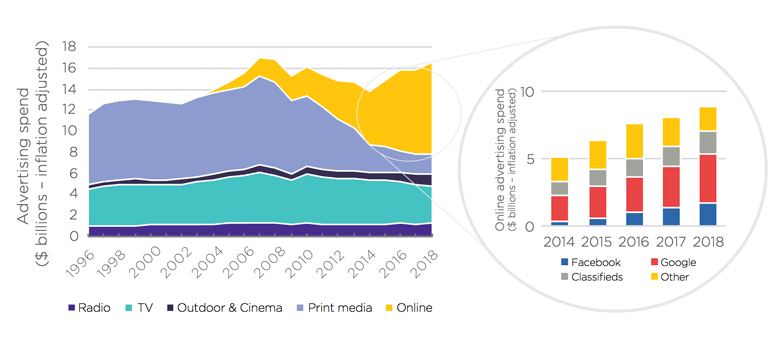
At this moment, no regulation can fix this.
The Australian Competition and Consumer Commission (ACCC), whose job is to look at how online search engines, social media and digital content aggregators use their power to conquer digital media and advertising, is putting an increasing concern on Google and Facebook.
Australia's competition regulator is worried about how the two giants undermine the viability of traditional journalism, and is seeking for a solution.
As the competition watchdog’s report notes, Australian law does not prohibit any company from having substantial market power. It is also not forbidding any company “from ‘out-competing’ its rivals by using superior skills and efficiency”.
But its their tech innovations that makes literally the world's information controlled by the duopoly of Google and Facebook.
One of their solution, is to limit the recommendations tech companies offer that underlines their dominance, and use of personal data.






















































































































































































































































































