In places where certain forms of expression carry heavy consequences, a single recorded performance can leave the circle of those who made it and reach audiences who were never meant to see it.
What begins as a carefully staged moment for a small group of collaborators can, once it enters open networks, gather force from people who share it for reasons of their own.
The distance between the original intent and the eventual reach is often wider than anyone involved expects.
Parastoo Ahmadi, an Iranian artist, learned this the hard way.

Parastoo Ahmadi. born in Nowshahr in 1997, had trained in voice and piano from her early teens, before studying film directing.
She has worked in folk and traditional Iranian repertoire.
During the protests that followed the death of Mahsa Amini in 2022, she performed a song associated with those events. The following year, she released a piece whose lyrics were presented as a tribute to the broader calls for change that had circulated under the phrase "Woman, Life, Freedom."
Those earlier works already placed her in the path of official scrutiny.
In December 2024 she and a small group of musicians recorded a concert inside the historic caravanserai at Dayr-e Gachin in Qom province.
No public audience was present.
She appeared in a long black dress with bare shoulders and without a headscarf, singing solo while accompanied by male instrumentalists.
The roughly half-hour recording was placed on her YouTube channel and framed by her as an imaginary concert offered to the land and the people she cares for.
Within hours it had been watched more than a hundred thousand times.
Within days the figure climbed into the millions.
Further reading: Hollywood Celebrities Stand With #StopExecutionsInIran Campaign: 'The World Is Watching'
Iranian law has long restricted women from singing solo in mixed or public settings and requires covering of hair and modest dress.
Authorities described the uploaded performance as a breach of legal and cultural regulations and as the production of material that offended public decency.
Ahmadi and two of the musicians were briefly detained in Mazandaran province in mid-December 2024, and released the next day after the video’s circulation produced noticeable public reaction.
The case continued.
In June 2026, a criminal court in Qom convicted Ahmadi and eight others connected to the recording.
The sentence was 74 lashes together with two-year bans on artistic work and on leaving the country. An appeals court later rejected the challenge without holding a hearing, leaving the penalties final.
In Iran, after the 1979 Revolution, hijab became mandatory for all women by order of Ayatollah Ruhollah Khomeini, then supreme leader of the new Islamic Republic.
The rule remained in force after his death in 1989 under his successor, Ayatollah Ali Khamenei, who was killed in a U.S.-Israeli strike on 28 February 2026, and under Ali Khamenei's son and successor, Mojtaba Khamenei.
Further reading: The Anti-Hijab Social Media Campaign Where Iranian Women Remove Their Hijab In Public
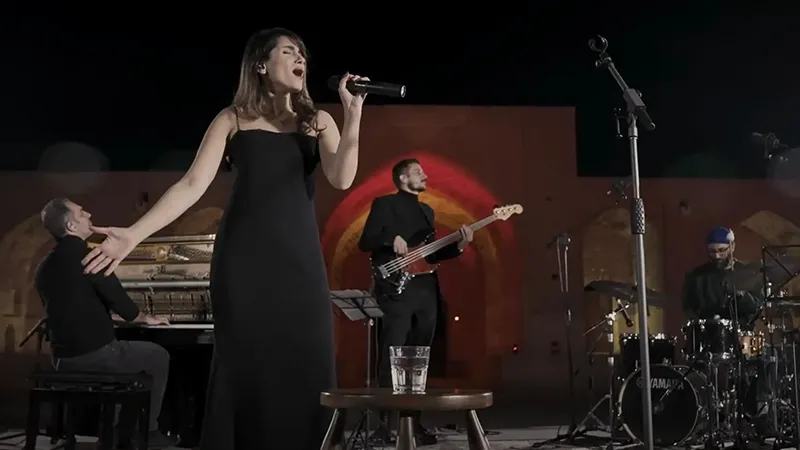
The speed of the video’s spread turned a closed recording into an international reference point.
Viewers outside Iran encountered it as evidence of restriction on women’s voices and dress. Inside the country it became material that courts treated as deliberate violation. Human rights observers have called the flogging sentence degrading and have linked the outcome to wider patterns of enforcement against artists and women who appear without the required covering.
Supporters of stricter rules have treated the same recording as justification for punishment.
The original framing, an imagined performance for a beloved place, did not determine how far the images traveled or what uses others found for them.
Once a recording leaves the hands of its makers, the channels that carry it also reshape its meaning.
Shares multiply for reasons that range from solidarity to simple curiosity, and each new audience brings its own reading.
In this instance the rapid accumulation of views both amplified the gesture and supplied the evidence later cited in court.
The gap between a performance staged without spectators and the legal and public consequences that followed is one measure of how far a message can move once it is no longer under the control of the person who first sent it.
Further reading: Iran's Prominent Celebrity Stripped Her Clothes Off On Instagram To Support 'Women, Life, Freedom'






















































































































































































































































































