Every generation has individuals who emerge when the distance between what people are told and what they experience becomes too difficult to ignore.
They do not always begin with an ambition to become public figures, nor do they necessarily seek recognition beyond the communities around them. Often, they simply begin by asking questions, voicing concerns, and refusing to accept that certain problems must remain unspoken.
In Indonesia, that tradition has long been closely associated with students, whose movements have repeatedly brought issues from university campuses into the national conversation.
In recent months, that refusal to remain silent has taken a clear and increasingly visible form in the figure of Fathimah Azzahra.
She's still young. But her courage in fighting is far from ordinary. Her body is petite, but her voice thunders loudly and boldly, defending her friends so they don't become victims of the authorities' arrogance.
Fathimah Azzahra is already renowned throughout the country and now, her name also echoes in the corners of the internet.
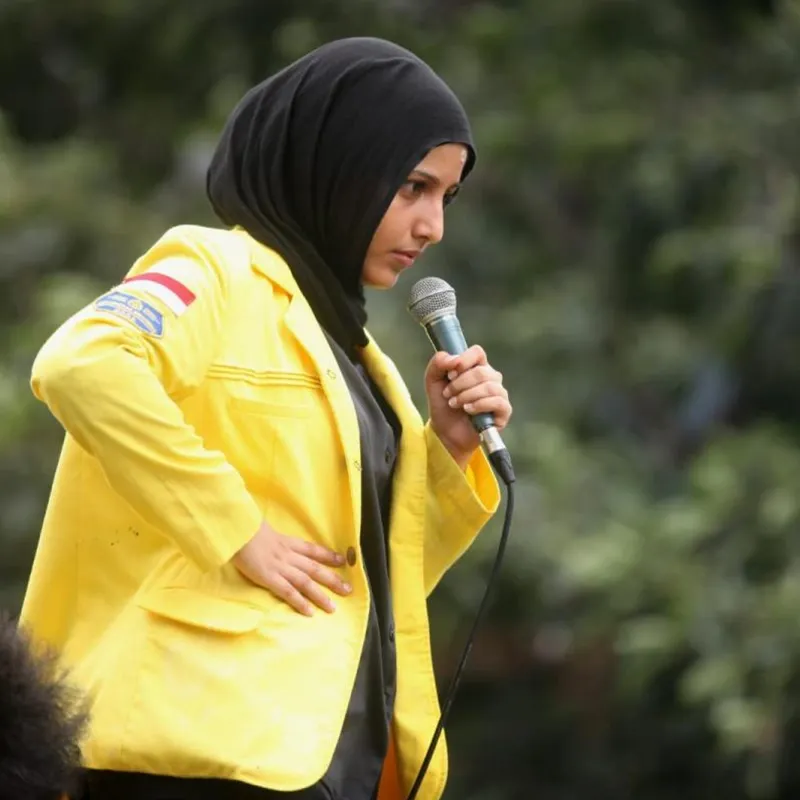
Fathimah is a medical student at the Faculty of Medicine of Universitas Indonesia, and has since become one of the most visible young voices in that conversation.
She entered the international track of the medical program through talent scouting after completing her earlier studies at an integrated Islamic school and then at the high school SMAN 3 in Depok.
The curriculum demands long hours in lecture halls and laboratories conducted largely in English, with pathways that open toward partner universities abroad and the possibility of dual credentials.
Yet she has never treated academic excellence as a reason to step away from collective responsibility.
Since early 2026, she has served as vice chair of the university student executive board, building on earlier roles that included leading a commission in the student representative council, heading a community focused on neuroscience and psychiatry, organizing large-scale community service during Ramadan, and delivering a formal oration on the independence of the medical profession before senior faculty and peers.
In May of the previous year, she and her research team earned first place in a national competition examining issues in hepatology.
The record is not ornamental. It shows a young woman who treats both the clinic and the public square as places where precision, responsibility, and care are required.
The first wave of wider recognition arrived when she appeared in televised discussions examining the free nutritious meals program (MBG).
She did not raise her voice for effect.
Instead, she placed the announced intentions beside reports of uneven delivery, questions of priority, and the lived experience of families still waiting for reliable support in education and basic needs.
The calm structure of her arguments, her refusal to trade substance for performance, and the visible balance she maintained between rigorous study and civic duty struck a chord.
Clips circulated rapidly.
Commentators began describing her as a rare combination of competence and composure.
Followers on her personal channels grew. For many young people watching, she offered proof that someone could remain deeply engaged in demanding professional training without surrendering the right, or the duty, to question public policy.
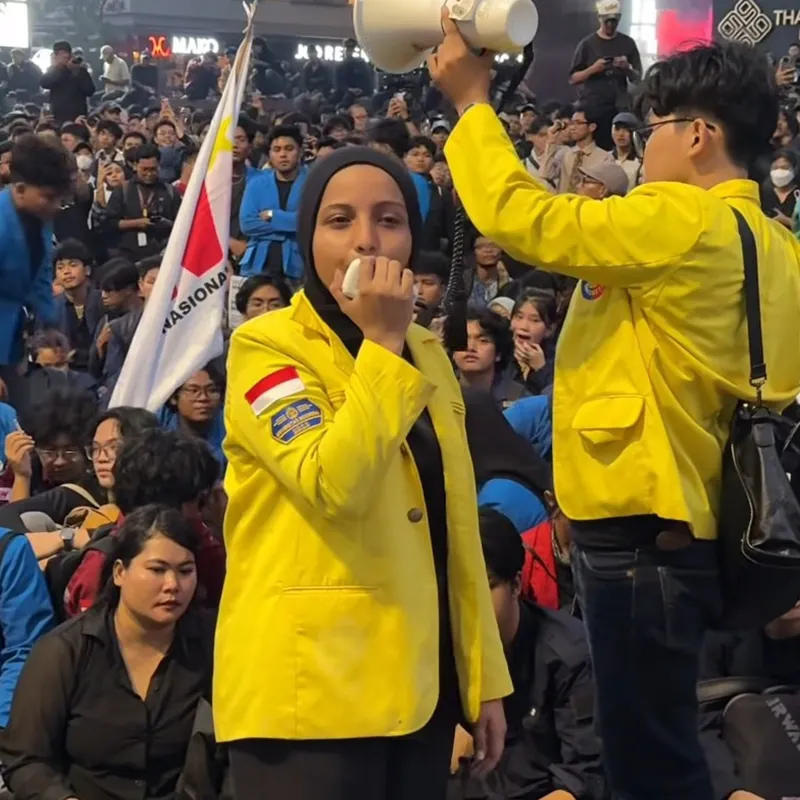
That attention intensified sharply during the August 18 demonstration, which took place just one day after Indonesia celebrated its Independence Day on August 17 and was organized by the student executive board and allied groups.
Participants carried a set of eight demands.
They ranged from ending patterns of overreach by the state against its own citizens, to genuine agrarian reform, to the reduction of prices for essential goods and fuel, to a full evaluation of strategic national projects and related food programs, to the restoration of meaningful regional autonomy, to faster recognition of disaster zones, and to clearer limits on the presence of security forces inside civilian space.
The tension began when one police officer yelled at the student command vehicle driver and forced him to turn around. This action left the driver in shock, and Fathimah would not accept such treatment.
She emphasized that the command vehicle was rented using leftover funds from public donations, so it must be respected as a legitimate tool for expressing opinions.
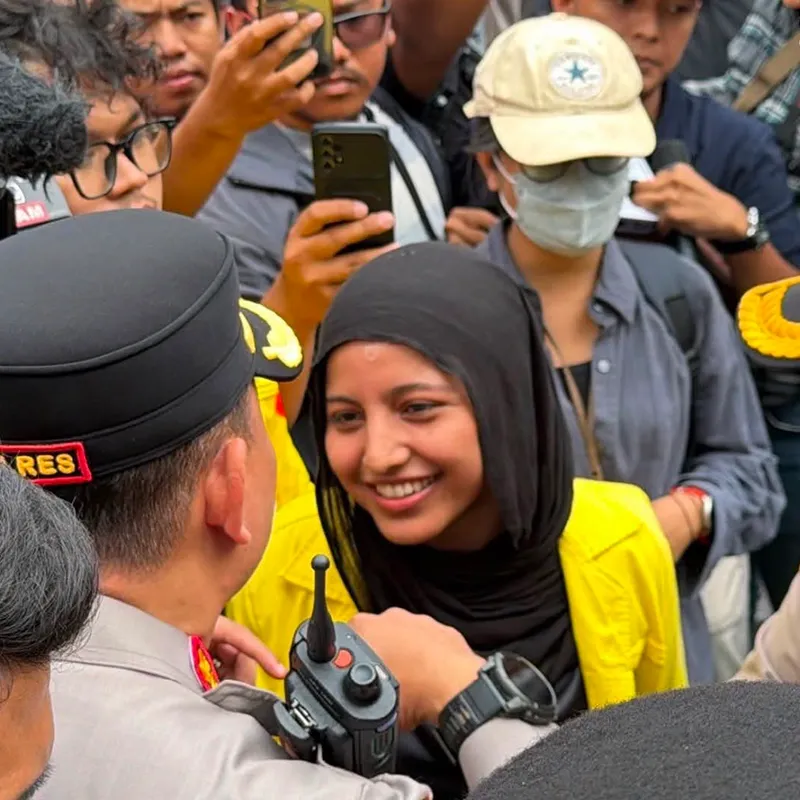
Fathimah climbed onto the vehicle to address the crowd, argued face to face with the ranking officer, and continued pressing the point even as emotions rose and tears became visible.
The police prohibited the command vehicle from passing through, citing that the loudspeaker's sound could disrupt office activities in the surrounding Sudirman and Jalan MH Thamrin areas.
Fathimah also protested the police's use of their own command vehicle to control the crowd. According to her, the sound volume from the police actually incited provocation and hindered field coordinators from organizing the student ranks to keep them safe.
Another video of her that also goes viral, is the one where she grabbed the collar of an officer, and then scolded him right in his face.
This happened around the time when she pulled out an earpiece of the officer, telling him to listen to her.
While trying to force the officer to pay attention, Fathimah reached out and forcibly pulled the earpiece/earphone out of the police officer's ear. Immediately after ripping the earpiece out, she snapped at him, yelling, "Sir, can you hear me?!" ("Bapak bisa dengar saya gak!")
Photographs of her standing with her hand on her hip before the barricades and videos of the exchange spread within hours.
Her name rose into national trends. Search interest surged. Mainstream outlets began producing profile after profile.
The reaction was never uniform.
Alongside the praise came a surge of personal attacks questioning her faith, her manner of dress, her motives, and her future character. Some labeled her in sectarian terms without evidence.
Others reduced her presence to a search for popularity or predicted that any later political role would simply repeat familiar patterns.
Those attacks, far from diminishing the attention, expanded it.
Every attempt to shift the conversation from the substance of the demands to the person making them only confirmed for many observers that the underlying issues remained difficult to answer directly.
Earlier in the year, after she and her colleagues assumed leadership roles, reports emerged of packages containing a shroud, sharp objects, and other forms of intimidation directed at them and even at family members.
The threats did not silence the work.
What has taken shape around her is larger than any single demonstration or any single debate.
Fathimah is becoming a figure who represents a generation increasingly unwilling to treat public institutions as distant and unaccountable.
She has become a voice amplifying the quieter pressures felt by households watching prices rise, communities waiting for recovery after disaster, and students who measure the success of policy by its effect on ordinary lives rather than by its announcements.
Her example also carries significance beyond the politics of any particular moment.
In study groups, late-night conversations, and the quiet decisions of young people deciding whether their own education leaves room for public engagement, her story has begun to circulate.
She shows that excellence in a demanding field and responsibility to the wider society do not have to cancel each other out. She shows that measured speech grounded in evidence can travel farther than noise.
She shows that standing in the open when lines are drawn does not require abandoning clarity or dignity.
The pressures around her continue, and the public conversation remains contested.
Yet the depth of the response itself reveals the space she now occupies. In a time when cynicism can often feel safer than hope, a medical student who continues to appear, continues to argue from the concrete details of policy and daily life, and continues to place the safety of those around her above personal comfort has become a reference point for many who are watching.
The attention surrounding Fathimah is therefore not simply the product of algorithms or momentary spectacle. It comes from something older than social media.
Every generation eventually produces people who decide that being young is not a reason to remain silent, and that being educated is not merely a path toward personal success.
Sometimes, a person becomes visible because they happen to stand where a moment demands it.
What happens afterward is no longer entirely theirs to control. Fathimah Azzahra has stepped into that moment, and her name now carries a conversation far beyond the university gates where it began.
Soon after Fathimah's virality took off, many began comparing her to Saffiyah Khan, the British political activist, singer, and model of Pakistani and Bosnian heritage.
Born in 1997 and based in Birmingham, Saffiyah became widely known in April 2017, the day after the Westminster attack. During an English Defence League (EDL) anti-Muslim demonstration in Birmingham's Centenary Square, she intervened to protect a hijab-wearing woman who was being harassed by protesters.
A widely circulated photograph of Saffiyah standing calmly, smiling with a mixture of composure and mild disdain as she faced EDL figure Ian Crossland, became an international symbol of passive resistance and defiance against far-right aggression.
Fathimah and Saffiyah are two different women fighting for different causes and operating in very different political and cultural contexts. Yet the comparison comes from something immediately recognizable in both women: a calm demeanor, an apparent refusal to be intimidated, and a smile during tense public confrontations.
That visual similarity has drawn comparisons between them, particularly across Indonesian media and social media, where photographs and clips of Fathimah's confrontation have been shared alongside the now-iconic image of Saffiyah.