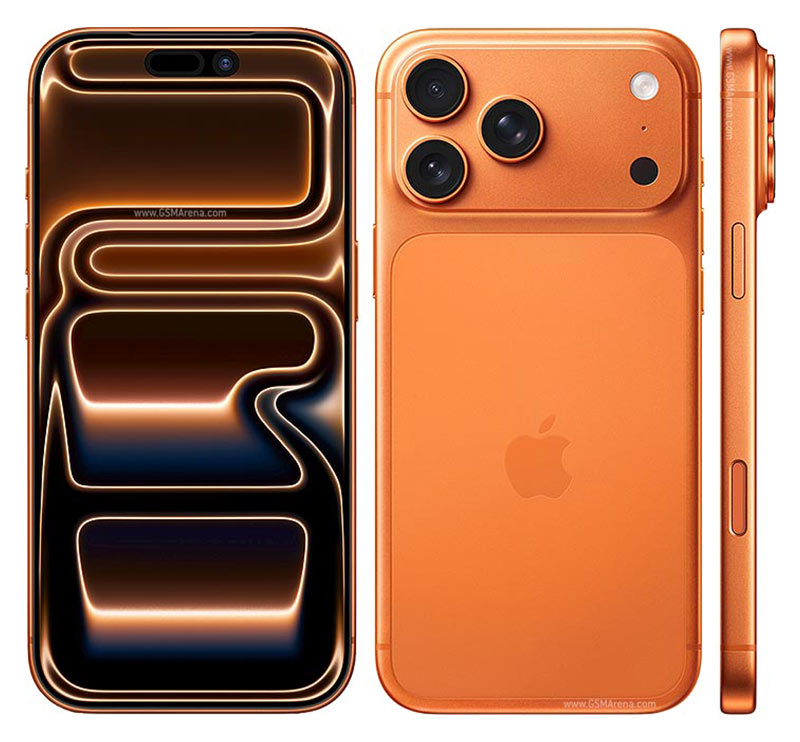
The relentless march of technology consistently brings consumers the devices that push the boundaries of what's possible, and the iPhone 17 Pro Max is no exception.
For the time, Apple has made an iPhone that boasts an impressive 2TB storage option, which was once the realm of high-end computers. Yet, beyond the sleek design and cutting-edge features, there's a fascinating subculture of individuals who feel compelled to peek behind the digital curtain, driven by an insatiable curiosity about how these sophisticated gadgets truly function.
This drive has led to a rich history of iPhone tinkering, a testament to the human desire to understand, to modify, and sometimes, to enhance.
In the early days of the iPhone, disassembly wasn't just about repair; it was an act of exploration. Enthusiasts would meticulously document every screw, ribbon cable, and component, sharing their findings in forums and on YouTube. These early teardowns were less about breaking the device and more about understanding its intricate dance of hardware and software.
People wanted to know what made their revolutionary new phones tick, how the capacitive touch screen worked, or what kind of battery powered their digital lives. This wasn't always about improving the phone; often, it was simply about satisfying a deep intellectual hunger to comprehend the engineering marvel in their pocket.
Over time, this curiosity evolved.
While many still disassembled iPhones purely for educational purposes, a select few, often possessing extraordinary technical skills and a keen understanding of electronics, began to push the boundaries of what was thought possible. These "gifted few" moved beyond simple observation to actual modification.
In this particular case, it has been long known that Apple keeps storage capacity as a fixed component, part of the factory configuration, which means that making the notion of upgrading it post-purchase seem impossible for the average user.
The company has been doing this business model for years now.
A man from China, equipped with the right tools, knowledge, and a steady hand, overcome that challenge.
He attempted to upgrade his base model iPhone 17 Pro Max from 256MB to 2TB, but ended up with just 1TB of storage.
And he did this on the same day the phone went on sale to the public.
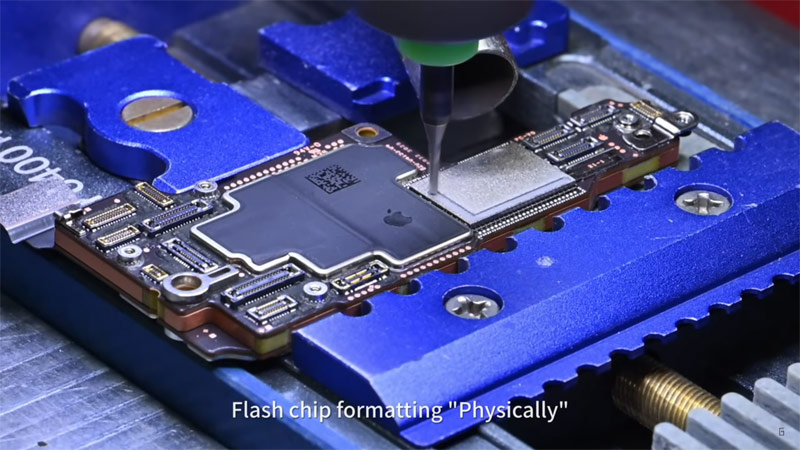
This process of "upgrading" the storage space of an iPhone typically involves desoldering the original NAND memory chip from the logic board.
Once that process is done, the next step would be to install a higher-capacity NAND chip by soldering it in the vacant space.
The process is easier said than done.
The operation is delicate, and requires extreme precision of heat application and microscopic work.
This isn't a task for the faint of heart, as a single misstep can render the entire device inoperable.
However, when successful, it allows an iPhone, perhaps a 256GB model, to suddenly boast a colossal 1TB or even 2TB of storage, rivaling the highest-end factory configurations. These successful modifications stand as a testament to the ingenuity and dedication of a community that refuses to accept factory limitations, always striving to understand, to explore, and to enhance the technology that defines today's modern world.
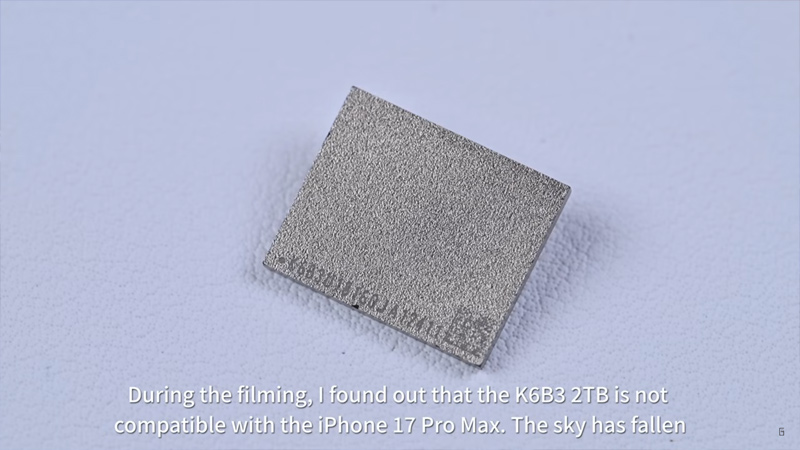
Unfortunately, the man, who is also a YouTuber on the channel called DirectorFeng, he only ended up with 1TB due to the K6B3 2TB compatibility issues.
K6B3 refers to a specific type of NAND flash memory chip commonly used in solid-state drives (SSDs) and mobile devices, including MacBooks and iPhones. These chips are a key component in the internal storage of modern electronics. At this time, the use of this kind of NAND, especially in a 2TB configuration, is a hallmark of high-capacity storage solutions.
These chips are produced by major memory manufacturers like SK Hynix, Kioxia, and Micron, which are constantly developing more advanced versions with higher densities and improved performance.
Realizing that the iPhone 17 Pro Max doesn't support K6B3 2TB he had, "the sky has fallen."
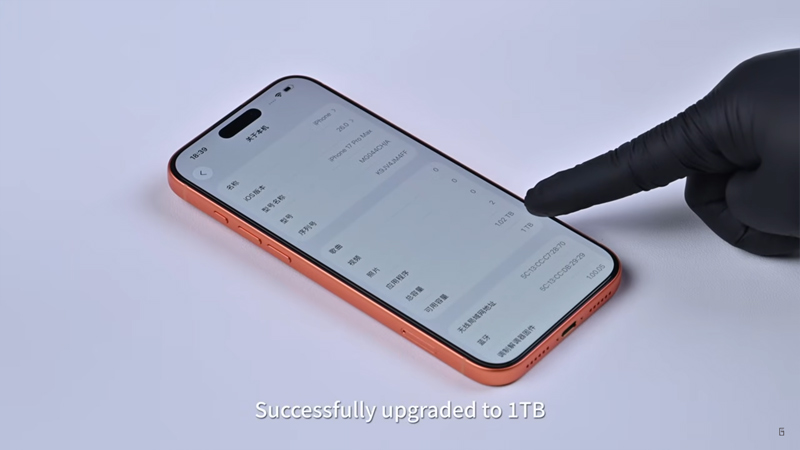
He had no choice but to stick the next best biggest storage: 1TB.
After assembling everything back in place, he flashed the iOS with Apple's own DFU (Device Firmware Update) tool.
He then turned on the phone, and it "legally" reads his newly installed 1TB NAND.
The process of upgrading a device's storage using this type of chip is highly technical and risky. It involves desoldering the original NAND chip from the logic board and then soldering the new, higher-capacity chip in its place.
This is a very delicate operation that requires specialized equipment and expertise.
Since DirectorFeng failed in this first try, the YouTuber promises to return with another attempt toward the full 2 TB in the near future.
Beyond the storage saga, the video doesn’t shy away from showing off the iPhone 17 Pro Max’s new engineering.
The full teardown reveals the vapor-chamber cooling system, an impressively compact logic board, and changes in how key components are laid out.
Viewers also see the painstaking work of desoldering the original 256 GB NAND to free up space for the new module.
Despite failing, DirectorFeng does offer a fascinating peek under the hood, showing what’s possible when you push the limits of design, repair, and customization.
Before this, the internet was already awed by the unbreakable iPhone 17 Air.














































































































































































































































































