The Jakarta Administrative District Court panel of judges has found President Jokowi and the Minister of Communication and Informatics guilty for throttling internet connection in Papua and West Papua.
The move happened for several times in 2019, which followed the government's deployment of additional military and police personnel to the region to help to quell protests and secure vital public facilities.
At the time, civil unrest spread in the province of Papua following a raid on a student dormitory and arrest of students by Indonesian soldiers in Surabaya, East Java. The situation escalated further after a photo of an Indonesian flag allegedly thrown into a sewer spread ahead of the country’s independence celebration on August 17.
To control the spread of the unrest, the government took additional measures to control misinformation and fake news by systematically throttling internet connectivity in West Papua and Papuan provinces.
“By here the acts by the government committed by defendants number one and two are deemed in violation of the law,” said Judge Nelvy Christin in the virtual verdict trial on Wednesday, June 3, saying that the government violated their own principles.
Read: Papua Internet Blackout: Isolating The Already Isolated Region That Backfires

This is because disruption of the internet can prevent people from doing their jobs, and is considered a backward step in a democracy.
As reported and visualized by NetBlocks during those times, that connections in Jayapura was around 50%, while in Manokwari and Sorong were around 70%.
It was during those times that protests and riots happened in areas at Papua and West Papua.
Later, NetBlocks reported that connection in some of the regions dropped significantly.
In Jayapura, connections were only at 10%, Sorong and Manokwari at 30%, while Timika, Sentani, and Abepura at 50%.
Overall, internet access was restricted or limited in 29 cities in Papua, and 13 cities in West Papua.
During the verdict hearing, the panel of judges rejected the defendants’ exception and considered the internet bandwidth throttling for several times in August and September of 2019, are legal violations.
Defendant number one in the case is the Communication and Informatics Minister while defendant number two is President Jokowi.
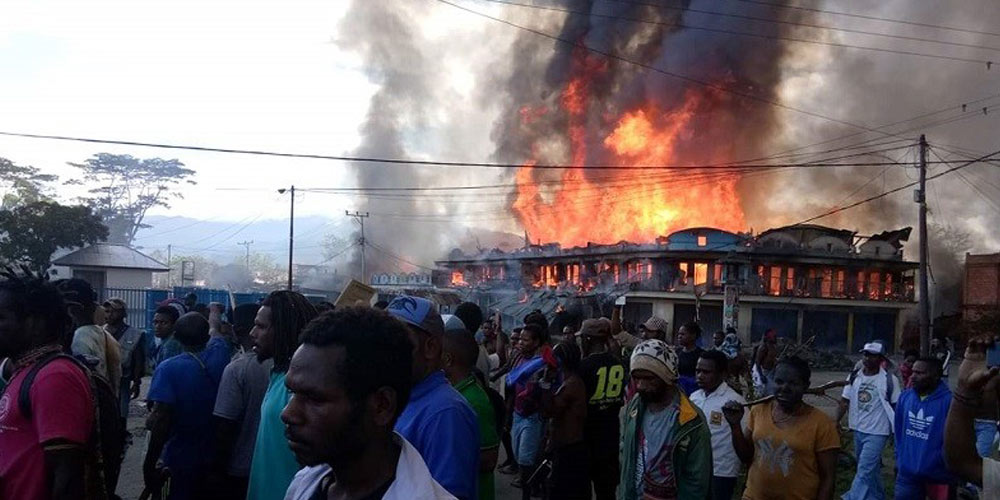
At the time, Indonesia's Information Ministry said that the decision to "temporarily block" internet communication was to "to accelerate the process of restoring the security and order situation in Papua and the surrounding areas".
The order was meant to stand "until the situation in Papua returned to being conducive and normal," according to the Ministry of Communication and Information Technology’s official website.
"It is only data," the Ministry said, adding that people "can still make and receive calls, and send and receive text messages"."
Unrest in Papua that sparks Incidents is nothing new, as Papuans have experienced racism elsewhere in Indonesia.
For many times Papuan activists have taken it to the streets to demand independence, and incidents of armed resistance to Indonesian rule have also occurred over the years. Pro-independence movement has been rumbling in the region, using the "morning star" flag as their symbol of resistance.
The Indonesian government banned pro-separatism demonstrations and have arrested Papuan activists for treason.
Papua homes the world's largest gold mine. Owned by the U.S. company Freeport McMoran, the mine is located in West Papua. But despite its natural wealth, West Papua remains the poorest region in Indonesia.






















































































































































































































































































