The internet is known for its long list of obsessions, from viral challenges and memes to niche fandoms and conspiracy theories.
It thrives on trends that capture attention, often fleetingly, yet leaving behind a trail of content, discussions, and communities that reflect the quirks, humor, and passions of its users. Some obsessions are harmless and entertaining, while others can spiral into echo chambers or fuel misinformation, showing just how powerful and unpredictable online culture can be.
The iPhone 17 Air that Apple introduced, is the sleekest iPhone yet.
Its revelation has ignited the internet’s favorite pastime: testing its durability to the extreme.
Many on the internet wonder: how can this ultra-thin marvel, measuring just 5.6mm at its slimmest point (making the already slim 6.9mm iPhone 6 look fat by comparison) endure, or even survive, the extreme tests and tortures enthusiasts have in mind
It didn't take long until content creators and others subjected the iPhone 17 Air into a series of grueling tests that have both impressed and entertained tech enthusiasts worldwide.
One of the most talked-about trials is the bend test.
In a dramatic demonstration, Apple’s executives challenged interviewers to bend the iPhone Air, and nothing happened.
Despite the effort, the device just won't budge.
Others on the internet went to the more extreme. Instead of using their hands, they use tools and more barbaric. And with those attempts, they're impressed to see how a device so thin could endure up to 130 pounds of pressure without permanent deformation. This tests quickly went viral, reinforcing the internet’s obsession with seeing how far a device can be pushed before it breaks.
One example is Creator JerryRigEverything, who managed to bend the iPhone Air beyond its elasticity at around 200 pounds of pressure.
This is roughly the force exerted by a 90–95 kg (200 lb) person standing on the phone at its weakest point.
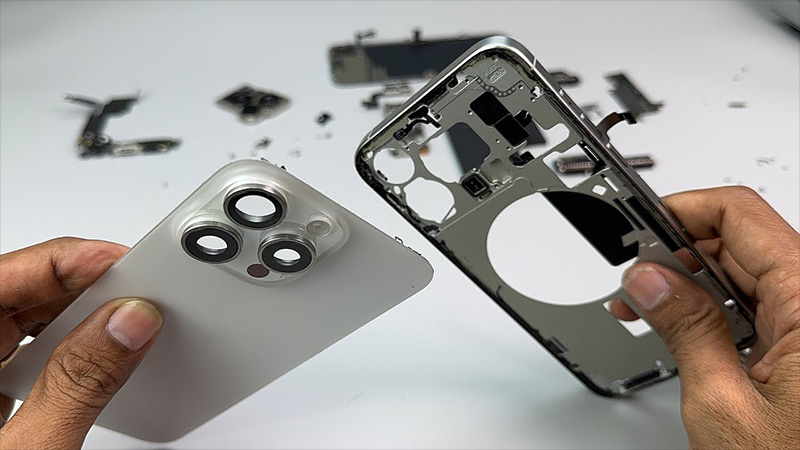
In order to make the iPhone Air capable of pass those grueling tests, the first thing is (of course) the fact that it's composed on a titanium frame.
Unlike aluminum which is cheaper and lighter, titanium, despite slightly heavier, can withstand more force before deforming.
Whereas aluminum alloys commonly used in smartphones have a tensile strength around 200–350 MPa, titanium alloys used by phones, which are also common in aerospace applications, have tensile strengths around 900–1200 MPa. In other words, titanium is roughly 3-2 times stronger than aluminum of the same size, meaning it resists bending and breaking much better.
And as for stiffness, aluminum flexes at around ~70 GPa, while titanium at ~110 GPa. What this means, a titanium frame should be a lot elastic than aluminum under the same load.
Titanium is more scratch-resistant than aluminum. Aluminum dents and scratches more easily. Titanium develops a hard oxide layer that protects it from scuffs.
Long story short, for the same size, titanium adds more weight, but a lot more strength.
This is the reason why iPhone 17 Air uses titanium, while its siblings, like the iPhone 17, the Pro and the Pro Max aluminum frame because Appel emphasizes sleekness.
But titanium is only one part of the equation.
The reason the iPhone 17 Air can be so strong, is also because it blends its titanium frame with design, and engineering.
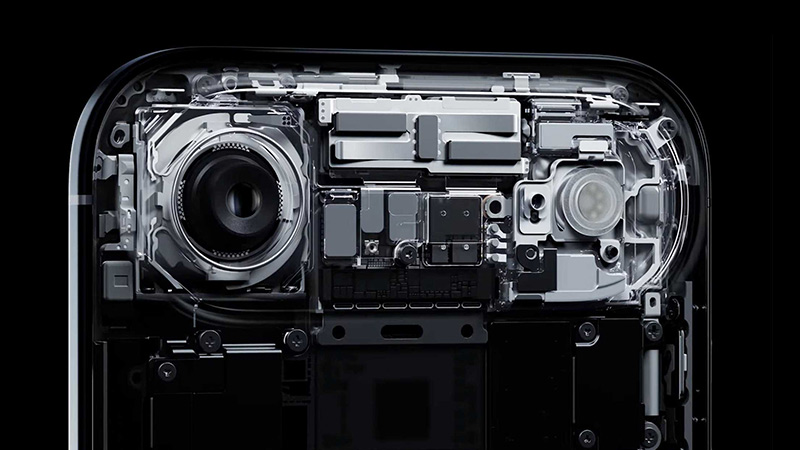
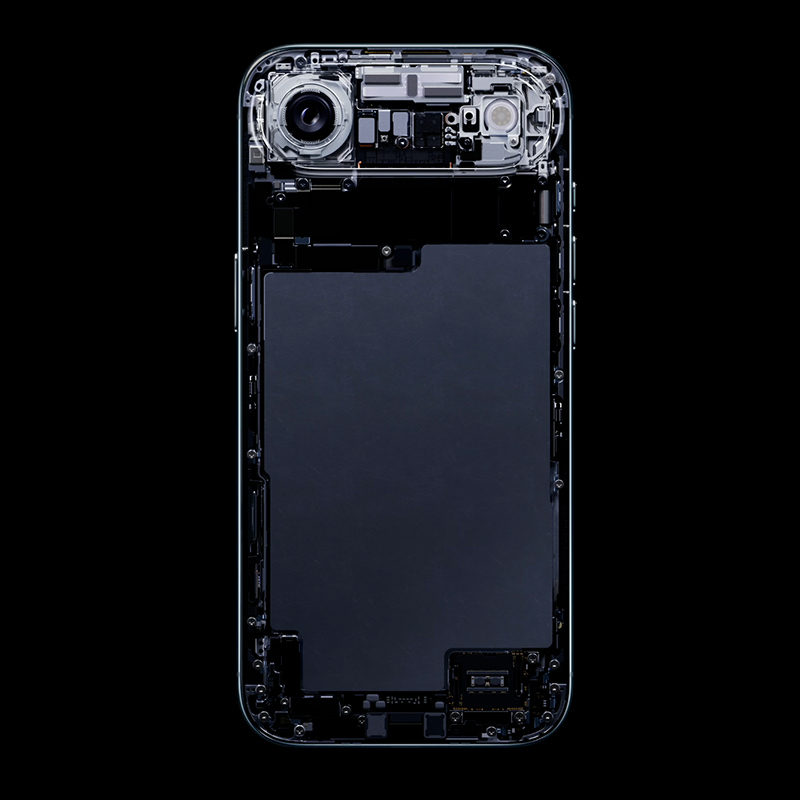
While the titanium allows it to take more stress without permanent deformation, acting as a frame that makes the overall structure rigid, Apple also redesigned the internal structure. For example, internal components are strategically positioned to distribute stress. And with the frame itself has reinforced cross-sections, the combination of these increase rigidity without adding much weight.
The unibody design reduces “weak points” where bending could start.
Let's not forget that the frame is also designed with I-beams in bridges. This mechanical engineering further makes the shape resist bending moments.
This shows that Apple has learned its lesson.
When iPhone 15 Pro and the 15 Pro Max were launched, Apple showcased their titanium frame. But it didn't take long until people realized that the 15 Pro Max exhibited vulnerabilities. In a bend test, the back glass shattered under moderate pressure, suggesting potential weaknesses in the design. Because of its larger frame, the 15 Pro Max could only endure 110 pounds of pressure before cracking.
The 17 Air can endure more than half of that, using a much thinner frame.
While bending an iPhone can be common in real-life scenario, and that scratches may be evident on devices that endured the harshness of life, there's nothing more annoying (and potentially damaging) than dropping an iPhone.
Depending on the material the iPhone is dropped on to, the phone could get a cracked screen, dented display or worse.
Drop tests showed that the iPhone 17 Air could survive multiple falls, including throws from chest height, with only minor scuffs.
The front and back Ceramic Shield glass largely remained intact, impressing viewers and adding fuel to countless online debates about the phone’s toughness.
While the iPhone 17 Air passed with remarkable results, scratch tests revealed mixed outcomes.
While the front Ceramic Shield 2, according to Apple, is 3 times more resistant to scratches than the Ceramic Shield 1 on iPhone 16 series, capable of resisting scratches up to level 7. However, the anodized aluminum back shows visible marks more easily than expected, especially on darker colors. This sparked further online discussion, with users sharing videos and photos of their own scratch experiments, eager to see if their device could endure daily wear.
The internet’s obsession with destroying and stress-testing phones can be traced back to the early 2010s, fueled by Apple’s string of infamous "gates."
It started with Antennagate in 2010, when the iPhone 4 revealed reception issues if held a certain way, sparking widespread curiosity about testing phones’ limits. Soon after, came Bendgate in 2014 with the iPhone 6 Plus, where videos of phones bending under minimal pressure went viral, cementing the public’s fascination with seeing expensive gadgets fail, or survive, dramatic stress tests.
Other moments, like Hairgate, Sleepygate, and even Scuffgate, while less destructive, added to the culture of obsessively scrutinizing every flaw of a new device.
Read: How Apple Skips The AI Hype: When Plan A Becomes Plan B, And The Backup Still Works
Each "gate" became an excuse for the internet to poke, prod, bend, drop, and scratch smartphones, blending curiosity, entertainment, and a little schadenfreude into a viral formula that persists today, reaching its latest expression with the iPhone 17 Air’s bend and drop tests.
There’s no doubt that the tests made are impressive. But still, nobody shouldn't be able to deny that tests like these don’t always represent the chaos of the real world.
The iPhone 17 series appears to be very durable at a glance, and should manage daily wear and tear, plus the odd drop, with no issue.
Having ignited internet’s long-standing obsession with destroying, and testing, the limits of new gadgets, with each experiment draws millions of eyes, Apple has proven the world once again that the thrill of seeing something expensive survive, or fail, remains one of the web’s most irresistible pastimes.
But unlike many times before, Apple's 2025 phones, particularly the iPhone 17 Air, pass with flying colors.














































































































































































































































































