With the many Android apps uploaded to Google Play Store, Google is having difficulties in policing the app store in its battle with malicious apps.
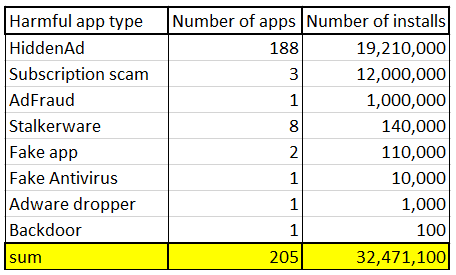
According to malware researcher Lukas Stefanko from ESET, the company hosted over 205 harmful apps on the Play store in July alone. These malicious apps were downloaded over 32 million times in total that month.
Most of the apps in question, or 188 to be exact, contained hidden ads. They accounted to 19.2 million installs.
Others included subscription scam, ad fraud, stalkerware, fake apps, fake antivirus tools, adware droppers, and software with built-in backdoors.
Stefanko reviews malicious activity on the Play store on a monthly basis, and said that "All these apps and numbers are based on research, blogs, reports, and tweets published in July, 2019 by the infosec community,” he explained.
According to Stefanko, while hidden ads may not be intrusive, but they can be an aggressive breed of adware.
This is because "Upon launch, these apps hide their icons from the home screen. They have mostly no functionality, other than displaying fullscreen ads to the user."
Stefanko' research which was supported by various other security researchers, is only the tip of an iceberg.
Back in June, a study conducted by the University of Sydney and CSIRO's Data61, used AI to discover thousands of dangerous apps on Google Play. The study examined the icons and descriptions associated with 1.2 million apps, and found "2,040 potential counterfeits that contain malware in a set of 49,608 apps that showed high similarity to one of the top 10,000 popular apps in the Google Play Store."
The research also found "1,565 potential counterfeits asking for at least five additional dangerous permissions than the original app and 1,407 potential counterfeits having at least five extra third-party advertisement libraries."
"When we do the math only on last month and only from available sources," Stefanko said "not counting apps that could be there still hidden - this number is huge."
Stefanko's research highlights how infected Google Play Store really is, with hidden ads as the main cause of the problem.
And what makes it even more worrying, the research found only three subscription scams, but they accounted for more than one-third of the downloads.
Stefanko explained that the three apps "are typical scam apps that try to exploit 3-day trial and then they can charge even $50 per week - unfortunately, Google doesn’t refund payments after 3 days."
The other one is a "scam app with ten-million-plus downloads actually wanted subscription from users for receiving Samsung firmware updates for $34.99, even though these updates are free for every Samsung user."
But despite its plagued app store, Google has steps to at least fight those malicious apps.
For example, Google introduced Google Play Protect to guard against app vulnerabilities and, in 2018, Google "introduced a series of new policies to protect users from new abuse trends, detected and removed malicious developers faster, and stopped more malicious apps from entering the Google Play Store than ever before. The number of rejected app submissions increased by more than 55%, and we increased app suspensions by more than 66%."
While the moves are certainly not enough to combat all malicious apps, they are better than nothing.




















































































































































































































































































