Indonesia is a archipelago country in Southeast Asia. Just like many other countries in the world, it too suffers from the coronavirus pandemic.
It began back when the coronavirus outbreak just started in Wuhan. When many other countries were bracing themselves, Indonesia was kind of playing down the possibilities.
And when the virus finally spread to more countries including Southeast Asia, Indonesia had yet to report its first case. When a Harvard University public health research said that Indonesia should have reported a coronavirus outbreak and could have undetected cases given its extensive air links to China, Indonesian health minister Terawan Agus Putranto called it "insulting".
Fast forward to March 29, or less than a month later, Indonesia has 1,285 cases of coronavirus, and reported 114 deaths.
With the numbers continue to grow, the authorities are confronted with growing calls to tighten restrictions on motion. And still, the earth’s fourth most populous country resisted to blanket lockdowns.
One of the ways people started complaining, was b\y creating the hashtag #LockdownAtauMusnah, translating as #LockdownOrDie.
Trending on social media networks, netizens started to urge stricter regulation. This follows the words from some politicians, medical doctors and rights leaders, who urge the government to really restrict people's mobility, especially in the capital Jakarta. where most of the coronavirus cases happen.
Afraid of economy breakdown, the government initiated the move rather slowly.
For example, the police has started planning highway closure simulations, but didn't really limit the number of vehicles passing throughout the city. They tell people to stay at home, but still allow businesses to run. The capital of more than 10 million people however, has already shut schools, universities and public venues until April 19.
President Joko Widodo has inspired social distancing, but questioned whether or not Indonesians have the self-discipline for lockdowns.
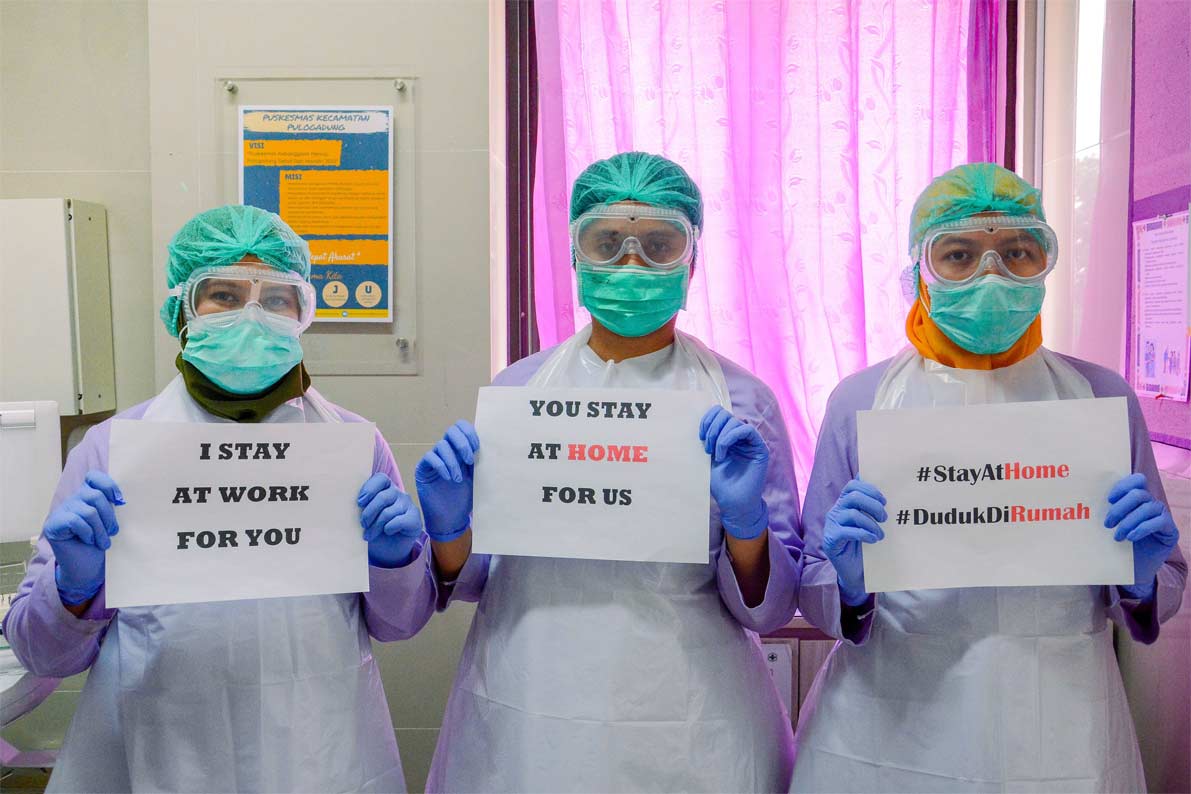
Meanwhile, medical staffs are also struggling with the increasing number of cases.
Indonesia has around 10 physicians, nurses and midwives per 10,000 population. With 321,544 hospital beds, according to Health Ministry data, that is about 12 beds per 10,000 people.
For comparison, South Korea has 115 per 10,000 people, according to the World Health Organization (WHO).
The slow government response was said to have masked the scale of the outbreak, considering that its data is based on low rate of testing.
A study by the London-based Centre for Mathematical Modelling of Infectious Diseases estimated that as few as 2% of Indonesia’s coronavirus infections have been reported. That would bring the true number to as many as 34,300, which is more than Iran.
“We have lost control, it has already spread everywhere,” Ascobat Gani, a public health economist. “Maybe we will follow Wuhan or Italy. I think we are in the range of that”.
The government however, said that the impact of the virus will not be that severe.
“We won’t be like that,” said Achmad Yurianto, a senior health ministry official, referring to comparisons with outbreaks in Italy and China. “What’s important is that we rally the people ... they have to keep their distance.”






















































































































































































































































































