People have spent years treating certain corners of their digital lives as off limits, places where the ordinary rules of online tracking seemed to pause.
Inboxes stayed private, photo libraries stayed personal, and the documents stored in the cloud were not supposed to feed the machinery that decides which advertisements appear next.
That boundary was never absolute, of course, but it was written into the terms in plain language and had held steady for a long stretch of time.
Then a quiet revision arrived, the kind that only becomes visible once someone notices the wording has shifted.
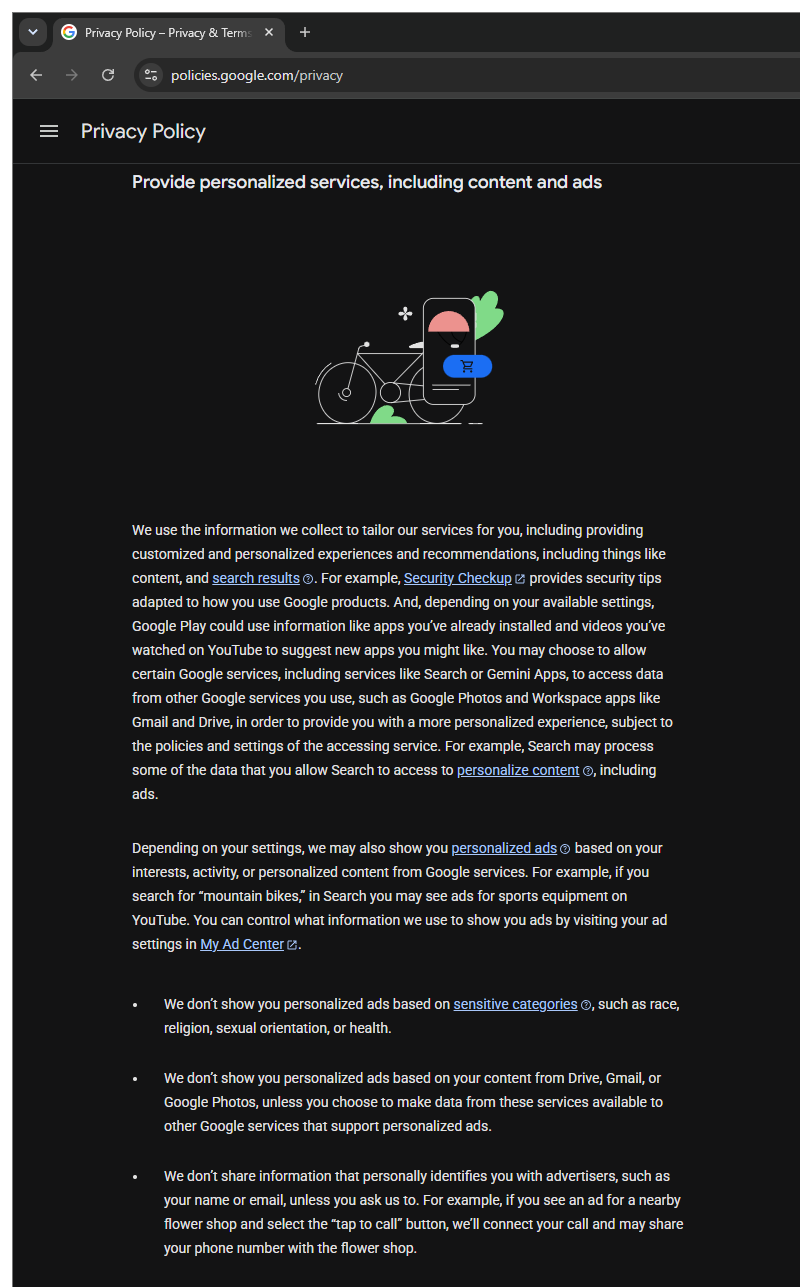
Google's privacy policy, updated with an effective date of October 16, now carries an exception to a longstanding assurance.
The company still states that it does not show personalized ads based on content from Drive, Gmail, or Google Photos. The sentence however, no longer ends there.
It continues with the clause that this holds unless a person chooses to make data from those services available to other Google services that support personalized ads.
The change is tied to Personal Intelligence, the opt in feature that lets Search, Gemini, and related tools draw on connected apps so that answers and suggestions can feel more specific to the individual. Connect Gmail or Photos for better recommendations, and the same information can now help shape the advertising that appears elsewhere.
The practical effect is narrower than a blanket scan of every message and image.
Google's own explanations note that ads will not be based directly on the contents of an inbox or a photo library. Instead, the systems may rely on summaries, excerpts, and inferences drawn from what has been shared with the connected services.
Advertisers themselves do not receive access to the underlying material or to identifying details such as a name or email address.
Categories considered sensitive, including race, religion, sexual orientation, and health, remain excluded from the targeting. The policy language itself offers an illustration:
Search may process some of the data a user allows it to access in order to personalize content, including ads.
Still, the distinction matters to people who enabled the feature for convenience rather than for marketing.
A search about activities near a hotel reservation pulled from an email can produce more useful results.
The same underlying signals may also influence which product or service appears in an ad slot. That trade off was not spelled out in the same way before the revision. Personal Intelligence itself began rolling out in beta earlier this year and remains optional.
In some regions, including the European Union, the United Kingdom, and Switzerland, the feature is not available at all.
Anyone who has already turned it on can reverse the connection.
Inside a Google Account, the path runs through Data and privacy, then Personalization settings, then Manage Personalized Recommendations in Search Services.
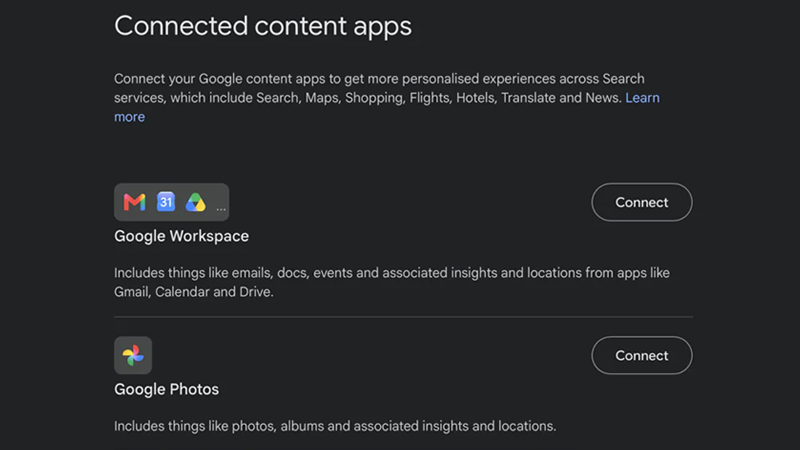
From there, connected content apps under Additional Personal Intelligence can be disconnected, or Personalized Recommendations can be turned off entirely.
Disconnecting an app does not automatically erase information that may already sit in Search Services History. That residual data can persist even after the original email or photo has been deleted.
The revision did not arrive with a prominent announcement. It surfaced through comparisons of the archived policy versions and subsequent reporting.
For users who treat their email and photo collections as spaces that should stay outside the advertising system, the new wording is a reminder that enabling richer AI features can expand the set of signals available to those systems.
The controls exist, yet they require deliberate steps, and the history of what was previously shared does not always vanish when the connection is closed. In an environment where most everyday tools are free in exchange for data, the precise boundaries keep shifting, sometimes by a single clarifying sentence.






















































































































































































































































































