Criminals have been targeting financial institutions for centuries. But with the internet, the term "robbing" doesn't necessarily mean the criminals have to be physically present to do what they want to do.
According to the Finnish cybersecurity firm F-Secure on its report, the cyber threat landscape for the finance sector indicates that it might be getting worse, with the cyber attack capabilities of nation-states spreading to more common cyber criminals.
Here, hackers are using a wide array of methods to launch cyber attacks against the global finance industry, with an aim to steal data and sabotage trading systems.
Using various tactics, techniques, and procedures (TTPs), SWIFT attacks, payment switch application compromises (using malware to authorize illegitimate ATM withdraws made by attackers) and others, financial institutions are becoming a lucrative target because of their socio-economic importance.
Hackers are making use of this fact, by exploiting the threat landscape to commit identify fraud, engage in insider trading, and inflict reputational damage that cost up to millions of dollars.
In a later report by the UN, North Korea could have earned up to $2 billion by hacking overseas financial institutions and cryptocurrency exchanges.
The company categorizes the threats into three: data theft, data sabotage, and direct financial theft.
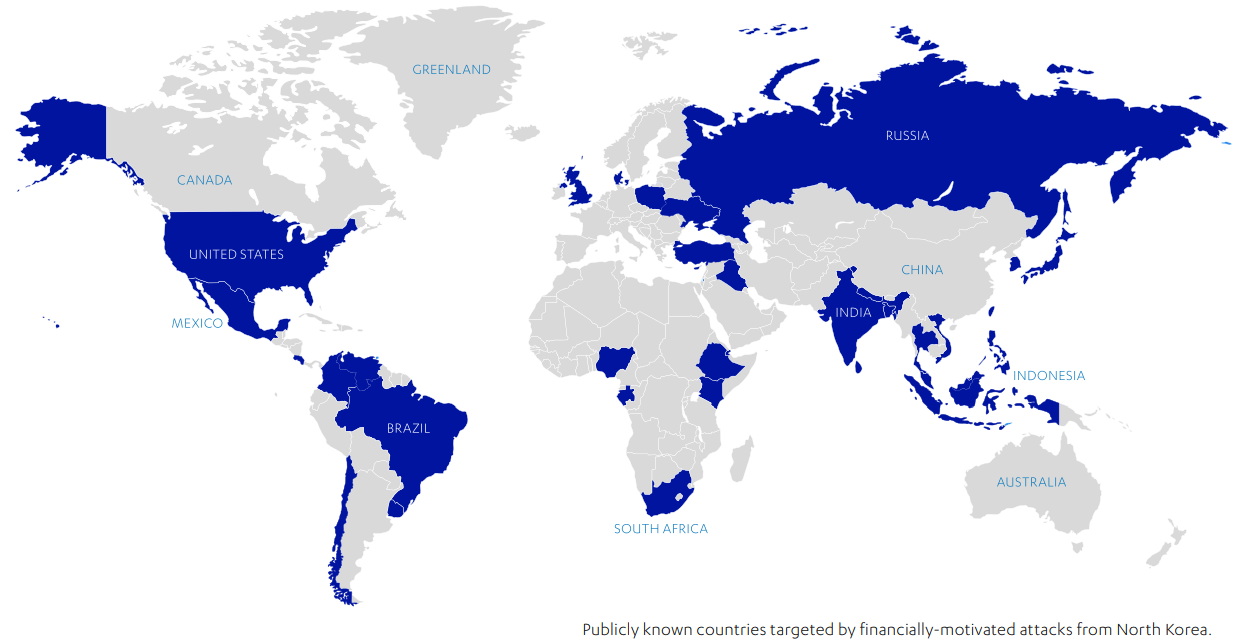
F-Secure singled out North Korea as being publicly implicated in financially-motivated cyber attacks against organizations in over 30 countries.
According to its report, "their targets include companies in the U.S., UK, India, and more. But the influence of nation-states on threats goes far beyond the odd bank robbery."
“While North Korea is a unique case of a nation-state conducting financially-motivated attacks — many of which have been against the banking sector — the techniques used by the country’s hacking units have also been adopted by organized crime groups, adding to their repertoire of ways in which to steal from banks,” the report cautioned.
"Data integrity/sabotage are also major motivations for attacks. Cyber criminals almost always do this to extort money (through ransomware or distributed denial-of-service-attacks). State-sponsored actors tend to do this for geopolitical purposes. Examples include North Korean attacks against South Korea, or Russian attacks against the Ukraine."
Cyber criminals and state-sponsored hackers have many reasons to attack the finance industry.
This sector has the money, data and influence to "attract everyone from script-kiddies to sophisticated state-sponsored adversaries."
And because these kind of hackers have a lot of resources to start with, they are posing threats to banks, insurance companies, asset managers, and other companies working directly or indirectly with the global finance industry.
Furthermore, the sector risks being exposed to a new wave of attacks, including the use of distractive malware, supply chain compromises and targeted ransomware, that go far beyond traditional "robbery".
The report also observed that hacking groups have also sell their “cybercrime-as-a-service” on dark web.
"he efficiency of many aspects of security, from high-level exercises such as risk analysis and management, down to the implementation of new technologies and procedures," said F-Secure.






















































































































































































































































































