For nearly four decades, the Predator franchise has built its reputation on a single, primal concept: humans being hunted by a terrifying alien species, which hunt and driven by ritual and honor.
From the jungles of Val Verde in the 1987 classic Predator to the neon-soaked cityscapes of Predator 2, the formula has always been clear: the Yautja, the Predators, arrive to hunt, and humanity fights to survive.
Yet Predator: Badlands, directed by Dan Trachtenberg and released in 2025, boldly upends that familiar dynamic.
This time, the Predator isn’t the monster lurking in the shadows, killing to create trophies out of skulls.
Instead, the Yautja is actually the protagonist, the one we’re meant to follow, fear for, and even sympathize with.
The hunter has now become the prey.
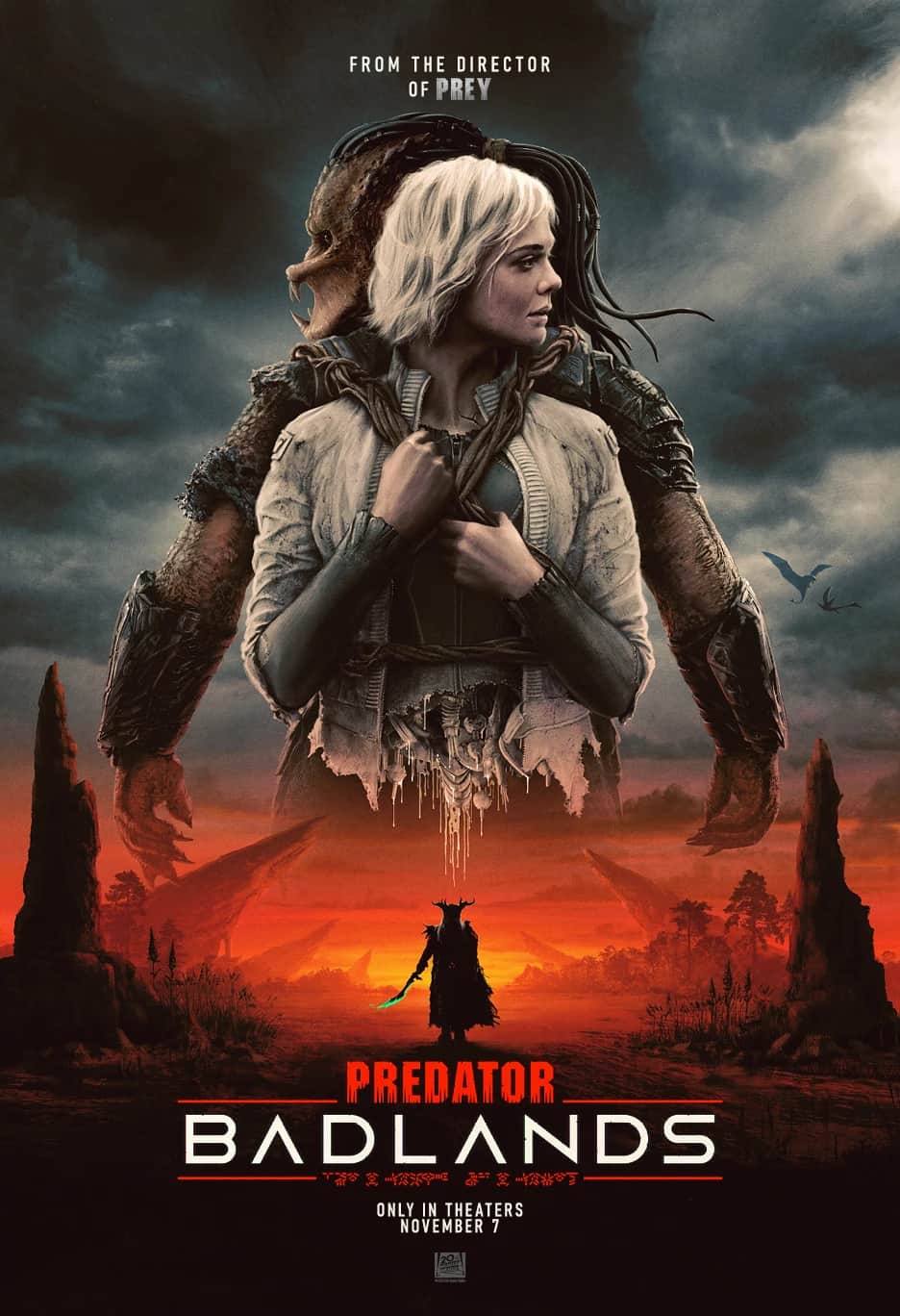
The story follows Dek, a young and disgraced Yautja warrior cast out from his clan.
Noticeably smaller than the average size on his species, Dek's mission is not one of conquest or bloodlust, but redemption.
His clan sees him as a runt, and also a weakling. He also lacks the killer instinct and the raw aggression the Yautjas normally have. This his clan, Dek is a disappointment. He failed tests meant to prove his adulthood and skills.
Now, Dek is exiled to a desolate planet known as the Badlands. And there, he seeks to restore his honor and prove his worth. The narrative unfolds entirely from his point of view, a first for the series, offering an intimate look into Predator culture, hierarchy, and emotion.
Through Dek’s eyes, the audience finally sees the Yautja not merely as monstrous hunters.
No longer should a Predator seen as a sadistic bipedal warrior with mandibles hidden beneath its bio-helmet. Now, stripped from the iconic wrist blades, invisibility cloaking device, a shoulder-mounter plasmacaster, and a tactical nuclear bomb, viewers can finally see it as a complex, ritualistic civilization bound by pride and tradition.
This shift immediately gives the film a mythic quality, transforming what could have been another action-horror sequel into something more meditative and existential.
At the center of Dek’s journey is his relationship with Thia, a damaged android of Weyland-Yutani design, portrayed by Elle Fanning.
Their partnership forms the heart of the film, balancing raw survival with unlikely companionship.
Critics have described their connection as “the most surprising emotional core the franchise has ever had.” Thia, with her humanlike curiosity and vulnerability, slowly becomes a mirror to Dek’s inner conflict: both characters are creations of design and discipline, questioning their purpose beyond their intended functions.
The pairing is indeed an odd couple dynamic, yes.
After all, Yautja, an alien bred for killing and a synthetic built to serve, yet Dek's dependence on Thia feels deeply organic.
This is what at least Director Dan Trachtenberg said, after returning to the franchise after his success with Prey.
Trachtenberg described Dek as "a Predator you can root for."
This balance, allows the film to portray Dek as a brutal warrior, but still relatable.
This is the very thing that elevates Badlands beyond simple role reversal.
The Predator doesn’t suddenly become a hero in the human sense; he becomes something rarer: a tragic, noble creature driven by duty, not malice.
The film’s viral popularity online stems directly from this daring creative pivot.
When early trailers dropped, social media erupted with confusion and fascination. “A Predator movie without humans?” one viral tweet asked, while another quipped, “So the Predator has feelings now?” Yet as reviews and behind-the-scenes features began circulating.
Articles hailed the film as “a franchise evolution” and “the most soulful Predator story yet.”
Fan forums filled with debates about Yautja culture, honor codes, and whether the franchise was better off abandoning the human perspective altogether.
What further fueled its virality was the visual storytelling.
Scenes showing Dek carrying a severed Thia on his back, through a storm, or kneeling beside her malfunctioning body while removing his bio-mask. The moments quickly became GIFs and memes, in both serious and playful ways.
Some fans celebrated the emotional tone shift; others jokingly labeled it “Predator: The Last of Us.”
On TikTok, edits pairing the movie’s sweeping shots with melancholic music trended for weeks, while YouTube essayists began exploring the deeper lore implications: that the Yautja’s moral spectrum was far more intricate than previous films suggested.
Across the Predator film series, the portrayal of the Yautja species has seen an evolution.
What began as ruthless intergalactic hunters, viewers were then given a glimpse to how they are complex beings capable of respect, honor, and even fleeting alliances. While the Predators were introduced as unstoppable monsters, several films have blurred that moral line, revealing a species driven more by code than cruelty.
In Alien vs. Predator (2004), this transformation is most visible. The Predator known as Scar stands apart from his kin, forging an unexpected bond with human protagonist Lex Woods. Predators (2010) continues this exploration of morality and rivalry. Here, a captured, classic Yautja is discovered chained by a new breed of larger, more brutal "Super Predators." Then, in The Predator (2018), one of the alien hunters, known as the Fugitive Predator, arrives on Earth not to hunt, but to warn. In Prey, which was the franchise's return to simplicity and primal storytelling, the Yautja is depicted as neither savior nor villain, but as a force of nature.
Taken together, these films trace an arc that gradually humanizes the Predators without ever softening their essence. They remain hunters, bound by their code.
Predator: Badlands, on the other hand, experiments on a new point-of-view: the perspective of the Yautja itself, and its struggle against its own species.
But Trachtenberg was quick to clarify.
"He’s still a Predator, we didn’t declaw him. He’s just one who questions what his claws are for."
In other words, the franchise, which began as a cult classic that transcended its B-movie DNA, was originally built with a modest budget, especially when compared to films like Aliens. It had the trappings of a B-movie: a pulp sci-fi premise, a jungle setting, macho one-liners, and lots of practical effects.
But because it starred Arnold Schwarzenegger at the height of his fame after Commando and The Terminator, and had a theatrical release from 20th Century Fox, it was more of an A-movie in disguise.
But it was that dreadlocked, mandible-faced alien, which was unlike anything moviegoers had ever seen before.
And blend that with primal brutality and high-tech menace, the idea of a species that hunted for sport, following a warrior code, was so original that fans began mythologizing it even before sequels existed. The Yautja instantly became one of cinema’s most recognizable monsters, alongside the Xenomorph.
Subsequent films were developed based on that fascination, knowing that the audiences weren’t not just scared, but also fascinated.
And now, Predator: Badlands subtly nods to the creature’s long cinematic legacy, particularly its brutal encounters with the Xenomorphs in Alien vs. Predator and Aliens vs. Predator: Requiem (2007). The inclusion of Weyland-Yutani, the infamous robotics and biotech corporation from the Alien universe, ties those storylines together once again.
Interestingly, the same company features prominently in the recent Alien: Earth TV series, hinting that another crossover between the two legendary monsters might be on the horizon.
With Disney now holding the rights to both franchises following its 2017 acquisition of 20th Century Studios, the stage seems perfectly set for the next chapter in their intergalactic rivalry.

















































































































































































































































































