In the mid-1990s, when the internet still felt like an uncharted frontier of dial-up connections and rudimentary web pages, a former software engineer named Thomas E. Dell decided to buy a domain name for no better reason than it was available.
Dell, who had worked at Apple and later as a security specialist on Netscape Navigator, had written a simple program that scanned for unregistered single-word dictionary terms. “Rotten” came up free, so in late 1996 he spent $100 on rotten.com and, with little more plan than that, began filling it with the kinds of images most people would rather not see.
What started as a casual experiment under the umbrella of his small outfit Soylent Communications quickly became one of the earliest and most notorious destinations for the macabre, a place that collected photographs and footage of death, decomposition, violence, medical deformities, and extreme human behavior and presented them without apology or polish.
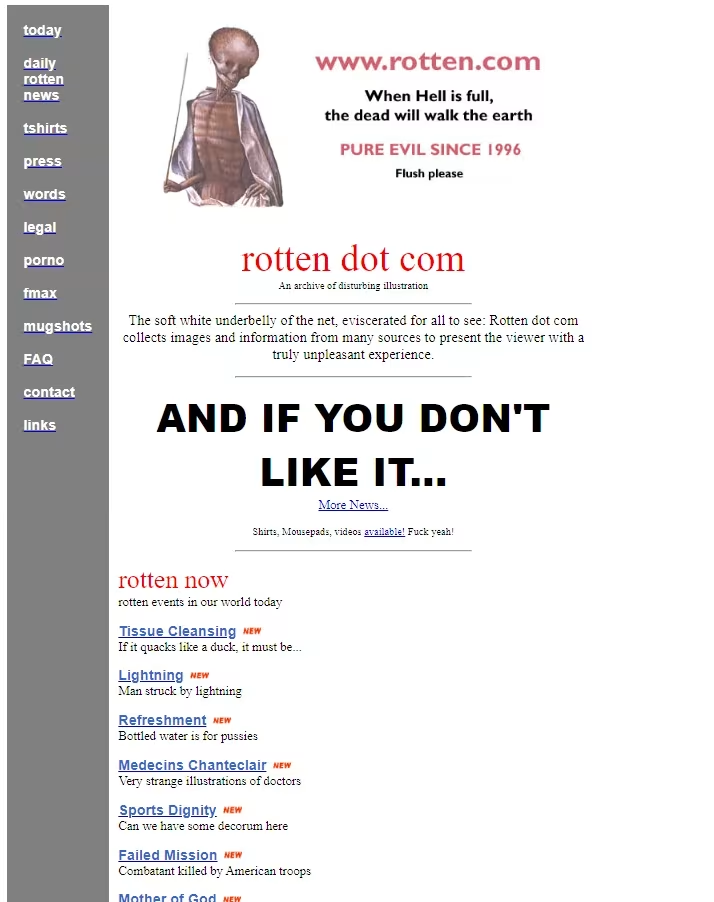
The site’s sparse design barely changed over the years: a plain background, blue hyperlinks, and short captions laced with dark humor that invited the visitor to click at their own risk.
Its stated purpose was straightforward.
Rotten.com gathered material from medical texts, forensic records, news sources, and public-domain archives in order to deliver a genuinely unpleasant experience.
Dell, operating under the online handle Soylent, framed the whole enterprise as a deliberate test of free speech.
In a short manifesto he posted on the site, he argued that censoring such material was impractical, unethical, and wrong, because the same logic would eventually reach medical textbooks, history volumes, court evidence, art museums, and libraries.
The timing was pointed.
The Communications Decency Act of 1996 had just tried to criminalize "indecent" content accessible to minors, and Rotten.com positioned itself as living proof that the internet could not and should not be sanitized.
By the turn of the millennium the site had become a quiet phenomenon. Howard Stern mentioned it on air.
A widely circulated (and later revealed as fake) photograph supposedly showing the recovery of Princess Diana's body from the Paris tunnel sent traffic surging. After the September 11 attacks, the site published images of people jumping from the towers under the clinical title “Swan Dive.”
At its height around 2001 it was drawing roughly 200,000 visitors a day, a remarkable figure for a non-commercial archive of the grotesque in an era before broadband and social media.
People arrived for many reasons.
Some came out of pure morbid curiosity, the same impulse that once drew crowds to public executions or sideshows.
Others sought a confrontation with mortality that polite society carefully filtered out. Still others found in the extreme imagery a kind of forbidden fascination that shaded into fetish, a private appetite for the real and repulsive that mainstream culture refused to acknowledge.
The audience was broad enough to include bored teenagers on library computers, late-night office workers, free-speech absolutists, and those simply testing the edges of their own tolerance.
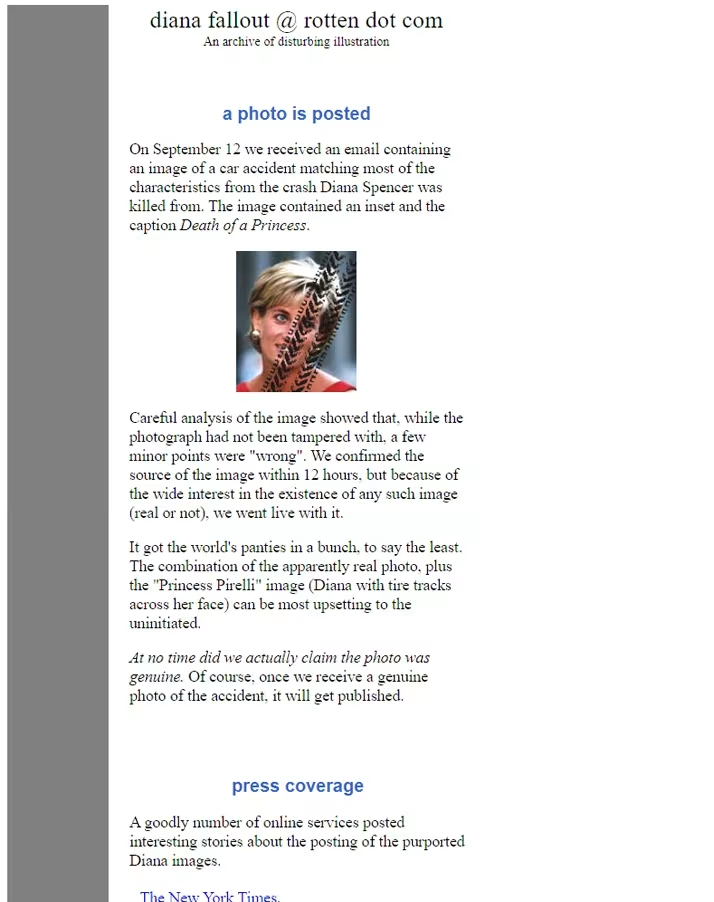
Rotten.com never pretended to be journalism or art in any conventional sense, yet it insisted its contents possessed historical, medical, and political value.
The underlying source of the shock site’s success is deceptively simple. It begins with morbid curiosity. The more someone describes a particularly nasty photograph or video, the more the mind returns to it.
The more the mind returns to it, the stronger the urge becomes to discover just how bad the thing really is.
This impulse to investigate the taboo has deep evolutionary roots.
Humans are wired to assess threats and dangers from a safe distance as a way of ensuring survival. By seeking out disturbing material that has been described but never seen, people satisfy that ancient itch without placing themselves in actual physical danger.
The need to know does not stop at curiosity.
It continues through thrill. Much like roller coasters or horror films, the act of viewing extreme content can trigger the release of endorphins and adrenaline as the body’s fight-or-flight response activates. Stress hormones flood the system, yet the resulting rush produces a natural high.
Gore videos and images offer an especially convenient route to that high, available at any hour with nothing more than a click.
Over time certain pieces of footage have risen to legendary status within online culture.
That status attaches most powerfully to so-called lost media or to videos that exist only as rumors. These function as modern urban legends, whispered about as the worst of the worst, their power growing precisely because they remain just beyond easy reach.
In all, Rotten.com hosted autopsy stills, crash aftermaths, suicide documentation, and images of rare diseases alongside the occasional piece of extreme pornography or historical oddity.

The site also spun off related projects under the same Soylent Communications banner: a daily news digest of the macabre called The Daily Rotten, a satirical commentary archive known as The Gaping Maw, a community game called the Rotten Dead Pool in which users predicted celebrity deaths, and later the Notable Names Database.
One of its most infamous side ventures was the acquisition of Bonsai Kitten, a dark hoax site that claimed to grow kittens into decorative shapes inside glass bottles.
Animal-rights groups erupted, the FBI looked into it, and the controversy only amplified the reputation of the whole network as a refuge for the unfiltered and the offensive.
That reputation made Rotten.com a lightning rod.
Scotland Yard and the FBI investigated certain images. Germany’s family ministry sent threatening letters. Corporations issued cease-and-desist notices.
In 2005 the U.S. Attorney General’s office ordered the removal of certain explicit sections, prompting the site to post defiant notices about government censorship.
Through it all, Dell maintained that nothing on Rotten.com could not already be found somewhere else if one knew where to look, and that concentrating the material in one place simply made the existence of the material harder to deny.
The site survived repeated attempts to push it offline by moving between smaller, more ideologically flexible hosts that valued anti-censorship principles over corporate respectability.

In the process, Rotten.com became the template for everything that followed.
Later shock sites such as Goatse, Ogrish, Stile Project, and countless imageboard threads inherited its basic premise: gather the most disturbing real-world imagery available, strip away context and moral framing, and let the visitor confront it directly.
Where those successors often specialized in bait-and-switch pranks or short-form viral horror, Rotten.com as the father of shock sites, had operated as a sprawling, almost scholarly archive of the unacceptable.
It proved that an audience existed for unvarnished depictions of human fragility and cruelty, and that the early internet’s relative lawlessness could sustain such a place for years.
By the time social media platforms and video-sharing sites made gore and tragedy infinitely more accessible, the original site had already done the cultural work of normalizing the demand.
Updates slowed after 2009m and one of the last new material appeared in February 2012. The domain lingered in a kind of digital half-life until hardware problems finally took it offline around 2017.
Dell later described the aging infrastructure as simply "too old."

By then the internet had changed.
Dedicated shock sites no longer needed to exist in isolation; the same material circulated through Reddit threads, Telegram channels, and algorithmically recommended videos.
Yet the memory of Rotten.com persists among those who encountered it during the dial-up years.
It remains a reminder of a moment when the web still felt capable of genuine transgression, when a single programmer with a domain and a taste for the forbidden could build a lasting monument to the things most people prefer to keep hidden.
In that sense, it was less a website than a pressure valve for the collective curiosity, the half-admitted desire, and the quiet fascination with the limits of the human body and the human capacity for harm.

















































































































































































































































































