There was a time when people visit physical stores to buy the films they want to watch at home.
With the internet, people can buy films right from the comfort of their homes, and watch almost anything imaginable, by just spending a small amount of money for subscription.
Among the many subscription-based streaming service provider offering online streaming from a library of films and television series, Netflix is one of the biggest.
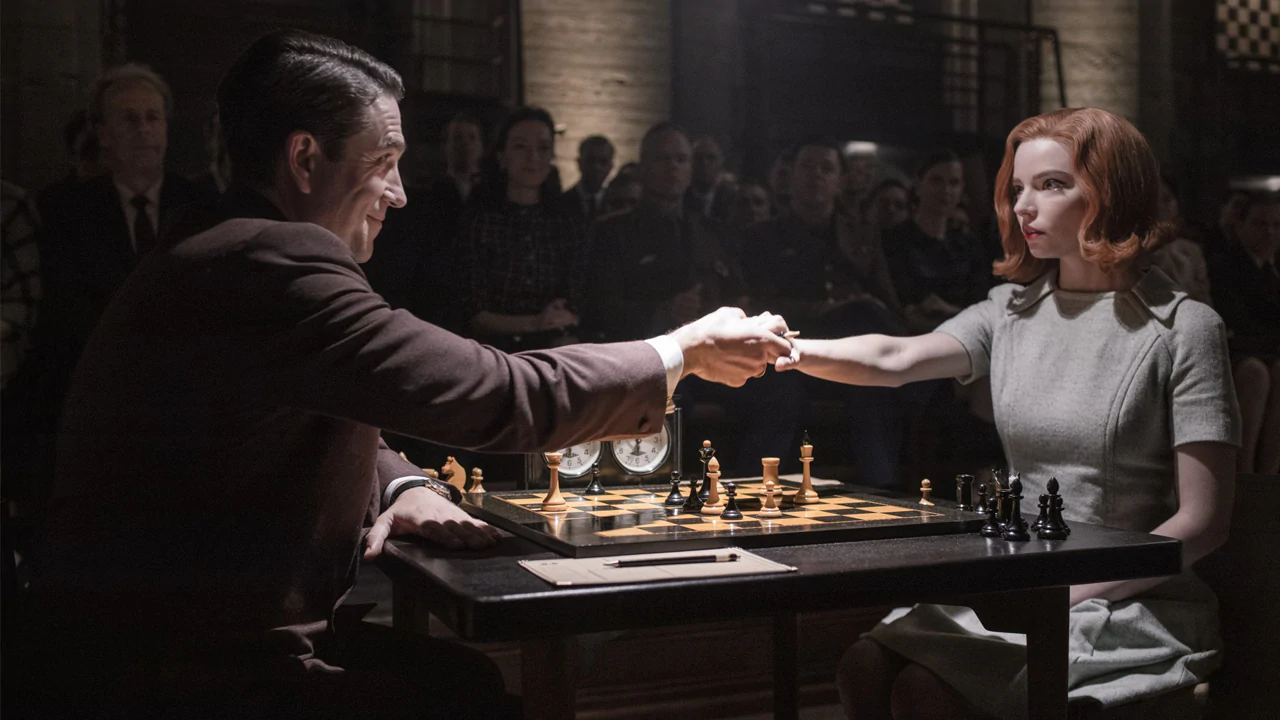
One of the most popular titles available on Netflix, is The Queen's Gambit, the 2020 American coming-of-age period drama miniseries based on Walter Tevis's 1983 novel of the same name. Taking the name of a chess opening, the film was written and directed by Scott Frank, and stars Anya Taylor-Joy, who portrays Elizabeth "Beth" Harmon, the main character in the film.
The miniseries follow her rises through the male-dominated chess world of the 1960s, ultimately facing down the Russian world champion at the height of the Cold War.
After four weeks, The Queen's Gambit become Netflix's most-watched scripted miniseries, making it Netflix's top show in 63 countries.
While the series received critical acclaim and positive reception by many, there is one prominent person who dislikes it.
And that person, is no other than Nona Gaprindashvili, a chess Grandmaster whose name was mentioned in the film, but in the wrong way.
Gaprindashvili, born in 1941 at a Georgia's western town of Zugdidi, is a Soviet and Georgian chess player.
Her enthusiast and passion for chess began at an early age, which was around the age of 13. And by the time she reached the age of 20, Gaprindashvili already won the fourth women's Candidates Tournament, setting up a title match against world champion Elisaveta Bykova, where Gaprindashvili won the match easily.
By defeating Bykova, Gaprindashvili became the female World Champion in 1961. She lost her crown only to another Georgian, 17-year-old Maia Chiburdanidze, in 1978.
Gaprindashvili played for the Soviet Union in the Women's Chess Olympiads of 1963, 1966, 1969, 1972, 1974, 1978, 1980, 1982, 1984, 1986, 1990, and for Georgia in 1992.
She was one of the contributing players of the USSR team who dominated the Women's Olympiads of the 1980s.
Overall, she won 25 medals, including 11 team gold medals and 9 individual gold medals. At the Olympiad of Dubai 1986, she won all ten games she played.
She was a five-time winner of the Women's Soviet Championship, in which she won them in 1964, 1973, 1981, 1983, and 1985.
And at the peak of her career, she is also known to be the first woman to be awarded the FIDE title Grandmaster. This happened in 1978.
In all, she was was the fifth women's world chess champion.
She is even credited with inspiring other female chess players and helping to combat sexism in the game.
Her brilliance afforded her rare privilege within the Soviet Union at the time, in which the government granted her international travel and a degree of adulation in her homeland. These were not common, especially among young women.
She was an influencer, way before the internet. This was seen when she won the world championship, and people were crowding the railway station to welcome her home, and cheer her as she passed through.
With her many achievements, recognitions and series of accolades, Netflix's The Queen's Gambit seemed to fail to mention any of them.
Gaprindashvili is suing Netflix for defamation over a line in the miniseries, in which the lawsuit calls a "devastating falsehood, undermining and degrading her accomplishments before an audience of many millions."
The line in question comes in the series' final episode.
In it, Anya Taylor-Joy's character Beth competes for the world chess title in Moscow. At that scene, an announcer, commentating during one of Beth's matches, said that: "The only unusual thing about her, really, is her sex. And even that's not unique in Russia. There's Nona Gaprindashvili, but she's the female world champion and has never faced men."
The problem is that by the year 1968, the time when The Queen's Gambit final match scene takes place, Gaprindashvili had faced men more than several times. In fact, in that year alone, Gaprindashvili defeated 7 men. In the years before that, she defeated at least 4 male competitors, per year. And in 1965, she even played against 28 men.
"The allegation that Gaprindashvili 'has never faced men' is manifestly false, as well as being grossly sexist and belittling," the lawsuit said, alleging that "she had competed against at least 59 male chess players" by 1968, "including at least 10 Grandmasters."
"Piling on additional insult to injury, Netflix described Gaprindashvili as Russian, despite knowing that she was Georgian."

Because Netflix failed to mention any of her achievements, and somehow downplayed her career, Gaprindashvili's complaint accuses Netflix of false light invasion of privacy and defamation, arguing that "these facts were well known to Netflix."
Netflix must be aware of this fact, because it did researches on the subject, as well as about Gaprindashvili’s accomplishments, and because it also hired "two of the world’s leading chess authorities” as consultants, the lawsuit noted. Even the book the series was based on also acknowledged that Gaprindashvili faced male Grandmasters.
"Netflix brazenly and deliberately lied about Gaprindashvili's achievements for the cheap and cynical purpose of 'heightening the drama' by making it appear that its fictional hero had managed to do what no other woman, including Gaprindashvili, had done," the chess master's complaint states.
"Thus, in a story that was supposed to inspire women by showing a young woman competing with men at the highest levels of world chess, Netflix humiliated the one real woman trail blazer who had actually faced and defeated men on the world stage in the same era."
With the lawsuit, she seeks at least $5 million in damages, as well as a court order to remove the offending line from the series.
In a statement, a Netflix spokesperson said that Netflix "has only the utmost respect for Ms. Gaprindashvili and her illustrious career," but believes that the claim has no merit. Because of that, the company wants to "vigorously defend the case."
While Gaprindashvili wants Netflix to pay for what it did, the claim merits that the millions in damages listed in the case is not really the point. It's only that it's a shame for Netflix to catastrophically misrepresented her on its most popular miniseries played a role that on a television show, that has repositioned chess under a spotlight it has not enjoyed for decades.
"This is my entire life that has been crossed out as if it is not important,” Gaprindashvili said as she tried to explain.

















































































































































































































































































