Large Language Models (LLMs) have reshaped the technological landscape, sparking an intensifying global race for dominance.
What began with the release of ChatGPT by OpenAI quickly escalated into a full-blown arms race, with tech giants and emerging players alike striving to develop ever more capable artificial intelligences. While much of the momentum has historically come from the West, innovation from the East is rapidly gaining ground—and in some cases, outpacing it.
One of the emerging players from China, is DeepSeek, an AI research group driven by a small but ambitious team with aspirations toward Artificial General Intelligence (AGI). Despite its modest size, DeepSeek has shaken the global AI scene.
The lab made headlines with its release of DeepSeek-R1, a powerful model positioned as a direct rival to OpenAI’s o1. Not long after, it struck again with the introduction of DeepSeek-V3, a formidable contender that openly challenged—and by some metrics surpassed—OpenAI's flagship GPT-4o.
And this time, DeepSeek has launched 'DeepSeek-Prover-V2.'
This particular model, based on the DeepSeek-V3 architecture, boasts 671 billion parameters.
Available on GitHub, it comes with 61 Transformer layers and a hidden size of 7,168, and supports long-context tasks with a position embedding limit of up to 163,840 tokens. The model incorporates FP8 quantization to reduce size and improve inference performance, and it's compatible with the safetensors file format and various precision types to enhance training efficiency and deployment.
DeepSeek-Prover-V2-671B is a highly specialized large language model designed for one purpose: formal mathematical reasoning.
Unlike general-purpose models such as DeepSeek-V3 or OpenAI's GPT-4o, which are built for versatility across various domains, Prover-V2-671B narrows its focus to excelling in rigorous, symbolic logic tasks.
Developed to work seamlessly within the Lean 4 proof assistant, this model is a powerful companion for researchers, educators, and developers in mathematics and formal verification.
Users can leverage DeepSeek-Prover-V2-671B to generate step-by-step formal proofs, verify logical consistency in theorems, and even automate traditionally manual processes in proof writing.
It’s particularly valuable in academic and research environments where formal methods are essential, such as in pure mathematics, computer science theory, and formal software verification. Students learning the intricacies of formal logic can also benefit from this model, using it as an interactive tool to understand how complex proofs are constructed and validated in Lean.
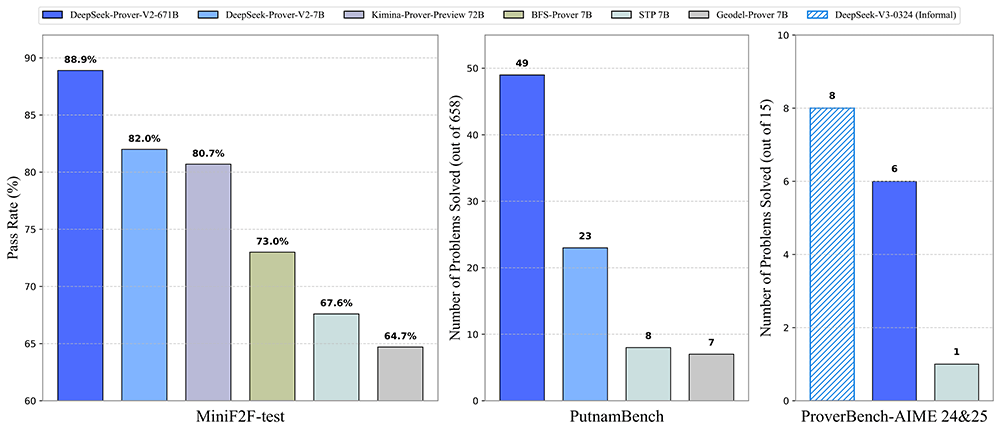
Where Prover-V2-671B shines is in its deep integration with formal logic systems and its performance in dedicated benchmarks. It achieves an 88.9% pass rate on the MiniF2F test and successfully solves 49 out of 658 problems from the PutnamBench—results that underscore its strength in high-level mathematical problem-solving. Notably, the model uses reinforcement learning to decompose complex problems into smaller subgoals, a strategy that allows it to approach proofs with a human-like thought process.
Read: DeepSeek Further Disrupts LLM By Becoming 'Transparent' And Open-Sourcing Source Code
In all, DeepSeek-Prover-V2-671B doesn’t aim to be an all-in-one assistant.
Instead, it’s a purpose-built, deeply optimized tool for a specific domain, and within that niche, it leads the field. While GPT-4o may be more conversational and multimodal, it doesn’t offer the same precision or compatibility with formal proof environments. DeepSeek-Prover-V2-671B represents a different class of intelligence: one focused on verifiability, rigor, and the future of automated mathematics.
DeepSeek-Prover-V2-671B represents a significant advancement in AI-driven formal theorem proving, offering a powerful tool for mathematicians and researchers engaged in formal verification and proof development.
Its release underscores DeepSeek's commitment to pushing the boundaries of AI capabilities while maintaining cost-effective and efficient development practices.
As DeepSeek continues to innovate and release models that rival those of established Western tech giants, it not only showcases China's growing prowess in AI research but also emphasizes the potential of open-source models to democratize access to advanced AI technologies.
The company's trajectory suggests a future where AI development is more globally distributed, fostering a competitive environment that benefits the broader technological community.




















































































































































































































































































