Theft on the internet is extremely common. The most common commodity, would be user data. Lesser known commodity, include creative arts.
And speaking of creative arts, one of the most popular places on the web where artists can showcase and sell their works, is on DeviantArt, an online art and design community founded in 2020 by Angelo Sotira.
In anticipation of the increasing sale of non fungible tokens (NFTs) on the web, DeviantArt is taking things a step further.
Knowing that stolen arts are common, in which bad actors may copy artworks from DeviantArt and turn them into NFTs without their creators' permission, DeviantArt is opening up its NFT protection tool to everyone.
Previously, the tool was only available to a select number of DeviantArt partners.
This time, any artist who wish to use it can sign up for it.
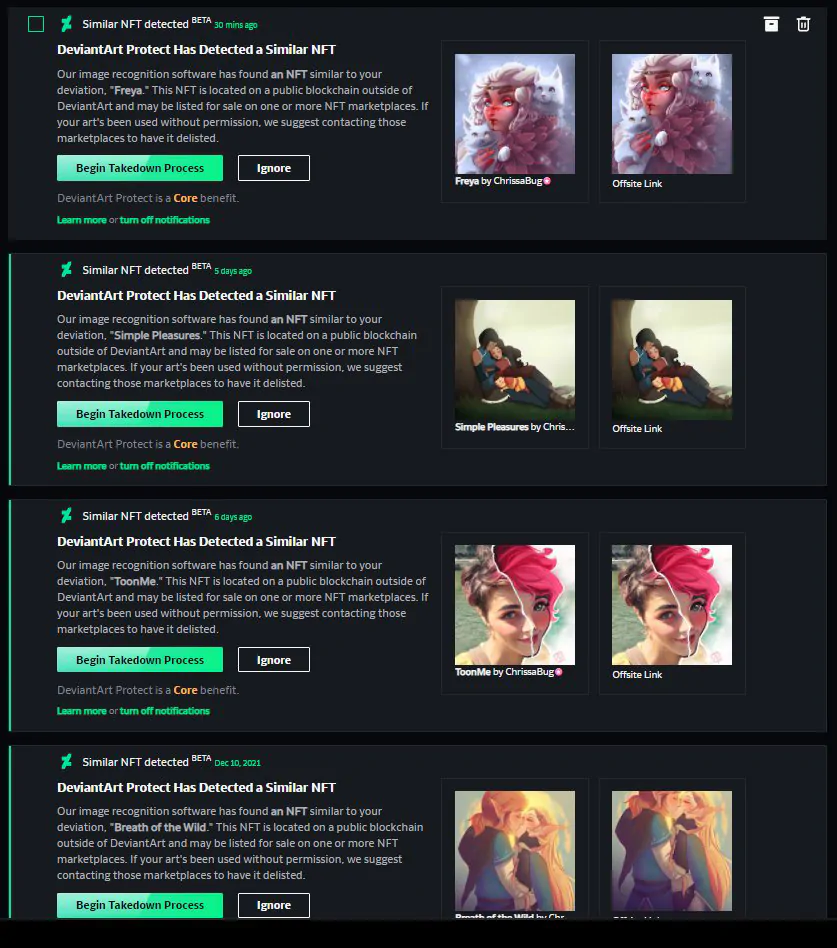
DeviantArt offers two tiers for this tool it called 'DeviantArt Protect'.
The first one, the free one, allows users to upload 10 images. Users will get alerts if anyone is using their artworks as an NFT. If ever users get a notification, DeviantArt can also help users form a takedown request with the platform that hosts the stolen NFT.
The second tier, users pay $9.95 per month to get protection for 1,000 pieces of art with a size limit of 50GB.
DeviantArt said that the tool can also detect similar art.
So in cases like when the thief has moved around some of the design elements, or even changed its style, the tool can still spot it.
In other words, the tool is capable of identifying derivative works for potential art infringement.
DeviantArt Protect uses image recognition technology that works by scanning files uploaded to DeviantArt, as well as files uploaded to public blockchains and third-party marketplaces.
The tool works to catch any form of possible minted NFTs.
"The Protect Protocol is a decentralized cross-chain standard utilized to safeguard creators against art theft in Web3," DeviantArt explained.
"It is used to identify, communicate about, and respond to potentially infringing NFTs and NFT collections, as well as to verify trusted NFTs and NFT collections."
At the moment of its launch to the public, the DeviantArt-led initiative is still in alpha phase.

NFTs can take the form of anything that is digitized.
When a file is put and stored inside a blockchain, which is a form of a distributed ledger, the ownership can also be recorded.
In this case, if an NFT is recorded, the owners name will be stored alongside it.
What makes NFTs a commodity is that, the ownership of the NFTs can be transferred. This allows NFTs to be sold and traded.
NFTs typically contain references to digital files such as photos, videos, and audio. Because NFTs are uniquely identifiable, they differ from cryptocurrencies, which are fungible. The market value of an NFT is associated with the digital file it references.
At this time, DeviantArt hosts around 70 million artists who have uploaded more than half a billion images to the platform.
With so many creativities trusted with it, DeviantArt has the responsibility to protect the arts from thieves, who think that they can get away with the artworks by copy-paste.
NFT plagiarism is unfortunately already common.
Earlier this 2020, NFT marketplace OpenSea stated that some 80% of NFTs created for free on the platform are either spam or fraud.