
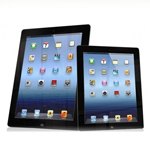
On October 16, 2012, Apple announced a media event scheduled for October 23 at the California Theater in San Jose, California.
On the day of the event, Apple CEO, Tim Cook introduced a new version of MacBook family and new generations of the MacBook Pro, Mac Mini, and the iMac before the fourth generation iPad and the iPad Mini.
The fourth generation iPad and the iPad Mini are introduced in the lines of tablet market. Both devices features iOS 6 with 16GB, 32GB and 64GB capacity, Wi-Fi only and Wi-Fi + 3G/4G LTE capabilities.
Whereas the fourth generation iPad highlights several tweaks and improvements, the iPad Mini opens a new doorway for Apple to compete in the 7" mobile device market.
The Fourth Generation iPad
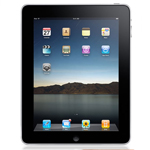
The fourth-generation iPad (marketed as iPad with Retina display, and referred to as the iPad 4, or technically just known as "iPad" at the Apple Store), was released on November 2, 2012. Since it was first announced on October 23, the fourth generation of the iPad line is succeeding the third generation iPad that was introduced earlier this year.
The device follows the same pricing model as its predecessor. The third generation was discontinued following the fourth generation's announcement.
The fourth generation iPad is however identical to its recent predecessor - same size, weight, and Retina screen. It's heavy to hold in one hand, and most older accessories won't work without investing in a Lightning adapter. The new iPad adds several tweaks and improvements to secure its position in the market, making it more like a iPhone products with the "S" suffix.
The fourth generation iPad has a few upgrades, two minor, one significantly major. A Lightning connector replaces the old 30-pin, just like all other new iOS devices this fall. And while the rear iSight camera remains the same with 5 megapixels, the front-facing FaceTime camera has been upgraded to HD status: 720p video recording and sharper self-portraits.
Although the fourth generation iPad still uses the all-metal-and-glass construction with identical dimension with its predecessor, it houses a faster A6X processor which adds extra system speed and graphics power. The built-in Wi-Fi antennas on the fourth generation iPad are now dual-band (2.4GHz and 5GHz 802.11a/b/g/n), which offers better connections and speeds over the average home network. Apple made the move to dual-band on the iPhone 5 and the iPad Mini.
The LTE versions of the iPad are available in three versions: AT&T, Verizon, and Sprint. The LTE connection has improved to offer greater compatibility with global cellular networks. The improved worldwide cellular compatibility makes the LTE model a more appealing proposition with a wider range of international carriers.
The landscape's view changed a little bit, and the iOS App Store remains a pioneer in its class.
With the same amount of RAM as before (1GB), the number of apps in the multitasking that can be opened simultaneously remains largely the same.
The iPad Mini
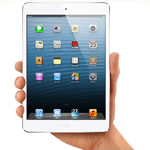
The iPad Mini is a mini tablet computer designed, developed, and marketed by Apple Inc. to compete with the tablets like Nexus 7. It was announced on October 23, 2012, as the fifth overall generation of the iPad line and the first to feature a reduced screen size of 7.9 inches, in contrast to the standard 9.7 inches. The iPad Mini features similar internal specifications as the iPad 2.
The iPad Mini and the iPad 2 both display 1024x768 resolution, but the iPad Mini has a higher pixel density (163ppi vs 132ppi). Unlike the iPad 2, it has 5MP and 1.2MP cameras and the Lightning USB connector.
Speculation about the iPad Mini began as early as April 2012, as competition rose from 7" devices. Rumors initially suggested it would feature a 7.85" display at 1024×768 pixels. It was originally thought to be announced at the Apple Special Event on September 12.
The iPad Mini is thinner and lighter design lies down far more flatly than the fourth generation iPad. It is also far more intimate and booklike . The cameras, storage capacities, optional LTE antenna, and general functionality offer a full iPad experience. The iPad Mini is a design shift from the iPad, and perhaps the biggest one in the iPad's entire history.
The iPad Mini is an extremely easy-to-hold tablet that, despite its wider form, feels as light as a Kindle. It's thinner than an iPhone 5, and seems proportionally as thin as the new iPod Touch.
Apple is aiming consumers that need the full, polished Apple tablet experience in a smaller package. However, regular iPad users may find typing on the iPad Mini more difficult with its smaller screen. And considering the lower resolution and non-Retina display, the iPad Mini premium price costs more than its size, and more than any of its competitors. The iPad Mini not only has a lower-resolution screen than much of the competition, but it's probably the least impressive screen of Apple's 2012 stable of iOS devices. The iPod Touch, iPhone 5, and fourth-gen iPad all seem brighter, more vibrant, and far higher-definition.
The iPad Mini has all the same features, essentially, as found in the larger iPad: Bluetooth 4.0, front- and rear-facing cameras, video-out and SD card via the Lightning connector, AirPlay compatibility, and optional LTE via Sprint, Verizon, and AT&T models. Comparable with other iPads and iPhones, the storage isn't expandable, but the same storage options are offered as on the fourth generation iPad: 16GB, 32GB, 64GB. The device houses a dual-core A5 processor chip with 512MB RAM.
One big advantage of the iPad Mini with iOS: it's compatible with all the big services (Kindle, Nook, Google Books). It's the closest to a universal e-book reader.