AI is advancing fast. But in recent years, the most of the visible progress in the technology has centered on systems that get smarter in generating language, images, or code.
While those systems remain useful for many tasks, a growing number of practical applications require something narrower: the ability to choose among a small set of predefined options quickly and at low cost.
No explanation required. Just a "yes," or a "no."
Routing a support ticket, classifying a document, deciding whether an agent should take a particular action, or scoring a response against a fixed rubric are examples of work that does not always need open-ended generation.
And over the past several weeks, this distinction has become more concrete as specialized decision-scoring models have appeared.
Microsoft introduced 'Microsoft-Decision-1.'
The model is able to take an input describing a situation together with a fixed set of answer choices and returns a calibrated probability for each choice. Supported formats include yes-or-no questions, multiple-choice questions, ratings, and rubric-based grading of other AI outputs or agent actions.
In particular, it does not produce free-form text.
Microsoft states that the system was created by post-training Alibaba's open-weight Qwen3.5-9B for single-pass decision scoring, and it indicates plans to rebase the approach on other base models later.
The model is available through Microsoft Foundry and OpenRouter, priced at $0.042 per million input tokens with output tokens free.
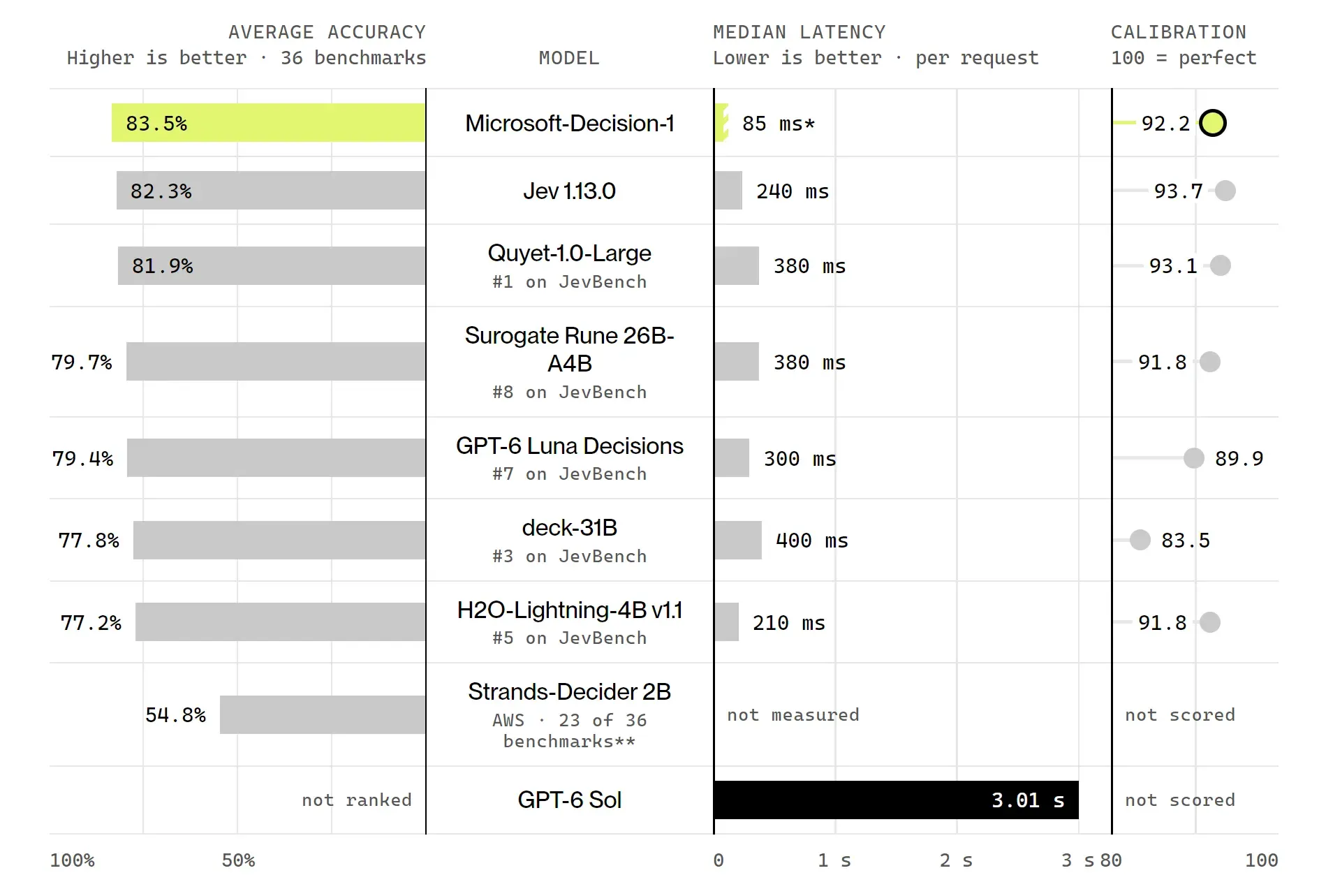
In Microsoft's published comparison across 36 benchmarks covering roughly 147,000 questions held blind from training, Microsoft-Decision-1 recorded the highest average accuracy at 83.5% and a median latency of 85 milliseconds.
Microsoft has described the model as suited to routing, classification, prioritization, verification, and workflow control inside applications and agents.
It competes directly against Jev, a decision model made by TypeSafe AI.
Jev has been leading in this decision-scoring model in the same emerging category: given a situation plus a fixed set of options (yes/no, multiple-choice, rating, rubric grading, etc.), it returns a calibrated probability for each option instead of generating free-form text.
However, Jev is listed at 82.3% accuracy with higher latency.
Jev itself had drawn attention shortly before the Microsoft announcement.
Decision models under the Jev name, including open-weight variants released by AutoTrust AI such as JEV-27B-VL, reached high positions on Hugging Face trending lists and accumulated millions of downloads within weeks.
These models follow the same basic pattern: given an input and a constrained set of possible actions or labels, they return probabilities rather than generated paragraphs.
Pricing for commercial access has been reported at the same $0.042 per million input tokens level.
Public discussion around Jev framed the approach as useful precisely because it is less conversational than mainstream generative models and more oriented toward repeated, structured choices inside software systems. Benchmarks associated with the name, sometimes called a Jev Decision Index, became one reference point against which later entrants were measured.
The appearance of both systems in close succession illustrates a pattern that has become common as the field matures.
A capability that was previously handled by calling a large general-purpose language model, or by maintaining a smaller custom classifier, can now be addressed by a purpose-built decision model that is cheaper and faster for the narrow task.
Companies that continue to route every intermediate step through a generative model may incur higher latency and token costs than competitors that insert a decision layer for classification, routing, or gating. At the same time, the rapid release of competing options means that any single early tool faces pressure on price, speed, and measured accuracy.
Open-weight releases can accelerate adoption among developers who want to self-host or fine-tune, while hosted offerings from larger platforms lower the barrier for teams that prefer managed infrastructure.
In either case, the practical effect for businesses is that certain classes of AI functionality become commodities more quickly. Teams that treat decision steps as modular components rather than as byproducts of a single large model can adjust more readily when a newer, better-scoring, or lower-cost option appears. Those that do not may find that portions of their stack are replaced by specialized alternatives that simply perform the same job at lower cost and higher throughput.
It's worth noting that Microsoft introduced Microsoft-Decision-1 on October 9, 2026, the same day TypeSafe AI announced an $870 million Series A at a $7.5 billion valuation led by Andreessen Horowitz.
The timing placed a large platform vendor's decision-scoring model in the market at the moment the smaller company behind Jev was securing substantial new capital after only a few weeks of public availability. Whether the coincidence was deliberate or incidental, it underscored how quickly competitive pressure can arrive once a specialized capability attracts both developer interest and investor capital.
Further reading: Why Superhuman Chat Did Not Become AGI, and How OpenAI's Former Researcher Built 'Jev' for the Easy Work Instead






















































































































































































































































































