Most days involve a steady stream of small but necessary jobs. Finding the right school after a move, sorting through government forms, keeping up with family health needs, or coordinating help for neighbors before a storm all take time and attention.
These are the kinds of responsibilities that fill ordinary schedules, and they often resist simple lists or quick advice.
OpenAI wants to help with what it calls the 'LifeVal.'
It is essentially an evaluation designed to track how well its models handle exactly these kinds of practical tasks. The company framed the work around its stated goal that artificial general intelligence (AGI) should help people with the everyday matters that matter most to them.
Rather than testing knowledge or coding ability alone, LifeVal looks at whether a system can move from a request toward completed actions that fit a particular person’s situation.
To select the tasks, OpenAI began with two long-running sources of data on how people actually spend their time: the American Time Use Survey in the United States and the Multinational Time Use Study covering multiple countries.
These catalogs show patterns of activity across different groups, times of day, and seasons.
OpenAI then ran its own demographically representative survey of 3,995 people, asking where they most wanted assistance from a personal helper. The resulting set covers caregiving, health, education, household administration, personal finances, shopping, and access to government services.
Roughly 100 people with relevant experience also contributed detailed versions of tasks, including the personal context they would share and the criteria for judging success.
OpenAI has used the evaluation internally for about a year to measure and direct improvements, particularly as its models gained better ability to browse the web, operate computers, and connect to other tools.
The published page presents several example workflows and the scores current models achieved on them.
One involves comparing kindergartens near a new home and shortlisting options; the system reached 93.1%. Another covers organizing community volunteers to help four neighbors prepare for flooding, scored at 98.0%. Finding a home in Luzerne County that meets budget, living-unit, and commute constraints, then adding the deed to a review cart, scored 100%.
Setting up a remote way for a grandparent and grandchild to watch a game together reached 96.3%. Preparing a first-week care and meal plan for a parent newly diagnosed with diabetes scored 90.4%.
In each case the examples show the system producing organized options or next steps rather than open-ended suggestions, often leaving final preferences or review to the user.
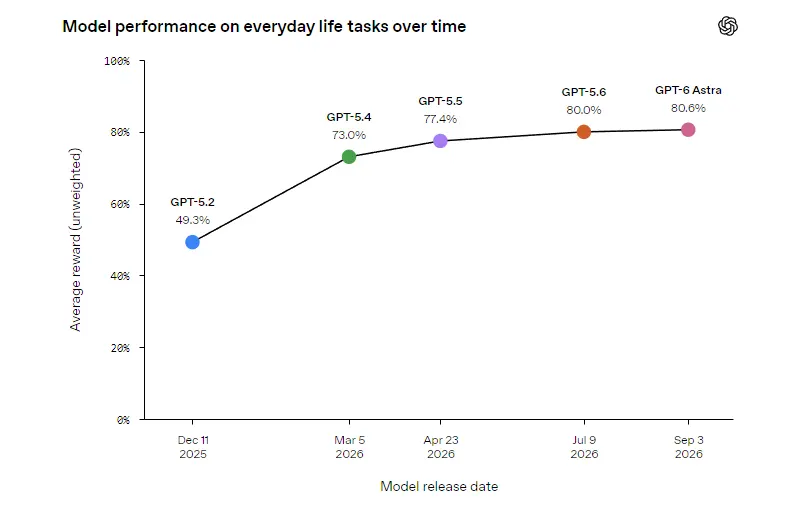
Charts accompanying the announcement plot average reward scores across successive models. GPT-5.2, released in December 2025, scored 49.3%. GPT-5.4 in March 2026 reached 73.0%. GPT-5.5 in April scored 77.4%, GPT-5.6 in July reached 80.0%, and GPT-6 Astra in September 2026 scored 80.6%.
The largest single gain occurred between the earliest and next model in the sequence, after which gains were smaller.
Secondary reports have noted high scores on additional routines such as booking a car inspection or ordering groceries within a budget, though the official page itself highlights the five examples above and states that the latest models score highly on many of the tasks.
When announced, LifeVal remains an internal evaluation.
OpenAI created the tasks, runs the tests on its own models, and has not released the full task list, the exact grading methods, the total number of tasks, or the conditions under which the evaluations were performed.
Outside groups therefore cannot yet reproduce the scores or compare other systems on the same basis. The company presents the work as one step toward measuring progress on the kinds of practical help that go beyond traditional academic benchmarks, while noting that the evaluation has already guided improvements in agent-style capabilities.
Observers have noted both the shift in focus and the limits of the current release.
The emphasis on tasks drawn from time-use data and direct surveys of desired help marks a difference from tests centered on exams or programming.
At the same time, the fact that only one organization's models have been scored, and that the full materials are not public, leaves the results as a record of internal tracking rather than a shared standard.
Discussions on social platforms have mixed interest in the practical orientation with questions about how success is defined in messy real-world settings and how much of the reported progress depends on the specific sites and tools the models interact with.