
For a long time, machine-made pictures lived in a narrow corner of the internet. They showed up in meme threads, pitch decks, and late-night experiments, then faded as people went back to cameras and design tools.
That is no longer how the work is used.
Image models have become increasingly powerful and capable.
They now sit inside chat products, marketing pipelines, product pages, and developer APIs, and the volume has moved from novelty to routine production. OpenAI says more than three billion images are now created each week across ChatGPT Images and the GPT-Image models in its API.
The company has now announced 'ChatGPT Images 2.5,' and is rolling it out to ChatGPT, ChatGPT Work, and Codex users on desktop, mobile, and the web.
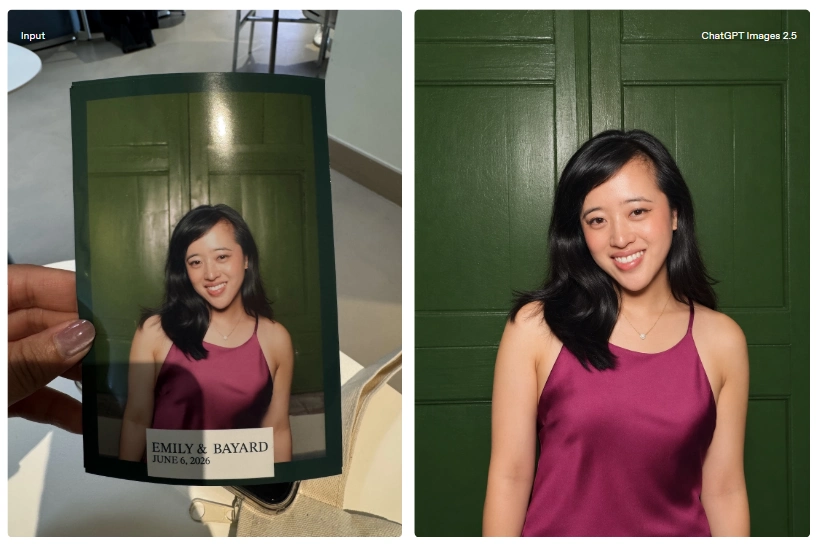
The company presents it as a quality and control upgrade rather than a new category of product: sharper detail, more natural lighting, richer textures, and edits that are supposed to change only what a user asks for.
Generation latency is claimed to fall by up to 50% compared with Images 2.0, a figure OpenAI uses as its own benchmark, not an independent test against every rival model.
The practical problem the update is trying to solve is familiar to anyone who has tried to refine an AI image.
A first result can look close enough. The second request, change the background, fix the text, keep the face, often rewrites parts of the picture that were already acceptable.
OpenAI says Images 2.5 is better at preserving subjects from reference photos, holding distinctive features across new settings and styles, and following instructions across multiple turns in the same conversation.
Comment-based edits let a user mark a specific area of an image instead of restating the whole brief.
Sharing can now include the prompt that produced the picture, so someone else can rerun the idea with different photos or details.
The most visible product change is Sketch.
Users can type @sketch in ChatGPT, draw a layout or a rough figure inside the chat, and use that drawing as the visual guide for the finished image. Templates sit next to that feature as a starting point for common formats such as posters, flyers, merch, and product photos.
Early testers have treated Sketch as a way around the limits of language: a room plan, a thumbnail composition, or a bad doodle can be faster to draw than to describe.
Developers are getting a split rather than a single model name.
GPT-Image-2.5 Flare is positioned as the default API option, with higher quality than GPT-Image-2 at lower latency, aimed at social content, product experiences, visual search, prototyping, and high-volume generation.
GPT-Image-2.5 Sunburst is the slower lane, sold as extra precision for campaign creative and polished product imagery.
Both are listed at the same token prices as the previous GPT-Image-2 generation: $8 per million image-input tokens, $30 per million image-output tokens, and $5 per million text-input tokens, with lower rates for cached input.
Sunburst can still cost more per finished image if it consumes more tokens on longer runs.
ChatGPT users do not get a simple Flare-or-Sunburst switch in the consumer interface, and some testers report mixed consistency depending on whether they are in ordinary chat or ChatGPT Work.
Partners already using the models have focused on control more than spectacle.
Higgsfield AI’s head of product said Flare's value was in what it leaves alone during an edit.
Adobe said it is adding the 2.5 models to Firefly.
Manus reported Flare running two to four times as fast as GPT-Image-2 in its own tests, with better transparent-background results for brand assets and web work.
Runway described the update as fitting existing creator workflows rather than replacing them.
Those comments are vendor statements, but they point to the same job: keep an approved composition intact while a team iterates.
Safety handling is layered rather than new.
OpenAI says prompts and outputs still pass through existing checks, and generated files carry C2PA metadata plus invisible watermarking. Separate reporting has also pointed to Google DeepMind's SynthID as part of that watermark stack in ChatGPT, Codex, and the API. The company published a system card with its evaluations. None of that resolves the larger issue created by the volume figure. When billions of synthetic images move through consumer apps and production tools every week, provenance becomes an operations problem for newsrooms, brands, and platforms, not only a model-card footnote.
At this time, the market is already crowded with Google's Gemini with Nano Banana 2 as the main comparison point in consumer coverage. Arena's early text-to-image ranking has placed Sunburst and Flare at the top of the board, though vote counts are still thin. Independent write-ups have been more measured than the launch posts: speed is the clearest claimed gain, subject preservation is the feature users will test first, and Sketch is the interface change most people will actually try.






















































































































































































































































































