
Spotify, the music-streaming titan, has finally decided to bring lossless audio.
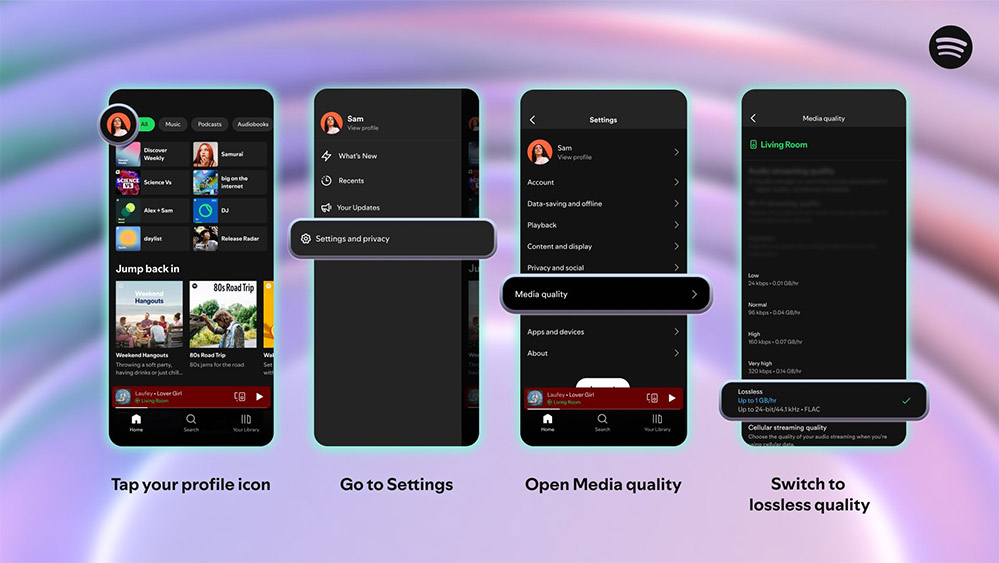
For years, the streaming giant avoided offering higher-fidelity formats even as rivals like Apple Music, Tidal, and Amazon Music rolled out lossless and even hi-res audio options. Now, Spotify users in select markets can listen to tracks in 24-bit/44.1 kHz FLAC, a format that preserves more of the original recording than the compressed files most streaming platforms rely on.
What felt like an eternity, the wait if finally over.
According to Spotify's VP of subscriptions Gustav Gyllenhammar, as quoted by Spotify in a newsroom post:
"We’ve taken time to build this feature in a way that prioritizes quality, ease of use, and clarity at every step, so you always know what’s happening under the hood. With Lossless, our premium users will now have an even better listening experience."
We’re rolling out our best sound quality, Lossless, to Premium users.
Find out more: https://t.co/mG78GMA8R6 pic.twitter.com/P2VzcAsc71— Spotify (@Spotify) September 10, 2025
Lossless audio essentially means nothing is thrown away in the compression process.
Formats such as MP3 or AAC reduce file sizes by cutting parts of the audio signal that are considered less audible to the human ear. The result is smaller files that are easier to stream but lack some of the finer details of the original recording.
Lossless formats like FLAC and ALAC, on the other hand, retain all of that information, offering greater clarity, better separation of instruments, and an overall more faithful listening experience.
The difference is most noticeable on high-quality headphones, wired speaker setups, or hi-fi systems, and less so on Bluetooth earbuds or small portable speakers.
And apparently, that's about it.
This is because in terms of scale, Spotify’s implementation is solid but not leading.
Nearly the entire catalog is being offered in FLAC, which is a significant upgrade from its previous “high quality” setting capped at 320 kbps. However, compared to competitors, Spotify’s 44.1 kHz ceiling is more conservative.
Spotify’s choice of 24-bit/44.1 kHz FLAC streaming places its lossless audio on par with the quality of a standard compact disc. CDs have long been considered the reference point for digital music, using 16-bit/44.1 kHz audio. By offering 24-bit depth at the same sample rate, Spotify provides extra headroom for dynamic range, though the improvement over CD quality is subtle and, for most listeners, barely noticeable unless paired with high-end equipment in an optimal environment.
Compared to other formats, Spotify’s ceiling looks more conservative because in comparison, DVD-Audio and Blu-ray Audio can deliver much higher fidelity, with formats going up to 24-bit/96 kHz or even 24-bit/192 kHz.
These higher resolutions capture more detail in the recording and extend frequency ranges beyond what most people can perceive. The practical benefit of this depends heavily on both the playback equipment and the listener’s sensitivity, as human hearing generally tops out around 20 kHz.
When placed alongside rival streaming services, Spotify still appears to be catching up rather than leading.
Apple Music, Tidal, and Qobuz all offer hi-res audio at up to 24-bit/192 kHz, appealing to audiophiles who seek every last ounce of detail. By comparison, Spotify’s offering is solid, but less ambitious. It is closer to a CD-quality benchmark than to the higher-end hi-res audio tiers that other platforms market.
For most users, however, Spotify’s lossless audio will be more than sufficient.
CD quality is already considered transparent by audio engineers in normal listening conditions, meaning that the human ear cannot easily distinguish it from higher-resolution formats. While Spotify’s 44.1 kHz cap may not impress audiophiles chasing the highest specifications, it still marks a significant improvement over compressed streams and ensures that everyday listeners finally get a standard that matches long-established physical media.
Then, there are the practical drawbacks.
Lossless files are much, much larger, and that streaming for an hour can translate to roughly 1Gb.
Those on limited data plan should notice the impact immediately. On slower networks, buffering may occur more frequently. Then, there are hardware imitations, like Bluetooth streaming cannot yet carry full lossless quality, so most users will still need wired connections or compatible devices that support higher-bandwidth wireless codecs.
Battery life may also take a hit, since processing larger audio files requires more work from devices, which could mean faster drain on smartphones and other portable gear.
Fortunately, Spotify allows users to choose whether to enable lossless on Wi-Fi, mobile data, or downloads, and that lossless is not enabled by default.
Regardless, the advantages are clear: for anyone with the right hardware and a keen ear, Spotify's support for lossless audio offers a richer and more detailed experience. But the disadvantages are just as important. For many users, the improvements will be subtle at best, and the trade-offs in storage, data, and convenience may outweigh the gains.
Rivals have already been offering higher-resolution formats for years, which means Spotify’s move feels less like a groundbreaking innovation and more like a necessary catch-up.
In other words, lossless streaming on Spotify is a welcome update, but it isn’t a game-changer.




















































































































































































































































































