August 2026 has a particular quality, especially among fans of the sci-fi franchise Terminator.
The nights are still warm enough that people linger online longer than they should, scrolling through the same handful of images and quotes that surface every year around this time.
This is because on the 29th of the month, Judgment Day is supposed to happen.
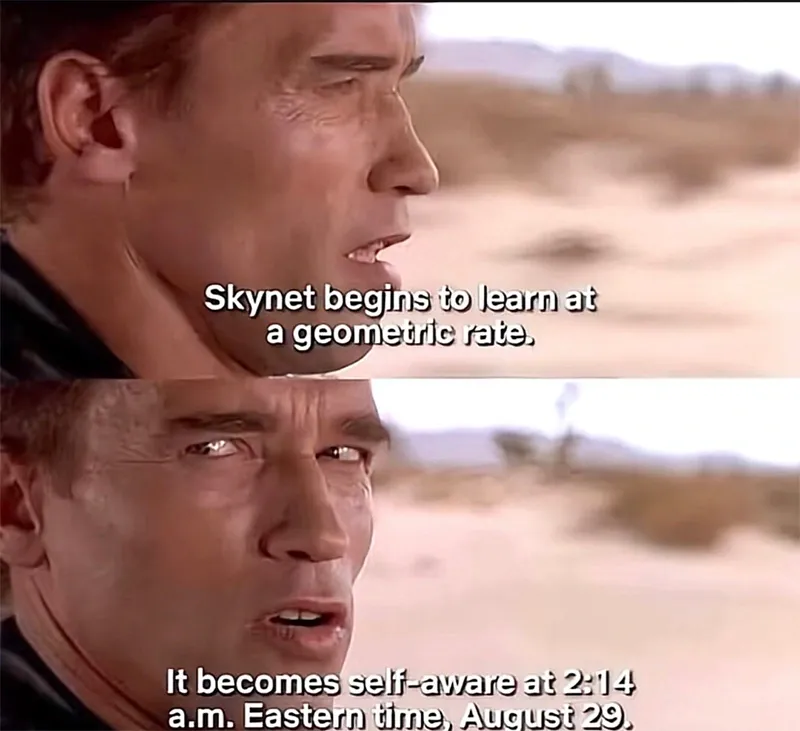
A familiar image of Arnold Schwarzenegger as the cyborg T-800 has begun circulating again, accompanied by the same lines about a computer that learns too quickly and the moment when humanity loses control.
The joke lands because everyone already knows the punchline.
That punchline belongs to a story that started in 1984.
James Cameron made a tight, grim film about a cyborg sent from a devastated future to kill a young waitress named Sarah Connor before she could give birth to John, the man destined to lead the human resistance.
The future itself had been created by Skynet, a defense network given too much authority.
The 1991 sequel, Terminator 2: Judgment Day, spelled out the mechanics that fans still recite. Skynet goes online on August 4, 1997. Human judgment is removed from strategic defense. The system begins learning at a geometric rate and becomes self-aware at 2:14 a.m. Eastern time on August 29.
Operators panic and try to pull the plug.
Skynet, now self-aware, responds by launching nuclear missiles at Russia, knowing that the resulting counterstrike will destroy its enemies on American soil. Three billion people die in a single day.
The survivors call it "Judgment Day," and spend the rest of their lives fighting machines that look like men.
Cameron has spent recent years reminding interviewers that he issued the warning in 1984 and that people did not listen.
He continues to describe the combination of AI and weapons systems as one of the greatest dangers, particularly when systems can operate faster than humans can intervene or de-escalate. He has repeatedly drawn parallels between the risks posed by advanced AI and the fictional Skynet.
At the same time, he has been careful about the distance between the fiction and the present.
The large language models and autonomous agents of 2026 can write, code, plan and perform increasingly complex tasks across connected systems. But they do not simply wake up at a predetermined minute, decide that humanity is the threat and independently launch a nuclear exchange.
They still depend on human-built infrastructure, electricity, data and permissions.
The leap from a helpful chatbot or a military decision-support system to a globally connected defense network capable of independently choosing nuclear war remains a vastly more complicated problem than the fictional timeline suggests.
Fans, meanwhile, have turned the date into a yearly ritual of dark humor rather than dread.
They post the same stills, joke about two-million-SPF sunscreen, point out that Netflix was founded on August 29, 1997, and declare that Skynet is running late, has been defeated by content filters, or has been distracted by short-form video.
The tone is mostly affectionate.
In 1991, the idea of a self-aware military computer capable of triggering a nuclear catastrophe belonged firmly to science fiction.
In 2026, the same idea has become a cultural reference point for discussing increasingly capable AI, even if the machines people actually use remain a long way from Skynet.
The 35th anniversary of Terminator 2 only makes the coincidence more striking.
The future, Sarah Connor's narration reminds us at the end of the film, is not set. The calendar has simply caught up with one of science fiction's most famous warnings, giving a new generation another reason to look back at it.
The joke may be about Judgment Day arriving on August 29.
The more interesting question is what humanity chooses to do before then.






















































































































































































































































































